The content provided in this video is for informational and educational purposes only. It does not constitute financial advice, investment recommendations, or an offer to buy or sell any securities. All views expressed are those of InsightfulValue and are based on publicly available information believed to be reliable, but no guarantee is made as to its accuracy or completeness. Always conduct your own research or consult a licensed financial advisor before making any investment decisions. Investing in the stock market involves risks, including the loss of principal.
Please be aware that the stock prices displayed on this website represent a curated selection of data. On desktop devices, you will see a wider range of stock prices, while on mobile devices, we provide a more streamlined view for better user experience and readability.
Our focus is on assessing a company's overall value and performance, rather than analyzing price fluctuations, even if we do watch prices in order to find companies trading below their intrinsic value. For more detailed charting and comprehensive market analysis, we recommend consulting a professional financial service or utilizing advanced charting tools.
We strive to provide accurate and timely information, but we encourage you to verify any financial data before making investment decisions.
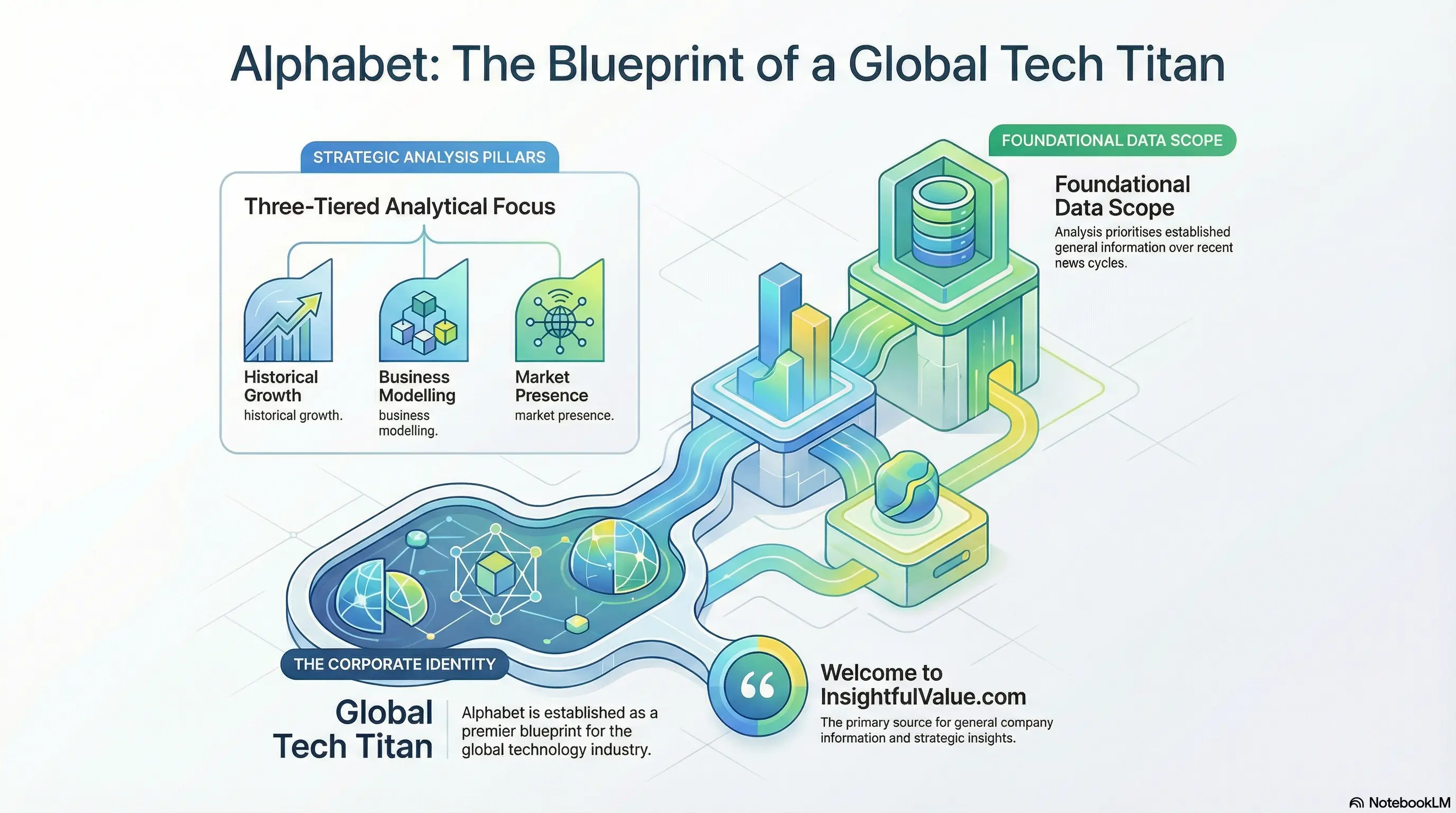
Infographic
Overview
Alphabet Inc. is a multinational conglomerate company that was created in 2015 as the parent company of Google. The company was formed as a restructuring of Google and houses several subsidiaries, including Google LLC, Google Ventures, Google Fiber, Calico, DeepMind, and X. Alphabet Inc. is one of the largest companies in the world and its primary business is internet-related services and products. The company’s headquarters are in Mountain View, California. Founded by Larry Page and Sergey Brin in 1998, Google was originally a search engine company. Today, Alphabet’s portfolio includes various technology sectors such as online search engines, cloud computing, advertising technologies, consumer electronics, and robotics. It also has investments in various other industries, such as biotechnology, healthcare, and transportation. Under the leadership of CEO Sundar Pichai, the company has continued to grow and expand, acquiring other companies and developing new products and services. In addition to its core businesses, Alphabet also operates a venture capital arm, Google Ventures, which invests in startups and emerging technologies. Alphabet has a strong global presence, with offices and operations in countries like the United States, Australia, Canada, China, France, Germany, India, Japan, Singapore, and the United Kingdom. The company has a strong focus on innovation and sustainability and has received numerous awards for its initiatives in these areas. In 2020, Alphabet had a revenue of $182.5 billion and employed over 135,000 people. It has consistently ranked among the top companies in terms of revenue and market capitalization. Alphabet’s mission is to organize the world’s information and make it universally accessible and useful, and the company continues to strive towards this goal through its various products, services, and investments.
How to explain to a 10 year old kid about the company?
AI does pose potential threats to Alphabet’s products, services, and competitive positioning in several ways, including substitution, disintermediation, and margin pressure. 1. Substitution: With the advancement of AI technologies, alternative platforms and services may emerge that can fulfill similar roles as Alphabet’s existing offerings. For example, AI-driven search engines or content creation tools could provide users with comparable or superior results, reducing reliance on Google’s search engine or YouTube. If users find these alternatives more efficient or effective, it could lead to a decline in user engagement and traffic for Alphabet’s core services. 2. Disintermediation: AI can enable direct communication and transaction channels between consumers and service providers, potentially bypassing platforms like Google altogether. For instance, businesses might use AI-driven chatbots or virtual assistants to interact with customers directly, negating the need for advertising on Google to reach those customers. This could diminish Alphabet’s role as an intermediary in digital advertising and reduce its revenue streams. 3. Margin Pressure: As AI technology becomes more widespread, the costs of implementing AI solutions may decrease, leading to increased competition. Smaller companies and startups could leverage low-cost AI tools to compete with Alphabet at lower margins, putting pressure on the profitability of Alphabet’s existing products and services. Additionally, as more players enter the AI space, the competitive landscape may intensify, forcing Alphabet to reduce prices or invest heavily in innovation to maintain its market position. In summary, while AI offers significant opportunities for enhancement and growth, it also presents material threats to Alphabet’s competitive positioning and profitability through the avenues of substitution, disintermediation, and margin pressure. Addressing these challenges will require strategic adaptations and continued innovation from the company.
Sensitivity to interest rates
The sensitivity of Alphabet’s earnings, cash flow, and valuation to changes in interest rates can be analyzed from a few perspectives: 1. Earnings Sensitivity: Alphabet’s earnings can be indirectly affected by interest rates, primarily through the impact on economic growth and advertising budgets. Higher interest rates can slow economic growth, leading companies to reduce advertising spending, which is a significant source of revenue for Alphabet. Additionally, higher borrowing costs might impact the investment capacity of businesses, further affecting demand for ads. 2. Cash Flow Sensitivity: Interest rates also influence Alphabet’s cash flow indirectly. If interest rates rise, the cost of capital increases. This affects future cash flows, especially if the company needs to finance new ventures, acquisitions, or investments. While Alphabet has substantial cash reserves, its acquisitions or growth strategies may be impacted by the overall cost of financing. 3. Valuation Sensitivity: Alphabet’s valuation is often calculated using discounted cash flow (DCF) models, which are highly sensitive to changes in the discount rate. An increase in interest rates raises the discount rate, which can lower the present value of future cash flows, thereby reducing the overall valuation of the company. Conversely, if interest rates fall, the opposite effect occurs, potentially increasing the company’s valuation. In summary, while Alphabet is fundamentally strong with significant cash reserves and consistent revenue from its core advertising business, changes in interest rates can have cascading effects on its earnings, cash flows, and overall valuation, primarily through pathways related to economic growth, capital costs, and investment strategies.
👉 InsightfulValue is a platform for public company analysis.
👉 We provide a database of public companies, with a focus on value investing principles.
👉 We carefully select every company in our database. With only 1859 listed, there's a reason for that.
👉 The reason is simple – we only select the best-performing public companies, true champions. And we know exactly what we mean by "champion."
👉 For us, a champion is a company with strong finances, a history of impressive dividends, great management, and standout products or services. We mean it.
👉 For each company, we have 663 questions and answers covering every aspect of their market position and operations. Everything.
👉 ... plus additional 164 Q&A about the industry each company operates in.
InsightfulValue is an independent platform dedicated to value investing research. The information provided on this website is for informational and educational purposes only and does not constitute financial, investment, tax, or legal advice. We are not financial advisors, investment consultants, or licensed consultants. Our analyses, insights, and criteria are based on principles learned from renowned value investors such as Benjamin Graham, Warren Buffett, and Charlie Munger, but they should not be considered personalized investment recommendations. Investing in financial markets carries risks, and past performance is not indicative of future results. Users of this website should conduct their own due diligence and consult with a qualified professional before making any financial or investment decisions. InsightfulValue assumes no liability for any financial losses or decisions made based on the information provided on this site. By using this website, you acknowledge and accept that all investments involve risk and that InsightfulValue does not guarantee any financial outcomes.