The content provided in this video is for informational and educational purposes only. It does not constitute financial advice, investment recommendations, or an offer to buy or sell any securities. All views expressed are those of InsightfulValue and are based on publicly available information believed to be reliable, but no guarantee is made as to its accuracy or completeness. Always conduct your own research or consult a licensed financial advisor before making any investment decisions. Investing in the stock market involves risks, including the loss of principal.
Please be aware that the stock prices displayed on this website represent a curated selection of data. On desktop devices, you will see a wider range of stock prices, while on mobile devices, we provide a more streamlined view for better user experience and readability.
Our focus is on assessing a company's overall value and performance, rather than analyzing price fluctuations, even if we do watch prices in order to find companies trading below their intrinsic value. For more detailed charting and comprehensive market analysis, we recommend consulting a professional financial service or utilizing advanced charting tools.
We strive to provide accurate and timely information, but we encourage you to verify any financial data before making investment decisions.
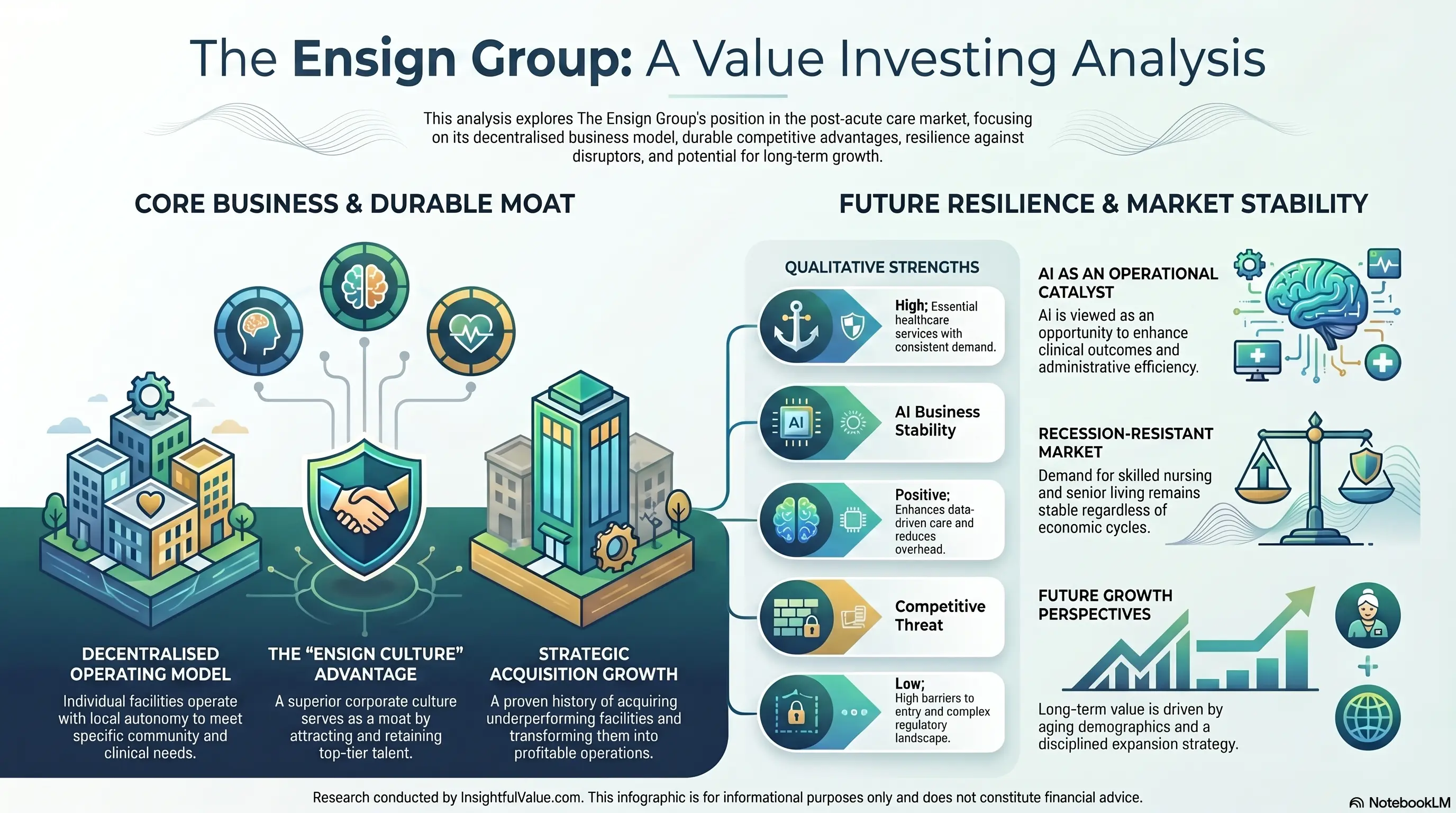
Infographic
Overview
The Ensign Group is a healthcare company headquartered in Mission Viejo, California. It was founded in 1999 and operates a network of healthcare facilities and services throughout the United States, including skilled nursing facilities, assisted living communities, hospice care, home health services, and other post-acute care services. The company’s primary focus is providing high-quality, personalized care for patients and residents in a community-based setting. They operate under various subsidiary names, including Ensign Services, Inc., The Pennant Group, and Cornerstone Healthcare, Inc. Ensign Group is committed to a patient-centered approach and strives to promote a culture of compassion, integrity, and excellence in their operations. They also have a strong commitment to employee development and satisfaction, offering ongoing training and support for their healthcare professionals. As of December 2021, the company operates more than 250 healthcare facilities in 16 states and employs over 35,000 healthcare professionals. They have consistently ranked among the top healthcare companies in the nation, receiving various awards and honors for their quality of care and business practices.
How to explain to a 10 year old kid about the company?
To assess whether AI poses a material threat to The Ensign Group’s products, services, or competitive positioning, we can consider a few key areas: substitution, disintermediation, and margin pressure. 1. Substitution: The Ensign Group primarily operates in healthcare services, including skilled nursing and rehabilitation. AI technologies could potentially enhance or substitute certain aspects of healthcare delivery, including diagnostic processes and patient management tools. However, the human element in healthcare—such as direct patient care and interaction—is hard to replace entirely with AI. Therefore, while AI might complement or enhance some services, it is unlikely to completely substitute the core offerings of the company. 2. Disintermediation: Disintermediation generally involves reducing or eliminating intermediaries in service delivery or product sales. In healthcare, this could mean direct-to-consumer health services that bypass traditional providers. Emerging AI applications could enable patients to access healthcare management and information more directly, which could impact the Ensign Group if it leads to a shift in how patients seek and receive care. However, given the complexity of healthcare needs, particularly for the demographics often served by The Ensign Group, traditional healthcare providers remain essential. 3. Margin Pressure: AI can lead to margin pressure by introducing efficiencies that competitors may exploit, or by reducing costs in areas such as staffing or operational overhead. Automation and AI-driven solutions can enhance operational efficiency and reduce costs, which may drive down pricing in the competitive landscape. If competitors effectively leverage AI to reduce their service delivery costs, this could create pressure on The Ensign Group to do the same, potentially impacting margins. In conclusion, while AI presents opportunities for enhancing operational efficiency and improving service delivery within The Ensign Group’s offerings, it also poses some risks through competition and potential changes in consumer behavior. However, due to the personalized nature of healthcare and the enduring need for human interaction, the direct material threat of substitution or disintermediation seems limited at the moment. Margin pressure could be a more significant concern as the industry continues to evolve with technological advancements. Companies like The Ensign Group will need to adapt to these changes to maintain their competitive positioning.
Sensitivity to interest rates
The sensitivity of the Ensign Group’s earnings, cash flow, and valuation to changes in interest rates can be assessed through several key considerations: 1. Interest Expense: If the Ensign Group has outstanding debt, changes in interest rates can directly affect interest expenses. An increase in rates would raise borrowing costs, potentially reducing net income and cash flow. 2. Discount Rate: Valuation models often use discounted cash flow (DCF) analysis, wherein the discount rate is influenced by prevailing interest rates. Higher interest rates typically lead to a higher discount rate, which can decrease the present value of future cash flows, adversely affecting the company’s valuation. 3. Cost of Capital: Interest rates impact the company’s weighted average cost of capital (WACC). An increase in interest rates raises the cost of debt and can alter the overall cost of capital, influencing investment decisions and potentially slowing growth. 4. Consumer Spending: Higher interest rates can affect consumer spending, particularly in sectors tied to discretionary spending or where financing is common (like healthcare services). If consumer demand decreases due to higher borrowing costs, it may impact the revenues and earnings of the Ensign Group. 5. Acquisitions and Investments: The Ensign Group may pursue growth through acquisitions or capital expenditures. Higher interest rates could make financing these endeavors more expensive or deter management from pursuing them altogether, impacting long-term growth prospects. Overall, while the specific sensitivity would depend on Ensign’s financial structure, operations, and market conditions, generally, rising interest rates tend to have a negative impact on earnings, cash flow, and valuation through increased costs and reduced consumer demand for services. Conversely, lower interest rates can provide a more favorable environment for financial performance.
👉 InsightfulValue is a platform for public company analysis.
👉 We provide a database of public companies, with a focus on value investing principles.
👉 We carefully select every company in our database. With only 1855 listed, there's a reason for that.
👉 The reason is simple – we only select the best-performing public companies, true champions. And we know exactly what we mean by "champion."
👉 For us, a champion is a company with strong finances, a history of impressive dividends, great management, and standout products or services. We mean it.
👉 For each company, we have 663 questions and answers covering every aspect of their market position and operations. Everything.
👉 ... plus additional 164 Q&A about the industry each company operates in.
InsightfulValue is an independent platform dedicated to value investing research. The information provided on this website is for informational and educational purposes only and does not constitute financial, investment, tax, or legal advice. We are not financial advisors, investment consultants, or licensed consultants. Our analyses, insights, and criteria are based on principles learned from renowned value investors such as Benjamin Graham, Warren Buffett, and Charlie Munger, but they should not be considered personalized investment recommendations. Investing in financial markets carries risks, and past performance is not indicative of future results. Users of this website should conduct their own due diligence and consult with a qualified professional before making any financial or investment decisions. InsightfulValue assumes no liability for any financial losses or decisions made based on the information provided on this site. By using this website, you acknowledge and accept that all investments involve risk and that InsightfulValue does not guarantee any financial outcomes.