The content provided in this video is for informational and educational purposes only. It does not constitute financial advice, investment recommendations, or an offer to buy or sell any securities. All views expressed are those of InsightfulValue and are based on publicly available information believed to be reliable, but no guarantee is made as to its accuracy or completeness. Always conduct your own research or consult a licensed financial advisor before making any investment decisions. Investing in the stock market involves risks, including the loss of principal.
Please be aware that the stock prices displayed on this website represent a curated selection of data. On desktop devices, you will see a wider range of stock prices, while on mobile devices, we provide a more streamlined view for better user experience and readability.
Our focus is on assessing a company's overall value and performance, rather than analyzing price fluctuations, even if we do watch prices in order to find companies trading below their intrinsic value. For more detailed charting and comprehensive market analysis, we recommend consulting a professional financial service or utilizing advanced charting tools.
We strive to provide accurate and timely information, but we encourage you to verify any financial data before making investment decisions.
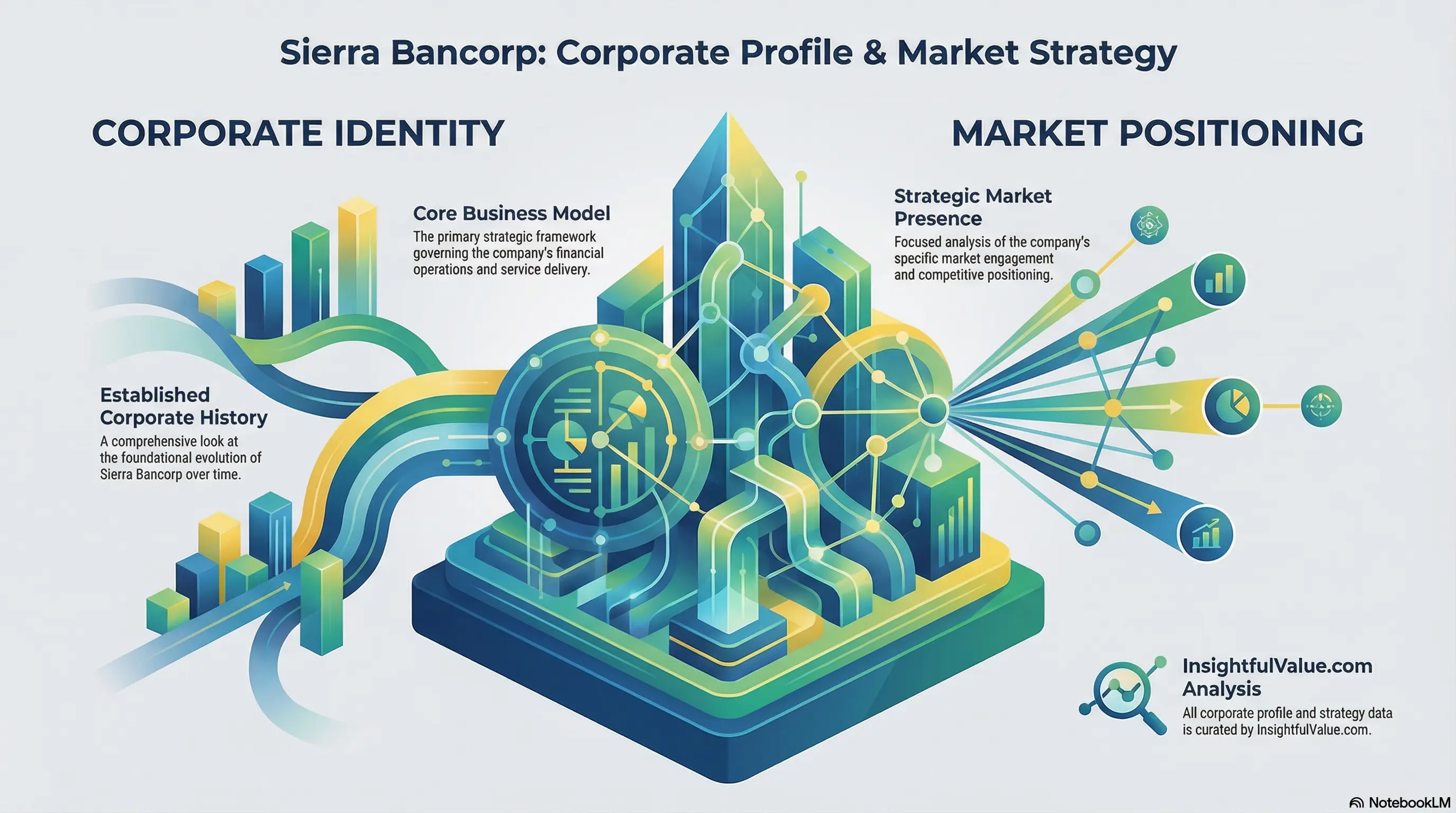
Infographic
Overview
Sierra Bancorp is a holding company of Bank of the Sierra, a California state-chartered bank headquartered in Porterville, California. It was founded in 1977 and has grown to become one of the largest independently owned community banks in California. Bank of the Sierra serves customers in Central and Southern California through 46 full-service branches, offering a full range of banking and investment services. Sierra Bancorp prides itself on being deeply rooted in the communities it serves and is dedicated to providing personalized and high-quality customer service. The company’s focus is on building strong relationships with its customers and supporting local businesses and organizations. In addition to traditional banking services, Sierra Bancorp also offers wealth management, insurance, and real estate services through its subsidiaries. The company is committed to responsible and sustainable growth, and has received multiple awards and recognition for its financial performance, community involvement, and ethical business practices. As of September 2021, Sierra Bancorp has approximately $3.1 billion in assets and employs over 800 people. It is publicly traded on the NASDAQ Global Select Market under the ticker symbol BSRR.
How to explain to a 10 year old kid about the company?
AI does present potential challenges to companies like Sierra Bancorp, particularly in the areas of products, services, and competitive positioning. However, the exact impact will depend on how Sierra Bancorp adapts to these advancements. 1. Substitution: The rise of AI-enabled financial services could lead to the development of new, automated solutions that may substitute traditional banking services. For example, AI can enhance mobile banking apps, offer personalized financial advice, or streamline loan approval processes, potentially reducing customer reliance on conventional banking products. If Sierra Bancorp fails to innovate and integrate AI features into its offerings, it risks losing market share to competitors that do. 2. Disintermediation: AI can facilitate direct transactions between consumers and service providers, bypassing traditional banking institutions. For instance, peer-to-peer lending platforms and fintech companies leveraging AI may provide cheaper or faster financial solutions, limiting Sierra Bancorp’s role as an intermediary. This trend could erode the bank’s customer base and revenue streams if customers prefer these alternative solutions. 3. Margin Pressure: The implementation of AI technologies could also lead to increased competition, resulting in pressure on profit margins. If competitors successfully adopt AI to improve efficiency or lower costs, Sierra Bancorp may be compelled to do the same to remain competitive. This could involve significant investment in technology and talent, impacting profitability if not managed effectively. In summary, while AI poses potential threats in the form of substitution, disintermediation, and margin pressure, it also offers opportunities for Sierra Bancorp to enhance its services and operations. The key will be how effectively the company embraces AI technologies to innovate and remain competitive in the evolving financial landscape.
Sensitivity to interest rates
The sensitivity of Sierra Bancorp’s earnings, cash flow, and valuation to changes in interest rates can be assessed through several key factors: 1. Interest Income and Expense: Sierra Bancorp, as a banking institution, earns a significant portion of its revenue from interest on loans. An increase in interest rates can lead to higher interest income from new loans and variable-rate loans. Conversely, if interest rates fall, the bank may earn less from its existing loan portfolio, potentially compressing margins if deposits are not adjusted accordingly. 2. Net Interest Margin (NIM): Changes in interest rates directly affect the bank’s net interest margin, which is the difference between interest income generated and interest expenses. An environment of rising interest rates could widen the NIM if the bank can increase loan rates more than its cost of funds, improving profitability. However, if deposit rates rise faster than loan rates, NIM might be negatively impacted. 3. Loan Demand: Interest rate fluctuations can influence overall loan demand. Rising rates often lead to reduced demand for loans, especially mortgages, as borrowing costs increase. This can impact future earnings and growth prospects for the bank. 4. Asset-Liability Management: Sierra Bancorp’s management strategies concerning interest rate risk will influence its sensitivity to rate changes. A well-structured asset-liability strategy can mitigate risks, but ineffective management could expose the bank to significant fluctuations in cash flow and valuations. 5. Valuation Models: Changes in interest rates typically influence the discount rate used in discounted cash flow (DCF) valuations. Higher rates generally lead to a higher discount rate, reducing the present value of future cash flows, thereby lowering the valuation of the bank’s equity. In a rising rate environment, investor sentiment may also lead to lower bank stock prices if anticipated earnings growth diminishes. 6. Credit Quality: Interest rate changes can impact borrowers’ ability to service debt. Higher rates may lead to increased defaults, affecting the bank’s credit quality and potentially leading to higher loan loss provisions. This impacts both earnings and cash flow. 7. Economic Conditions: Interest rates are often a reflection of broader economic conditions. Changes in rates can impact economic growth, which, in turn, affects loan growth, credit conditions, and the overall profitability of financial institutions. In summary, Sierra Bancorp’s earnings, cash flow, and valuation are sensitive to interest rate changes through their effects on interest income, net interest margin, loan demand, and overall financial health. Effective management of interest rate risk is crucial for sustaining profitability in varying interest rate environments.
👉 InsightfulValue is a platform for public company analysis.
👉 We provide a database of public companies, with a focus on value investing principles.
👉 We carefully select every company in our database. With only 1855 listed, there's a reason for that.
👉 The reason is simple – we only select the best-performing public companies, true champions. And we know exactly what we mean by "champion."
👉 For us, a champion is a company with strong finances, a history of impressive dividends, great management, and standout products or services. We mean it.
👉 For each company, we have 663 questions and answers covering every aspect of their market position and operations. Everything.
👉 ... plus additional 164 Q&A about the industry each company operates in.
InsightfulValue is an independent platform dedicated to value investing research. The information provided on this website is for informational and educational purposes only and does not constitute financial, investment, tax, or legal advice. We are not financial advisors, investment consultants, or licensed consultants. Our analyses, insights, and criteria are based on principles learned from renowned value investors such as Benjamin Graham, Warren Buffett, and Charlie Munger, but they should not be considered personalized investment recommendations. Investing in financial markets carries risks, and past performance is not indicative of future results. Users of this website should conduct their own due diligence and consult with a qualified professional before making any financial or investment decisions. InsightfulValue assumes no liability for any financial losses or decisions made based on the information provided on this site. By using this website, you acknowledge and accept that all investments involve risk and that InsightfulValue does not guarantee any financial outcomes.