The content provided in this video is for informational and educational purposes only. It does not constitute financial advice, investment recommendations, or an offer to buy or sell any securities. All views expressed are those of InsightfulValue and are based on publicly available information believed to be reliable, but no guarantee is made as to its accuracy or completeness. Always conduct your own research or consult a licensed financial advisor before making any investment decisions. Investing in the stock market involves risks, including the loss of principal.
Please be aware that the stock prices displayed on this website represent a curated selection of data. On desktop devices, you will see a wider range of stock prices, while on mobile devices, we provide a more streamlined view for better user experience and readability.
Our focus is on assessing a company's overall value and performance, rather than analyzing price fluctuations, even if we do watch prices in order to find companies trading below their intrinsic value. For more detailed charting and comprehensive market analysis, we recommend consulting a professional financial service or utilizing advanced charting tools.
We strive to provide accurate and timely information, but we encourage you to verify any financial data before making investment decisions.
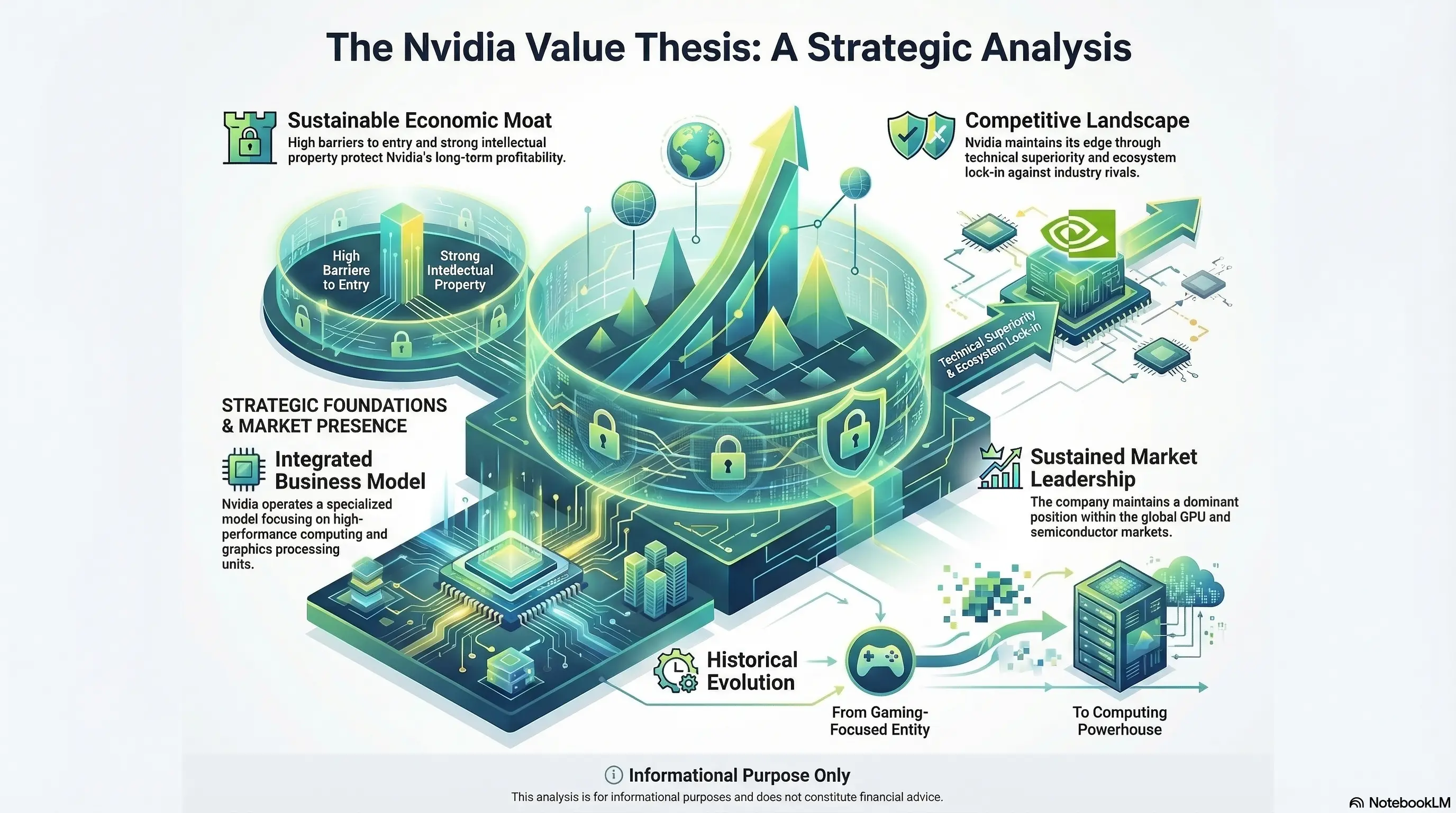
Infographic
Overview
Nvidia is an American technology company known for its graphics processing units (GPUs) and related products. The company was founded in 1993 by Jen-Hsun Huang, Chris Malachowsky, and Curtis Priem. Nvidia designs and manufactures graphics cards, mobile processors, and other computer hardware for personal computers, gaming consoles, and mobile devices. Nvidia is best known for its popular GeForce graphics cards, which are used by gamers and graphic designers to enhance the performance of their computers. The company also produces professional-grade GPUs for use in scientific and industrial applications. In addition to its hardware products, Nvidia also develops software and drivers for its GPUs, including its proprietary CUDA parallel computing platform. This technology enables developers to use the power of GPUs for non-graphical tasks, such as data analysis and machine learning. Nvidia is a major player in the gaming industry, with its GPUs powering many popular video games. The company also has partnerships with other tech companies, such as Intel and Google, to develop products for artificial intelligence, self-driving cars, and other advanced technologies. Headquartered in Santa Clara, California, Nvidia has offices and facilities around the world. The company employs over 13,000 people and reported revenue of $16.68 billion in 2020. In recent years, Nvidia has also become a leader in the field of cryptocurrency mining. Its GPUs are used by miners to solve complex mathematical equations and earn digital currencies like Bitcoin. In addition to its core business, Nvidia is also known for its commitment to environmental sustainability. The company has implemented various initiatives to reduce its carbon footprint and promote energy-efficiency in its products. Overall, Nvidia is a highly respected and influential company in the tech industry, known for its powerful and innovative products that have helped shape the gaming and computing industries.
How to explain to a 10 year old kid about the company?
AI does present both opportunities and challenges for Nvidia, particularly given its strong position in the GPU market, which is crucial for AI processing. In terms of substitution, while AI technologies can sometimes utilize alternative hardware (like CPUs or specialized chips), Nvidia’s GPUs, such as the A100 and H100, are highly optimized for AI workloads and deep learning tasks. Thus, while there is potential for substitutes, Nvidia’s technology currently holds a competitive advantage in terms of performance, efficiency, and software ecosystem. Disintermediation is another aspect to consider. However, Nvidia’s business model, which involves hardware sales coupled with software support (such as CUDA), makes it less susceptible to disintermediation by AI technologies. Instead, AI may enhance Nvidia’s offerings as demand for AI-related computing power continues to grow. Regarding margin pressure, competition in the semiconductor industry can lead to price erosion. As more companies enter the AI and GPU market, including startups and established tech companies developing custom chips, there is potential for increased competition that could pressure Nvidia’s margins. However, the high barrier to entry in developing competitive AI hardware and the ongoing demand for advanced computing might mitigate this pressure. In summary, while AI does pose some challenges related to competition and margin pressure, Nvidia’s current product positioning and advancements in AI-specific hardware and software give it a robust standing in the market. The overall outlook suggests that, rather than a material threat, AI could further solidify Nvidia’s role in the tech industry, provided it continues to innovate and adapt to the evolving landscape.
Sensitivity to interest rates
Nvidia’s earnings, cash flow, and valuation are influenced by interest rates in several key ways. 1. Earnings: Rising interest rates can impact consumer and enterprise spending. Higher rates might lead to increased borrowing costs, which could reduce capital expenditures by businesses, particularly in sectors heavily reliant on technology. This slowdown in spending can lead to decreased demand for Nvidia’s products, adversely affecting sales and earnings. Conversely, if interest rates remain low, it might encourage investment in technology, boosting Nvidia’s revenues. 2. Cash Flow: Interest rates affect the cost of borrowing. If Nvidia needs to finance operations or investments through debt, higher interest rates will increase its interest expenses, potentially reducing cash flow. On the other hand, low interest rates can act as a catalyst for more favorable cash flow performance, as financing becomes cheaper, allowing Nvidia to invest in growth opportunities without significantly stretching its financial resources. 3. Valuation: Higher interest rates typically lead to higher discount rates used in discounted cash flow (DCF) models, which can reduce the present value of future cash flows. For a growth stock like Nvidia, which relies on anticipated growth, an increase in interest rates can significantly lower its valuation. Investors might adjust their required rates of return based on changes in interest rates, leading to shifts in stock price. Lower valuations can occur if rates rise, as investors may seek safer assets that offer comparable returns. Overall, Nvidia’s financial performance and market valuation are sensitive to interest rate fluctuations, impacting everything from operational financing to investor sentiment.
👉 InsightfulValue is a platform for public company analysis.
👉 We provide a database of public companies, with a focus on value investing principles.
👉 We carefully select every company in our database. With only 1853 listed, there's a reason for that.
👉 The reason is simple – we only select the best-performing public companies, true champions. And we know exactly what we mean by "champion."
👉 For us, a champion is a company with strong finances, a history of impressive dividends, great management, and standout products or services. We mean it.
👉 For each company, we have 663 questions and answers covering every aspect of their market position and operations. Everything.
👉 ... plus additional 164 Q&A about the industry each company operates in.
InsightfulValue is an independent platform dedicated to value investing research. The information provided on this website is for informational and educational purposes only and does not constitute financial, investment, tax, or legal advice. We are not financial advisors, investment consultants, or licensed consultants. Our analyses, insights, and criteria are based on principles learned from renowned value investors such as Benjamin Graham, Warren Buffett, and Charlie Munger, but they should not be considered personalized investment recommendations. Investing in financial markets carries risks, and past performance is not indicative of future results. Users of this website should conduct their own due diligence and consult with a qualified professional before making any financial or investment decisions. InsightfulValue assumes no liability for any financial losses or decisions made based on the information provided on this site. By using this website, you acknowledge and accept that all investments involve risk and that InsightfulValue does not guarantee any financial outcomes.