The content provided in this video is for informational and educational purposes only. It does not constitute financial advice, investment recommendations, or an offer to buy or sell any securities. All views expressed are those of InsightfulValue and are based on publicly available information believed to be reliable, but no guarantee is made as to its accuracy or completeness. Always conduct your own research or consult a licensed financial advisor before making any investment decisions. Investing in the stock market involves risks, including the loss of principal.
Please be aware that the stock prices displayed on this website represent a curated selection of data. On desktop devices, you will see a wider range of stock prices, while on mobile devices, we provide a more streamlined view for better user experience and readability.
Our focus is on assessing a company's overall value and performance, rather than analyzing price fluctuations, even if we do watch prices in order to find companies trading below their intrinsic value. For more detailed charting and comprehensive market analysis, we recommend consulting a professional financial service or utilizing advanced charting tools.
We strive to provide accurate and timely information, but we encourage you to verify any financial data before making investment decisions.
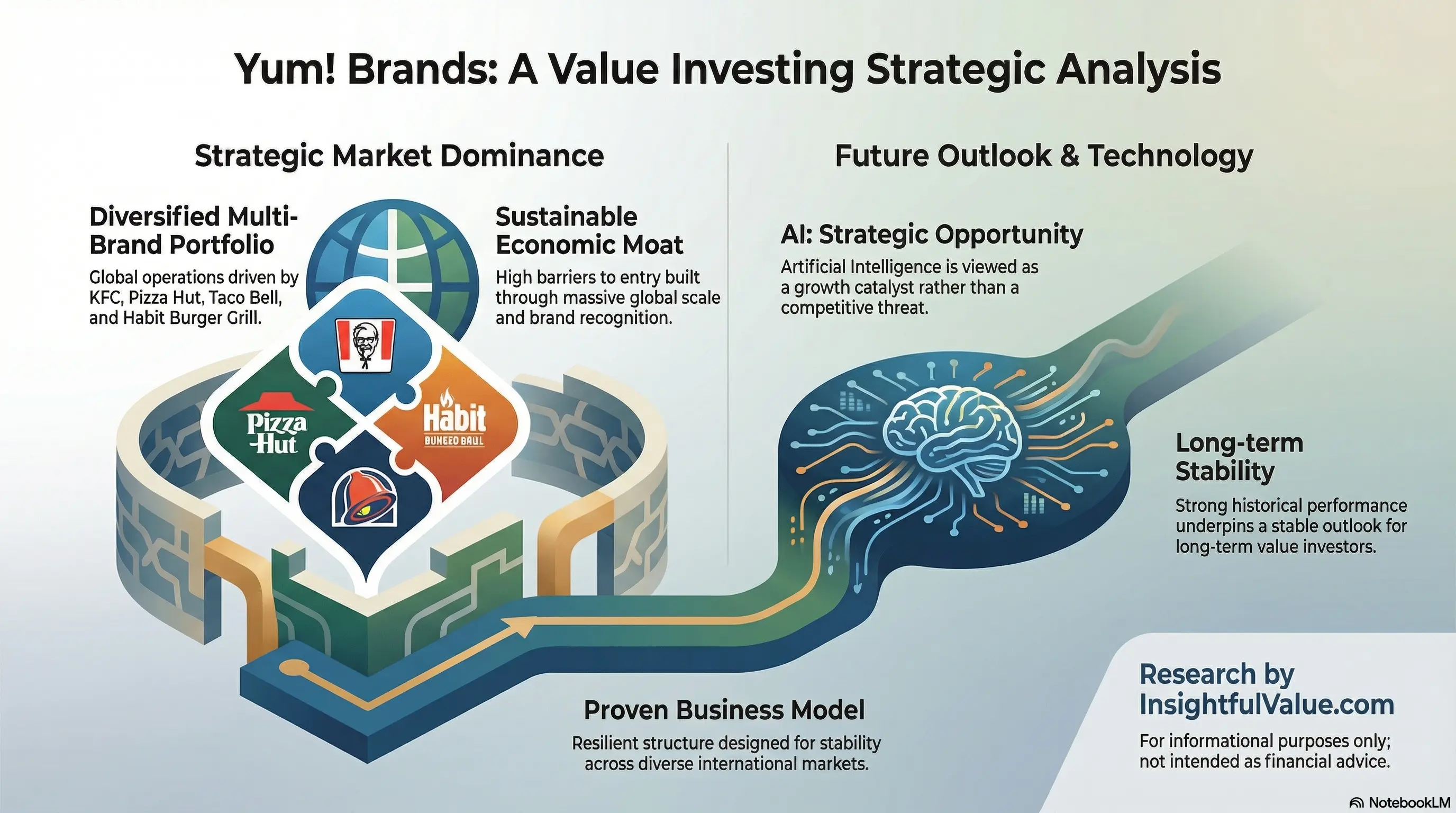
Infographic
Overview
Yum! Brands is a multinational fast food company based in Louisville, Kentucky. It is one of the largest fast food companies in the world, with over 50,000 restaurants in more than 150 countries. The company was founded in 1997 as a spin-off of PepsiCo and originally consisted of two brands, KFC and Pizza Hut. Today, it also includes the popular chains Taco Bell and WingStreet. The company's mission statement is "to build the world’s most loved, trusted and fastest growing restaurant brands." Yum! Brands is known for its global presence, innovative menu offerings, and commitment to social responsibility. History Yum! Brands was officially formed in 1997 when PepsiCo decided to spin off its restaurant division, which consisted of Pizza Hut, KFC, and Taco Bell. The company's name is based on its founders' goal of creating a brand that would make people say "wow!" In 2002, Yum! Brands acquired the fast casual chain Long John Silver's and A&W Restaurants. In 2011, they announced the spin-off of their China division, which became a separate publicly traded company, Yum China Holdings, Inc. In 2016, Yum! Brands announced a major rebranding effort, with a focus on driving growth for its core brands KFC, Pizza Hut, and Taco Bell. This included updating menus, restaurant designs, and digital and delivery capabilities. In recent years, Yum! Brands has also focused on expanding its plant-based offerings and reducing its environmental impact through initiatives such as sustainable packaging and renewable energy. Brands and operations As of 2021, Yum! Brands operates over 50,000 restaurants globally, making it one of the largest fast food companies in the world. KFC: Kentucky Fried Chicken, now known simply as KFC, was founded in 1930 by Harland Sanders. It is known for its signature fried chicken and has a strong presence in the United States and internationally, with over 24,000 restaurants in more than 145 countries. Pizza Hut: Founded in 1958, Pizza Hut is a popular pizza chain with over 18,000 restaurants in over 100 countries. It is known for its customizable pizzas and has expanded its menu to include pasta, wings, and other side dishes. Taco Bell: With origins dating back to 1962, Taco Bell is known for its Tex-Mex inspired menu, including tacos, burritos, and nachos. It has over 7,000 restaurants in over 30 countries. WingStreet: WingStreet is a wing restaurant chain that was launched in 2003 and is incorporated into Pizza Hut locations. Other brands under the Yum! Brands umbrella include Long John Silver's, A&W Restaurants, and KFC Super Chix. The company also has a significant presence in China through its subsidiary, Yum China Holdings. Social responsibility Yum! Brands is committed to social responsibility and sustainability, with a focus on three main areas: 1. Food: The company is working to reduce its environmental impact by sourcing sustainable ingredients and reducing waste. This includes efforts to source more humane and sustainable meat and seafood products. 2. Planet: Yum! Brands is committed to reducing its carbon footprint and has set a goal to reduce greenhouse gas emissions in its restaurants by 25% by 2030. This includes initiatives such as implementing renewable energy sources and investing in more sustainable packaging options. 3. People: The company has a strong commitment to its employees, franchisees, and communities. This includes initiatives such as providing training and development opportunities for employees, promoting diversity and inclusion, and investing in community programs. Yum! Brands also has a global partnership with the World Food Program to fight global hunger and has teamed up with organizations to support disaster relief efforts.
How to explain to a 10 year old kid about the company?
AI has the potential to influence various aspects of Yum! Brands’ operations and competitive positioning, but whether it poses a material threat depends on several factors. 1. Substitution: AI could facilitate the development of new food products or alternative dining experiences that may rival Yum! Brands’ offerings. For instance, advancements in food technology could lead to innovative plant-based or lab-grown foods that could substitute traditional fast food. Additionally, AI-driven meal delivery services could also change consumer preferences, impacting the traffic to traditional fast-food outlets. 2. Disintermediation: AI technologies enable direct-to-consumer models that could bypass traditional restaurant service models. For instance, AI-powered platforms may connect consumers directly with food producers or meal prep services, potentially reducing the demand for fast-food outlets. This could impact Yum! Brands if consumers opt for these alternatives instead of their restaurants. 3. Margin Pressure: AI can lead to increased competition by optimizing operational efficiencies for other food businesses, which could drive down prices across the industry. As competitors use AI to enhance supply chain management, reduce costs, and improve customer experience, Yum! Brands might face pressure to keep prices competitive while maintaining profitability. Overall, while AI presents opportunities for operational improvements within Yum! Brands, it also introduces risks that could impact their market position and profitability. The company’s response to these challenges, including innovation and adapting to changes in consumer behavior, will be crucial in mitigating potential threats.
Sensitivity to interest rates
The sensitivity of Yum! Brands’ earnings, cash flow, and valuation to changes in interest rates can be analyzed through several key aspects: 1. Debt Obligations: Yum! Brands has a certain level of debt, and fluctuations in interest rates affect the cost of servicing that debt. Higher interest rates can lead to increased interest expenses, which may reduce net earnings and cash flow. Conversely, lower rates can lower those expenses, potentially enhancing profitability. 2. Capital Expenditures: Changes in interest rates can influence Yum! Brands’ decisions on capital expenditures, including new store openings, renovations, or technology investments. If interest rates are high, the company may delay or scale back such investments, which could have a long-term effect on growth and cash flow. 3. Valuation: The valuation of Yum! Brands is often assessed through discounted cash flow (DCF) models, where future cash flows are discounted back to present value using a discount rate that is influenced by prevailing interest rates. An increase in interest rates raises the discount rate, which can decrease the present value of expected cash flows and, thus, reduce the company’s overall valuation. Conversely, lower interest rates can enhance valuation through a lower discount rate. 4. Consumer Spending: Interest rates can also impact consumer spending behavior. Higher interest rates may reduce disposable income and consumer confidence, leading to decreased spending at restaurants, which directly affects Yum! Brands’ revenues and cash flow. If consumers are less willing to spend on dining out, it can negatively impact earnings. 5. Overall Economic Impact: The macroeconomic environment shaped by changing interest rates can influence restaurant industry trends, competition, and market dynamics. Yum! Brands operates in many international markets, and changes in interest rates can also affect foreign investment, currency fluctuations, and economic stability in those regions. In summary, Yum! Brands’ earnings, cash flow, and valuation display sensitivity to interest rate changes due to debt servicing costs, investment decisions, valuation metrics, consumer spending, and broader economic conditions. Monitoring interest rate trends is vital for understanding the potential financial impact on the company.
👉 InsightfulValue is a platform for public company analysis.
👉 We provide a database of public companies, with a focus on value investing principles.
👉 We carefully select every company in our database. With only 1853 listed, there's a reason for that.
👉 The reason is simple – we only select the best-performing public companies, true champions. And we know exactly what we mean by "champion."
👉 For us, a champion is a company with strong finances, a history of impressive dividends, great management, and standout products or services. We mean it.
👉 For each company, we have 663 questions and answers covering every aspect of their market position and operations. Everything.
👉 ... plus additional 164 Q&A about the industry each company operates in.
InsightfulValue is an independent platform dedicated to value investing research. The information provided on this website is for informational and educational purposes only and does not constitute financial, investment, tax, or legal advice. We are not financial advisors, investment consultants, or licensed consultants. Our analyses, insights, and criteria are based on principles learned from renowned value investors such as Benjamin Graham, Warren Buffett, and Charlie Munger, but they should not be considered personalized investment recommendations. Investing in financial markets carries risks, and past performance is not indicative of future results. Users of this website should conduct their own due diligence and consult with a qualified professional before making any financial or investment decisions. InsightfulValue assumes no liability for any financial losses or decisions made based on the information provided on this site. By using this website, you acknowledge and accept that all investments involve risk and that InsightfulValue does not guarantee any financial outcomes.