The content provided in this video is for informational and educational purposes only. It does not constitute financial advice, investment recommendations, or an offer to buy or sell any securities. All views expressed are those of InsightfulValue and are based on publicly available information believed to be reliable, but no guarantee is made as to its accuracy or completeness. Always conduct your own research or consult a licensed financial advisor before making any investment decisions. Investing in the stock market involves risks, including the loss of principal.
Please be aware that the stock prices displayed on this website represent a curated selection of data. On desktop devices, you will see a wider range of stock prices, while on mobile devices, we provide a more streamlined view for better user experience and readability.
Our focus is on assessing a company's overall value and performance, rather than analyzing price fluctuations, even if we do watch prices in order to find companies trading below their intrinsic value. For more detailed charting and comprehensive market analysis, we recommend consulting a professional financial service or utilizing advanced charting tools.
We strive to provide accurate and timely information, but we encourage you to verify any financial data before making investment decisions.
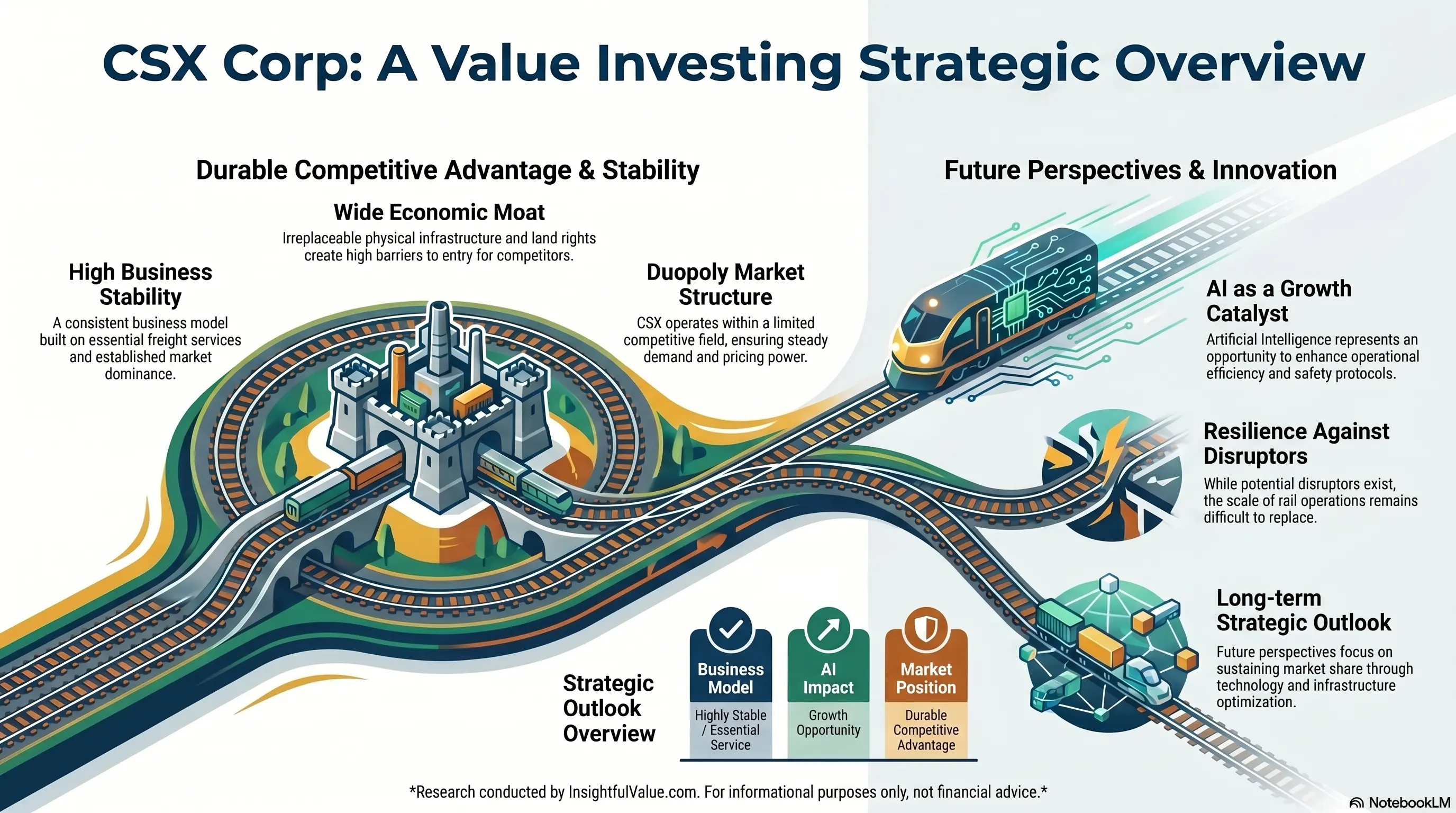
Infographic
Overview
CSX Corp, often referred to simply as CSX, is a transportation company that operates a rail transportation network in the United States and parts of Canada. It is one of the largest railway companies in the United States, with over 21,000 miles of track and serving 23 states. CSX Corp was formed in 1980 through the merger of several railroad companies, including Chessie System and Seaboard Coast Line Industries. The company is based in Jacksonville, Florida and employs over 24,000 people. The primary business of CSX Corp is freight transportation, specifically the transportation of coal, intermodal containers, agricultural and industrial products, and chemicals. The company also offers its customers services such as storage, distribution, and supply chain management solutions. CSX Corp is divided into four major operating divisions: Coal, Intermodal, Merchandise, and Industrial. These divisions reflect the different types of freight that the company transports. CSX Corp is also committed to sustainability and has implemented initiatives to reduce its environmental impact. These include using more fuel-efficient locomotives, developing technologies to reduce greenhouse gas emissions, and implementing recycling and waste reduction programs. The company has been recognized for its sustainability efforts, receiving awards from organizations such as the Carbon Disclosure Project and the Dow Jones Sustainability Index. In addition to its transportation operations, CSX Corp is also involved in community outreach and philanthropy. The company has programs that support education, health and wellness, environment, and safety in the communities it serves. CSX Corp also partners with organizations such as the Red Cross and the National Safety Council to provide disaster relief and promote safety initiatives. Overall, CSX Corp plays a significant role in the transportation industry and in the communities it serves. With a strong focus on sustainability and community involvement, the company continues to grow and adapt to meet the changing needs of its customers and the world.
How to explain to a 10 year old kid about the company?
AI can impact CSX Corp’s products, services, and competitive positioning in several ways, though the extent of the threat can vary based on several factors, including market dynamics and technological advancements. 1. Substitution: AI has potential applications in logistics and transportation management, which could lead to the development of alternative solutions for freight transport. For instance, advancements in autonomous vehicles or drones could offer new modes of transport that challenge traditional rail services. However, the scale and infrastructure required for rail transport make direct substitution less likely in the short term. 2. Disintermediation: AI could streamline supply chain processes, potentially reducing the need for certain intermediaries within logistics and shipping. This could lead to increased competition among service providers, as customers find alternatives that leverage AI for more efficient transportation solutions. CSX might face competition from tech-focused logistics firms that can offer real-time tracking, predictive analytics, and optimized routing, potentially displacing traditional rail services in some segments. 3. Margin Pressure: The implementation of AI can also contribute to margin pressure. For example, as competitors adopt AI-driven solutions to enhance efficiency and reduce costs, CSX may need to invest in similar technologies to maintain its competitiveness. This could lead to increased operational costs if the company lags in AI adoption. Furthermore, if customers begin to expect AI-driven efficiencies such as faster deliveries and real-time updates, CSX may need to adjust its pricing strategy, putting pressure on profit margins. In conclusion, while AI presents some potential threats to CSX Corp’s operations, its significant infrastructure, established market position, and the logistical realities of rail transport mean that the immediate risks of substitution or disintermediation may be moderated. Nonetheless, ongoing investment in AI and innovation will be critical for maintaining competitive positioning and mitigating margin pressure.
Sensitivity to interest rates
The sensitivity of CSX Corp’s earnings, cash flow, and valuation to changes in interest rates can be analyzed through several key factors: 1. Cost of Debt: Higher interest rates typically lead to increased borrowing costs. If CSX Corp has a significant amount of debt, a rise in interest rates can result in higher interest expenses, negatively impacting net earnings and cash flow. Lower interest rates, conversely, reduce financing costs, enhancing profitability. 2. Capital Expenditures (CapEx): CSX Corp’s growth strategies often involve significant capital expenditures. If borrowing costs rise due to higher interest rates, the company may scale back or delay investments in infrastructure and fleet upgrades, which could affect long-term growth and competitiveness. 3. Consumer Demand and Revenue: Increasing interest rates can lead to slower economic growth, which may reduce consumer spending and demand for freight services. A decline in shipment volumes directly impacts revenue and cash flow. 4. Valuation Metrics: Interest rates affect discount rates used in valuing companies. Higher rates typically lead to higher discount rates, decreasing the present value of future cash flows, which can lower the overall valuation of CSX Corp. Conversely, lower rates can increase valuations as projected revenues become more attractive. 5. Operational Flexibility: Companies with greater operational flexibility can better absorb interest rate changes by adjusting pricing or operational strategies. CSX’s freight services may allow for some pricing power, but significant economic shifts could limit this flexibility. 6. Market Sentiment: Rising interest rates can affect stock market sentiment, particularly for companies in capital-intensive sectors like transportation and logistics. A negative sentiment can lead to lower stock prices, which impacts valuation metrics such as price-to-earnings ratios. In summary, CSX Corp’s earnings, cash flow, and valuation are sensitive to interest rates through multiple channels, including borrowing costs, capital investments, consumer demand, and broader market dynamics. Understanding these relationships is important for assessing the company’s financial health and strategic decisions in varying interest rate environments.
👉 InsightfulValue is a platform for public company analysis.
👉 We provide a database of public companies, with a focus on value investing principles.
👉 We carefully select every company in our database. With only 1853 listed, there's a reason for that.
👉 The reason is simple – we only select the best-performing public companies, true champions. And we know exactly what we mean by "champion."
👉 For us, a champion is a company with strong finances, a history of impressive dividends, great management, and standout products or services. We mean it.
👉 For each company, we have 663 questions and answers covering every aspect of their market position and operations. Everything.
👉 ... plus additional 164 Q&A about the industry each company operates in.
InsightfulValue is an independent platform dedicated to value investing research. The information provided on this website is for informational and educational purposes only and does not constitute financial, investment, tax, or legal advice. We are not financial advisors, investment consultants, or licensed consultants. Our analyses, insights, and criteria are based on principles learned from renowned value investors such as Benjamin Graham, Warren Buffett, and Charlie Munger, but they should not be considered personalized investment recommendations. Investing in financial markets carries risks, and past performance is not indicative of future results. Users of this website should conduct their own due diligence and consult with a qualified professional before making any financial or investment decisions. InsightfulValue assumes no liability for any financial losses or decisions made based on the information provided on this site. By using this website, you acknowledge and accept that all investments involve risk and that InsightfulValue does not guarantee any financial outcomes.