The content provided in this video is for informational and educational purposes only. It does not constitute financial advice, investment recommendations, or an offer to buy or sell any securities. All views expressed are those of InsightfulValue and are based on publicly available information believed to be reliable, but no guarantee is made as to its accuracy or completeness. Always conduct your own research or consult a licensed financial advisor before making any investment decisions. Investing in the stock market involves risks, including the loss of principal.
Please be aware that the stock prices displayed on this website represent a curated selection of data. On desktop devices, you will see a wider range of stock prices, while on mobile devices, we provide a more streamlined view for better user experience and readability.
Our focus is on assessing a company's overall value and performance, rather than analyzing price fluctuations, even if we do watch prices in order to find companies trading below their intrinsic value. For more detailed charting and comprehensive market analysis, we recommend consulting a professional financial service or utilizing advanced charting tools.
We strive to provide accurate and timely information, but we encourage you to verify any financial data before making investment decisions.
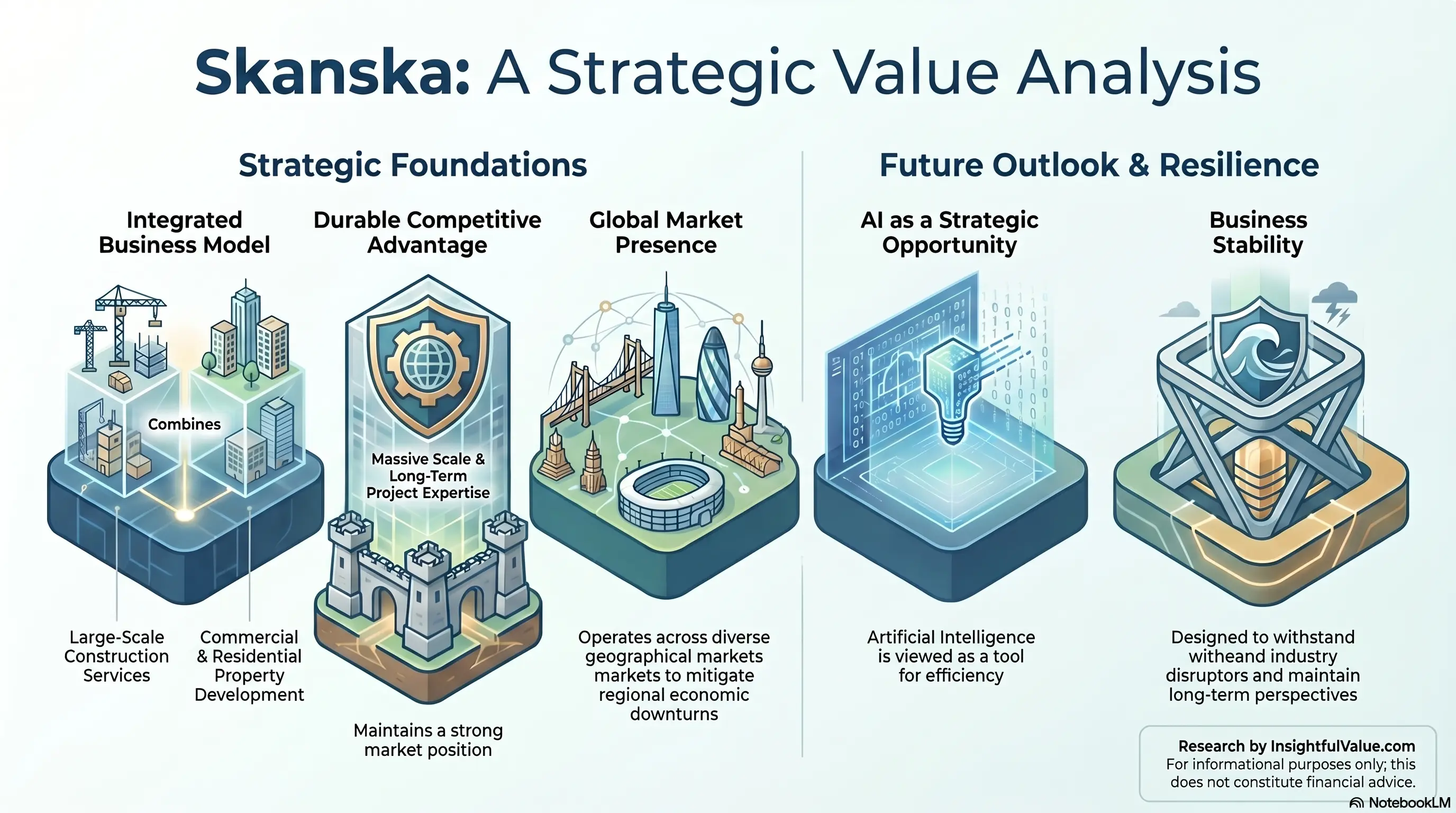
Infographic
Overview
Skanska is a multinational construction and development company headquartered in Stockholm, Sweden. It was founded in 1887 and has operations in Europe, North America, and Latin America. The company specializes in construction, project development, and commercial property development. Skanska is one of the largest construction companies in the world, with over 34,000 employees and annual revenues of more than $18 billion. The company is known for its sustainable and innovative approach to construction, with a focus on green building and renewable energy. It has been ranked as one of the most sustainable companies in the world by the Dow Jones Sustainability Index. The company's projects range from infrastructure and commercial buildings to residential developments and large-scale public-private partnerships. Some notable projects by Skanska include the New Karolinska Solna Hospital in Sweden, the World Trade Center Transportation Hub in New York City, and the Ormen Lange gas processing plant in Norway. Skanska also places a strong emphasis on workplace safety, and has implemented strict policies and procedures to ensure the health and well-being of its employees. Overall, Skanska is a well-respected and successful company in the construction industry, known for its high-quality projects, commitment to sustainability, and dedication to employee safety.
How to explain to a 10 year old kid about the company?
AI has the potential to impact Skanska’s products, services, and competitive positioning in several ways, though the extent of the threat can vary based on implementation and industry dynamics. 1. Substitution: AI technologies, particularly in construction and project management, could enable the development of automated systems that perform tasks traditionally done by human workers, such as project planning, scheduling, or monitoring construction progress. If these AI solutions become widespread, they may substitute certain services offered by Skanska, particularly if they can be implemented at a lower cost or with greater efficiency. 2. Disintermediation: AI could lead to disintermediation in the construction supply chain. For instance, AI platforms could connect clients directly with contractors or suppliers, bypassing larger firms like Skanska. As clients gain access to AI tools that streamline procurement or project management, they may choose to engage directly with service providers, potentially reducing Skanska’s role as an intermediary. 3. Margin Pressure: The adoption of AI in construction can lead to increased efficiency and reduced costs, which could pressure profit margins across the industry. If competitors adopt AI technologies and can deliver projects more efficiently or at a lower price, Skanska may face challenges maintaining its pricing structure. Additionally, if AI tools facilitate more competition by lowering barriers to entry, new players could emerge, further exerting pressure on margins. In summary, while AI does pose potential threats to Skanska’s competitive positioning through substitution, disintermediation, and margin pressure, it also offers opportunities for innovation and improved efficiency if embraced strategically. The overall impact will depend on how effectively Skanska adapts to these technological changes and incorporates AI into its operations.
Sensitivity to interest rates
The sensitivity of Skanska’s earnings, cash flow, and valuation to changes in interest rates can be assessed from several perspectives, as the construction and real estate sectors are notably impacted by interest rate fluctuations. 1. Earnings: Higher interest rates typically lead to increased borrowing costs for financing projects. This can reduce profit margins, especially if Skanska is engaged in fixed-price contracts where the company cannot pass through these costs to clients. Additionally, if higher rates dampen overall economic activity, there may be a slowdown in construction demand, impacting overall earnings negatively. 2. Cash Flow: Skanska’s cash flow may be affected by interest rate changes in two ways: operational cash flow and financing cash flow. Increased rates may lead to higher interest expenses on existing debt, thus lowering operational cash flows. Furthermore, if interest rates lead to a slowdown in new project development, it could result in delayed cash inflows from project completions, also hurting overall cash flow dynamics. 3. Valuation: Valuations are often influenced by the prevailing interest rates through the discount rate applied to future cash flows. Higher interest rates generally raise the discount rate, which decreases the present value of anticipated future earnings, thereby negatively impacting Skanska’s valuation. Conversely, if rates are low, the present value of future cash flows increases, enhancing the valuation of the company. Overall, Skanska’s financial performance is significantly affected by interest rate movements, which can influence earnings, cash flows, and valuations in interlinked ways. The company’s strategy in managing financial risks and maintaining leverage will play a crucial role in mitigating these sensitivities.
👉 InsightfulValue is a platform for public company analysis.
👉 We provide a database of public companies, with a focus on value investing principles.
👉 We carefully select every company in our database. With only 1853 listed, there's a reason for that.
👉 The reason is simple – we only select the best-performing public companies, true champions. And we know exactly what we mean by "champion."
👉 For us, a champion is a company with strong finances, a history of impressive dividends, great management, and standout products or services. We mean it.
👉 For each company, we have 663 questions and answers covering every aspect of their market position and operations. Everything.
👉 ... plus additional 164 Q&A about the industry each company operates in.
InsightfulValue is an independent platform dedicated to value investing research. The information provided on this website is for informational and educational purposes only and does not constitute financial, investment, tax, or legal advice. We are not financial advisors, investment consultants, or licensed consultants. Our analyses, insights, and criteria are based on principles learned from renowned value investors such as Benjamin Graham, Warren Buffett, and Charlie Munger, but they should not be considered personalized investment recommendations. Investing in financial markets carries risks, and past performance is not indicative of future results. Users of this website should conduct their own due diligence and consult with a qualified professional before making any financial or investment decisions. InsightfulValue assumes no liability for any financial losses or decisions made based on the information provided on this site. By using this website, you acknowledge and accept that all investments involve risk and that InsightfulValue does not guarantee any financial outcomes.