The content provided in this video is for informational and educational purposes only. It does not constitute financial advice, investment recommendations, or an offer to buy or sell any securities. All views expressed are those of InsightfulValue and are based on publicly available information believed to be reliable, but no guarantee is made as to its accuracy or completeness. Always conduct your own research or consult a licensed financial advisor before making any investment decisions. Investing in the stock market involves risks, including the loss of principal.
Please be aware that the stock prices displayed on this website represent a curated selection of data. On desktop devices, you will see a wider range of stock prices, while on mobile devices, we provide a more streamlined view for better user experience and readability.
Our focus is on assessing a company's overall value and performance, rather than analyzing price fluctuations, even if we do watch prices in order to find companies trading below their intrinsic value. For more detailed charting and comprehensive market analysis, we recommend consulting a professional financial service or utilizing advanced charting tools.
We strive to provide accurate and timely information, but we encourage you to verify any financial data before making investment decisions.
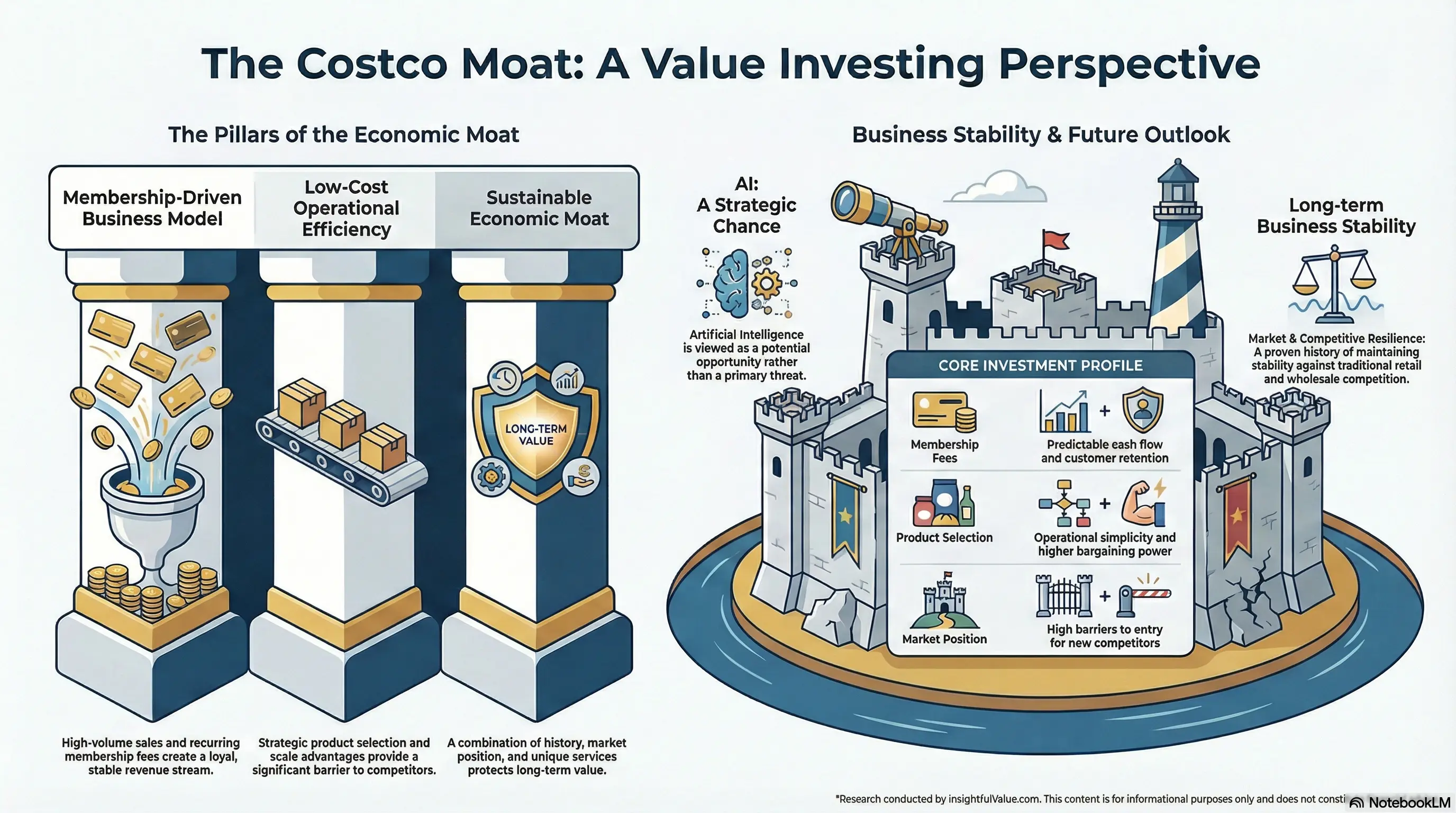
Infographic
Overview
Costco Wholesale is a membership-based warehouse retailer that was founded in 1976 in San Diego, California. It is currently headquartered in Issaquah, Washington and operates over 770 warehouses worldwide. The company is known for its low prices on bulk quantities of consumer goods and wide variety of products, including groceries, electronics, clothing, and household items. To become a Costco member, individuals are required to purchase an annual membership, which grants them access to the warehouse and its products at discounted prices. The company offers two types of memberships: Gold Star ($60 per year) and Gold Star Executive ($120 per year). The Executive membership includes additional benefits such as a 2% reward on eligible purchases and extra discounts on select services. In addition to selling products, Costco also offers services such as optical and pharmacy services, travel packages, and auto and home insurance. The company has a strong commitment to sustainability and has implemented various initiatives to reduce waste, conserve energy, and promote responsible sourcing. Costco is known for its unique business model and company culture, which values its employees and offers them competitive wages and benefits. It has been consistently ranked as one of the best places to work, and has a high employee retention rate. Overall, Costco Wholesale is a successful and reputable retail company known for its commitment to offering quality products at affordable prices, providing valuable services, and promoting a positive work environment for its employees.
How to explain to a 10 year old kid about the company?
AI does present a range of potential threats and opportunities for Costco Wholesale, but whether it poses a material threat depends on several factors. 1. Substitution: Different retail models, including online grocery services and direct-to-consumer brands, have increasingly adopted AI for personalization and targeted marketing. While Costco’s membership-based warehouse model is somewhat insulated due to its bulk purchasing and value proposition, there is a risk that AI-enhanced competitors could offer more personalized shopping experiences, potentially drawing customers away from Costco. However, the unique value Costco provides—such as unique bulk items and pricing—may mitigate this risk. 2. Disintermediation: AI can streamline supply chains and reduce dependence on traditional retail frameworks. For example, companies might use AI to manage inventory and logistics more efficiently, enabling direct sales to consumers without traditional intermediaries. Costco’s business model relies heavily on both purchasing and selling in bulk, which could be impacted if competitors leverage AI to reduce costs further and offer lower prices. However, Costco’s established relationships with suppliers and its significant purchasing power may shield it from some disintermediation pressures. 3. Margin Pressure: The implementation of AI can lead to operational efficiencies and cost savings in various sectors, intensifying competition on price. If competitors can leverage AI to lower their operational costs significantly, Costco may face margin pressure as it competes to maintain its value offering. However, Costco also has a history of strong pricing strategies and a loyal customer base, which might allow it to maintain its margins even in a competitive environment. In summary, while AI introduces challenges related to substitution, disintermediation, and margin pressure, Costco’s strong brand, unique business model, and established market presence may provide some buffers against these threats. The net impact will ultimately depend on how Costco adapts and leverages AI technology in its operations and customer engagement strategies.
Sensitivity to interest rates
Costco Wholesale’s earnings, cash flow, and valuation are sensitive to changes in interest rates for several reasons: 1. Cost of Capital: When interest rates rise, the cost of borrowing increases. If Costco needs to finance expansion or operations through debt, higher interest rates can lead to increased interest expenses, which may reduce net earnings. Conversely, lower interest rates can lower the cost of capital, potentially enhancing profitability. 2. Consumer Behavior: Interest rates influence consumer spending behavior. When interest rates are low, consumers are likely to spend more, which can positively impact Costco’s sales and overall revenue. Conversely, higher interest rates can lead to reduced consumer spending as borrowing costs increase. This can adversely affect sales growth and, subsequently, earnings. 3. Valuation: Valuation models, such as discounted cash flow (DCF), use discount rates that often include a component related to interest rates. When rates rise, the discount rate increases, which can lower the present value of future cash flows. This could lead to a decrease in the overall valuation of Costco’s stock. 4. Inventory Financing: Costco relies on inventory management and may use short-term financing for inventory purchases. Higher interest rates can increase the cost of this financing, affecting cash flow. 5. Competition: A higher interest rate environment may affect competition within the retail sector. Competitors with less efficient capital structures could be more adversely impacted, potentially allowing Costco to gain market share or, on the flip side, face price competition as competitors seek to maintain sales. In summary, while Costco is generally considered a resilient retailer with a strong membership model, it is not immune to the impacts of interest rate fluctuations. Changes in interest rates can influence both operational costs and consumer behavior, ultimately impacting earnings, cash flow, and the company’s valuation.
👉 InsightfulValue is a platform for public company analysis.
👉 We provide a database of public companies, with a focus on value investing principles.
👉 We carefully select every company in our database. With only 1853 listed, there's a reason for that.
👉 The reason is simple – we only select the best-performing public companies, true champions. And we know exactly what we mean by "champion."
👉 For us, a champion is a company with strong finances, a history of impressive dividends, great management, and standout products or services. We mean it.
👉 For each company, we have 663 questions and answers covering every aspect of their market position and operations. Everything.
👉 ... plus additional 164 Q&A about the industry each company operates in.
InsightfulValue is an independent platform dedicated to value investing research. The information provided on this website is for informational and educational purposes only and does not constitute financial, investment, tax, or legal advice. We are not financial advisors, investment consultants, or licensed consultants. Our analyses, insights, and criteria are based on principles learned from renowned value investors such as Benjamin Graham, Warren Buffett, and Charlie Munger, but they should not be considered personalized investment recommendations. Investing in financial markets carries risks, and past performance is not indicative of future results. Users of this website should conduct their own due diligence and consult with a qualified professional before making any financial or investment decisions. InsightfulValue assumes no liability for any financial losses or decisions made based on the information provided on this site. By using this website, you acknowledge and accept that all investments involve risk and that InsightfulValue does not guarantee any financial outcomes.