The content provided in this video is for informational and educational purposes only. It does not constitute financial advice, investment recommendations, or an offer to buy or sell any securities. All views expressed are those of InsightfulValue and are based on publicly available information believed to be reliable, but no guarantee is made as to its accuracy or completeness. Always conduct your own research or consult a licensed financial advisor before making any investment decisions. Investing in the stock market involves risks, including the loss of principal.
Please be aware that the stock prices displayed on this website represent a curated selection of data. On desktop devices, you will see a wider range of stock prices, while on mobile devices, we provide a more streamlined view for better user experience and readability.
Our focus is on assessing a company's overall value and performance, rather than analyzing price fluctuations, even if we do watch prices in order to find companies trading below their intrinsic value. For more detailed charting and comprehensive market analysis, we recommend consulting a professional financial service or utilizing advanced charting tools.
We strive to provide accurate and timely information, but we encourage you to verify any financial data before making investment decisions.
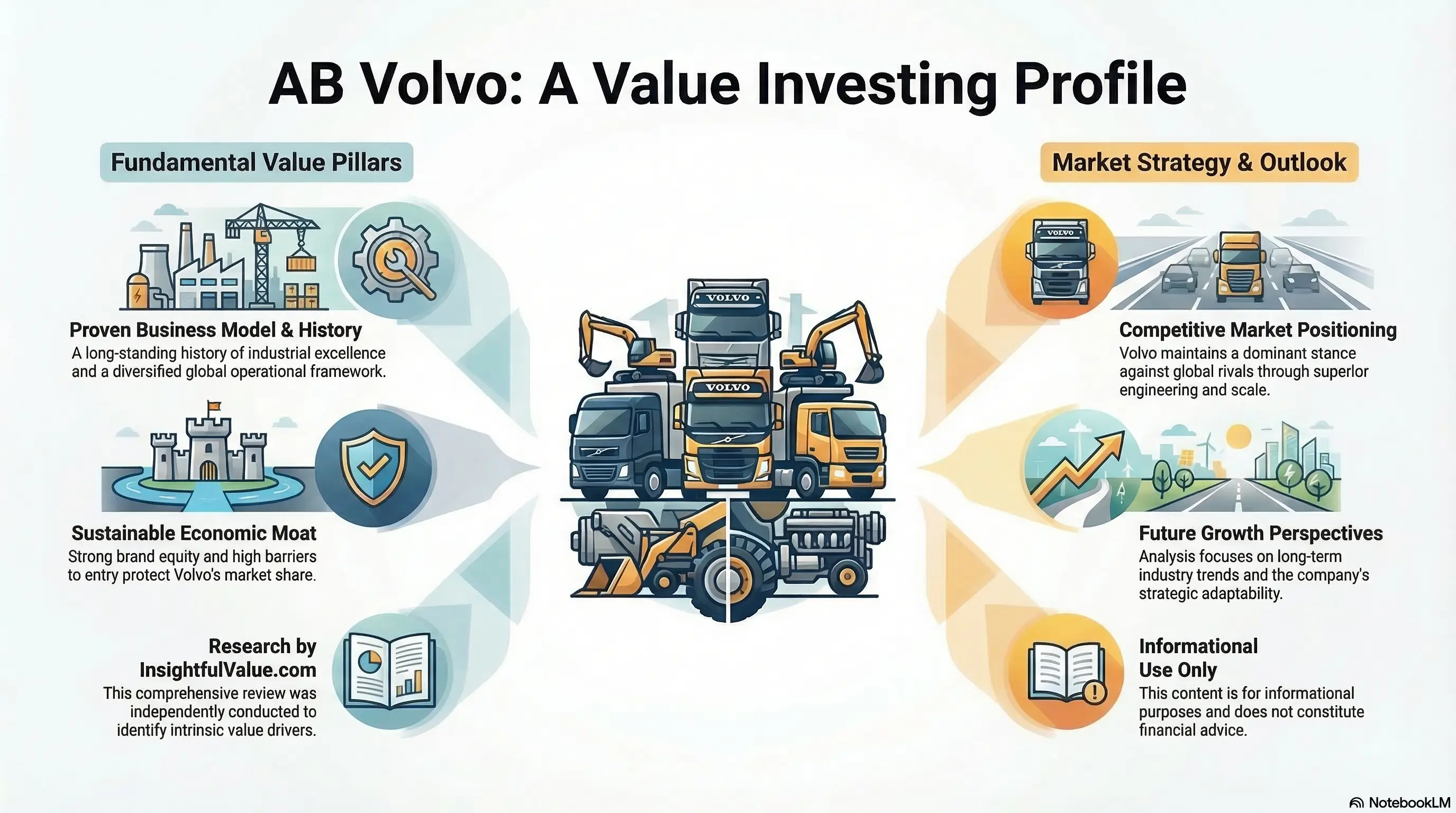
Infographic
Overview
AB Volvo is a Swedish multinational manufacturing company that specializes in the production of commercial vehicles, construction equipment, buses, and engines. The company was founded in 1927 by Swedish engineer Gustaf Larson and businessman Assar Gabrielsson, and is headquartered in Gothenburg, Sweden. Volvo is known for its strong commitment to safety, environmental sustainability, and technological innovation. Today, Volvo is divided into four main business segments: Trucks, Construction Equipment, Buses, and Volvo Financial Services. The company has production sites in 18 countries and sells its products in more than 190 countries worldwide. As of 2021, Volvo has over 105,000 employees and reported annual revenues of around 338 billion SEK. The company is listed on the Nasdaq Stockholm stock exchange and has a secondary listing on the New York Stock Exchange. Volvo has a long history of mergers and acquisitions. In 1999, the company merged with French automotive manufacturer Renault to form the Renault Trucks, Mack Trucks, UD Trucks, and Renault Trucks Defense brands. In 2010, Volvo sold its car division, Volvo Cars, to Chinese automotive company Geely Holding Group. Volvo has received numerous accolades for its safety innovations, including introducing the first three-point seatbelt in 1959, side airbags in 1994, and the pedestrian detection system in 2010. The company also has a strong commitment to sustainability, with a goal to become climate-neutral by 2040.
How to explain to a 10 year old kid about the company?
AI does pose potential threats to AB Volvo’s products, services, and competitive positioning, although these risks can vary in nature and intensity. First, regarding substitution, AI technologies in the automotive industry are advancing rapidly, particularly in the domains of electric and autonomous vehicles. Competitors may leverage AI to develop more efficient vehicles or smarter mobility solutions, which could substitute or diminish the demand for traditional Volvo products. For instance, if a competitor successfully integrates AI to create a superior autonomous driving system, it could draw customers away from Volvo. Next, disintermediation is a risk as AI facilitates more direct interactions between consumers and suppliers. For example, the rise of online vehicle purchasing and direct-to-consumer sales models, enhanced by AI-driven platforms, might reduce the traditional dealership roles. This shift could undermine Volvo’s distribution channels, affecting sales and service dynamics. Lastly, margin pressure is another important consideration. The integration of AI into manufacturing and operations could lead competitors to achieve greater efficiency and cost reduction, thereby allowing them to offer lower prices. If Volvo is unable to match these efficiencies or harness AI effectively in its own processes, it may face challenges in sustaining its profit margins. In summary, while AI presents opportunities for innovation and improvement, it also carries significant risks for AB Volvo related to substitution, disintermediation, and margin pressure. The company’s strategic approach to leveraging AI will be critical in mitigating these threats and maintaining its competitive edge.
Sensitivity to interest rates
The sensitivity of AB Volvo’s earnings, cash flow, and valuation to changes in interest rates can be assessed from several perspectives: 1. Earnings Sensitivity: Interest rates can significantly impact the company’s earnings, particularly due to the financing costs associated with its operations and sales. If interest rates rise, the cost of borrowing increases, which can lead to higher interest expenses for the company. This affects net income negatively, particularly if a significant portion of the capital structure relies on debt. Additionally, higher interest rates can dampen consumer spending, leading to reduced demand for trucks and other vehicles, thereby impacting sales revenue. 2. Cash Flow Sensitivity: Changes in interest rates can affect cash flow through increased financing costs and changes in working capital needs. For example, higher rates can lead to higher installment payments for financing arrangements, which could reduce operational cash flows. Conversely, if the company maintains a strong cash flow position, it could mitigate some of the negative effects of increased interest costs. Additionally, if customer demand weakens due to higher borrowing costs, it could lead to lower cash inflows from sales. 3. Valuation Sensitivity: The valuation of AB Volvo is typically assessed using discounted cash flow (DCF) models, which rely on the present value of future cash flows. An increase in interest rates raises the discount rate used in these models, leading to lower present value calculations for future cash flows. This can result in a decrease in the overall valuation of the company. Therefore, rising interest rates can lead to higher returns required by investors, further pressuring the stock price. In summary, AB Volvo’s earnings, cash flow, and valuation are sensitive to changes in interest rates through the impacts on financing costs, customer demand, and discount rates used in valuation models. Depending on the level of debt and the economic environment, the extent of this sensitivity may vary.
👉 InsightfulValue is a platform for public company analysis.
👉 We provide a database of public companies, with a focus on value investing principles.
👉 We carefully select every company in our database. With only 1853 listed, there's a reason for that.
👉 The reason is simple – we only select the best-performing public companies, true champions. And we know exactly what we mean by "champion."
👉 For us, a champion is a company with strong finances, a history of impressive dividends, great management, and standout products or services. We mean it.
👉 For each company, we have 663 questions and answers covering every aspect of their market position and operations. Everything.
👉 ... plus additional 164 Q&A about the industry each company operates in.
InsightfulValue is an independent platform dedicated to value investing research. The information provided on this website is for informational and educational purposes only and does not constitute financial, investment, tax, or legal advice. We are not financial advisors, investment consultants, or licensed consultants. Our analyses, insights, and criteria are based on principles learned from renowned value investors such as Benjamin Graham, Warren Buffett, and Charlie Munger, but they should not be considered personalized investment recommendations. Investing in financial markets carries risks, and past performance is not indicative of future results. Users of this website should conduct their own due diligence and consult with a qualified professional before making any financial or investment decisions. InsightfulValue assumes no liability for any financial losses or decisions made based on the information provided on this site. By using this website, you acknowledge and accept that all investments involve risk and that InsightfulValue does not guarantee any financial outcomes.