The content provided in this video is for informational and educational purposes only. It does not constitute financial advice, investment recommendations, or an offer to buy or sell any securities. All views expressed are those of InsightfulValue and are based on publicly available information believed to be reliable, but no guarantee is made as to its accuracy or completeness. Always conduct your own research or consult a licensed financial advisor before making any investment decisions. Investing in the stock market involves risks, including the loss of principal.
Please be aware that the stock prices displayed on this website represent a curated selection of data. On desktop devices, you will see a wider range of stock prices, while on mobile devices, we provide a more streamlined view for better user experience and readability.
Our focus is on assessing a company's overall value and performance, rather than analyzing price fluctuations, even if we do watch prices in order to find companies trading below their intrinsic value. For more detailed charting and comprehensive market analysis, we recommend consulting a professional financial service or utilizing advanced charting tools.
We strive to provide accurate and timely information, but we encourage you to verify any financial data before making investment decisions.
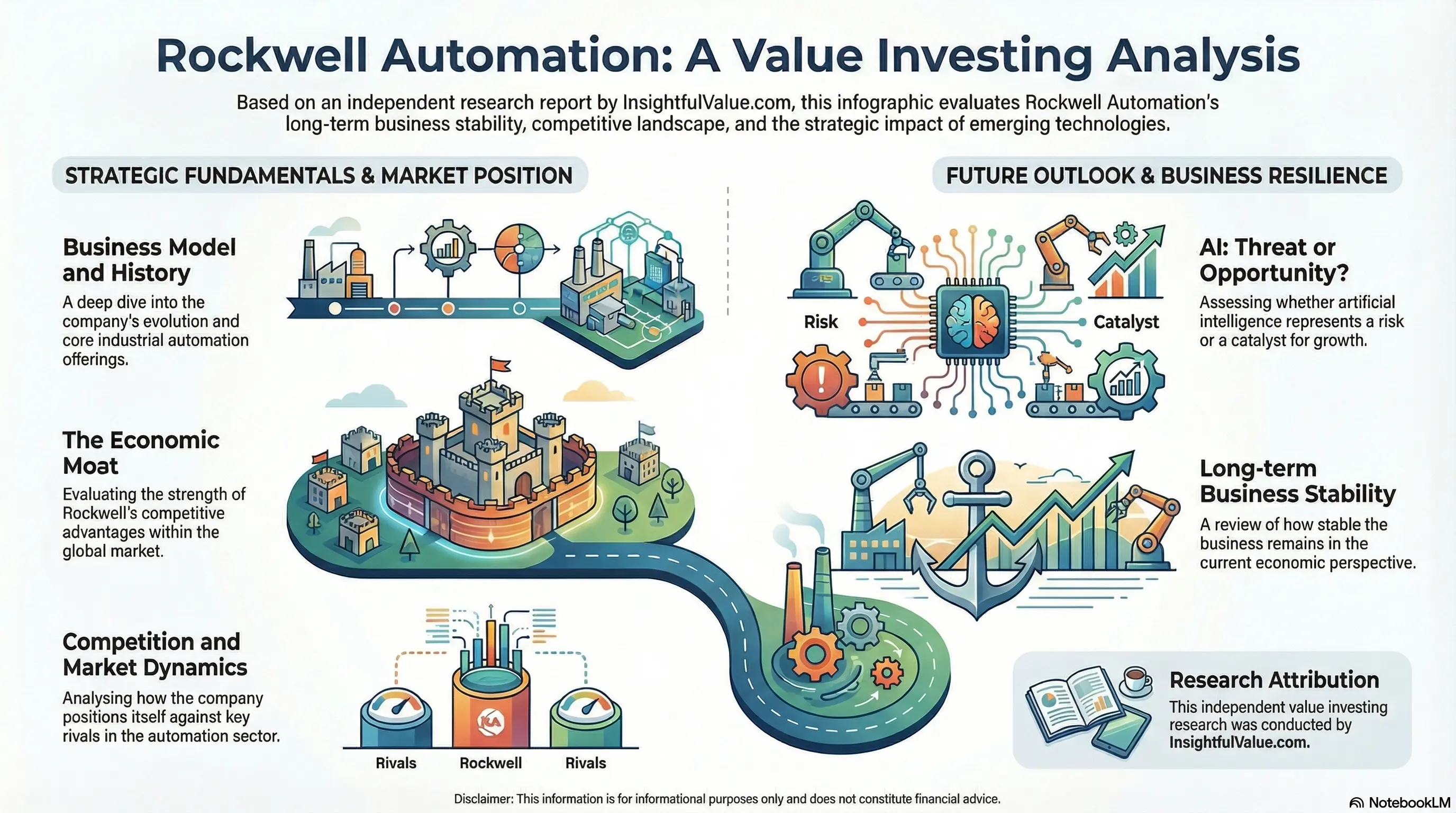
Infographic
Overview
Rockwell Automation is a multinational company that specializes in industrial automation and information technology. Founded in 1903 as the Compression Rheostat Company, it has since grown to become a global leader in the design, manufacture, and marketing of industrial automation and information solutions. Its products and services include programmable controllers, sensors, software, power devices, and industrial control panels, as well as consulting, technical support, and repair services. Headquartered in Milwaukee, Wisconsin, Rockwell Automation has operations in more than 80 countries and serves customers in a wide range of industries, including automotive, oil and gas, food and beverage, and healthcare. The company has approximately 23,000 employees worldwide and generated over $6 billion in revenue in 2020. Rockwell Automation is committed to helping businesses increase their productivity and profitability through automation and the use of advanced technologies such as the Internet of Things (IoT), artificial intelligence, and digital twin. The company is also dedicated to sustainability, with a focus on reducing energy consumption and greenhouse gas emissions, minimizing waste, and promoting the circular economy. As a leader in the industrial automation industry, Rockwell Automation is known for its innovative solutions, reliable products, and excellent customer service. It partners with other industry leaders, such as Cisco, Microsoft, and PTC, to provide comprehensive and integrated solutions to its customers. The company also invests heavily in research and development to continuously improve its products and stay ahead of industry trends. In addition to its business operations, Rockwell Automation has a strong commitment to corporate social responsibility (CSR) and actively supports various philanthropic and community initiatives, such as promoting STEM education and providing disaster relief. Overall, Rockwell Automation continues to be a trusted and influential player in the field of industrial automation, helping businesses around the world become more efficient, sustainable, and connected.
How to explain to a 10 year old kid about the company?
AI does pose some potential threats to Rockwell Automation, but the extent and impact vary across different dimensions of its business. 1. Substitution: AI technologies could lead to the development of new solutions that compete directly with Rockwell’s products, particularly in areas like process optimization, predictive maintenance, and industrial automation. Companies leveraging AI might offer software or services that enhance operational efficiency in ways that could replace traditional automation solutions. This creates a competitive landscape where AI-driven offerings can serve as substitutes for Rockwell’s existing products. 2. Disintermediation: Disintermediation could occur if companies begin utilizing AI technologies to automate processes more independently, reducing their reliance on incumbent automation providers like Rockwell. For instance, businesses might adopt DIY automation solutions driven by AI, negating the need for external vendors. This trend could potentially diminish Rockwell’s role in the supply chain for certain applications, affecting its market presence. 3. Margin Pressure: As AI technologies become more prevalent, the overall competitive landscape may shift, driving prices down for automation products and services. If competitors can offer AI-enhanced solutions at lower costs, Rockwell may feel pressured to lower its prices or invest heavily in R&D to maintain its value proposition. This scenario could lead to reduced profit margins if the company cannot differentiate its offerings effectively. In summary, while AI presents clear opportunities for innovation within Rockwell’s domain, it also carries risks related to substitution, disintermediation, and margin pressure that the company must address to maintain its competitive positioning.
Sensitivity to interest rates
The sensitivity of Rockwell Automation’s earnings, cash flow, and valuation to changes in interest rates can be understood through a few key factors: 1. Cost of Capital: Higher interest rates typically increase the cost of borrowing. If Rockwell Automation relies on debt to finance its operations or invest in growth opportunities, higher interest rates could reduce its net income and cash flow due to increased interest expense. Conversely, lower rates can enhance earnings by reducing financing costs. 2. Investment Decisions: Interest rates influence capital investment decisions for companies. Higher rates may lead to a more cautious investment environment, potentially slowing down expansion plans for Rockwell Automation. This could limit revenue growth and impact future earnings. 3. Valuation Models: Valuations for companies are often based on discounted cash flow (DCF) models, which use interest rates as a key input. If rates rise, the discount rate applied to future cash flows increases, which can lower the present value of those cash flows and negatively affect the company’s valuation. A decrease in rates would have the opposite effect. 4. Consumer and Business Spending: Changes in interest rates can affect economic conditions, influencing both consumer and business spending. For Rockwell Automation, which operates in the industrial automation sector, reduced spending due to higher rates may result in lower sales and profitability. 5. Currency Fluctuations: If rising interest rates lead to a stronger dollar, this could impact Rockwell Automation’s international sales, as many of their customers are located globally. A stronger dollar could make their products more expensive for foreign buyers, potentially decreasing international sales volumes. Overall, while Rockwell Automation’s operations and financial performance do have some sensitivity to changes in interest rates, the degree of this sensitivity also depends on the broader economic context, competitive dynamics, and the company’s strategic decisions.
👉 InsightfulValue is a platform for public company analysis.
👉 We provide a database of public companies, with a focus on value investing principles.
👉 We carefully select every company in our database. With only 1853 listed, there's a reason for that.
👉 The reason is simple – we only select the best-performing public companies, true champions. And we know exactly what we mean by "champion."
👉 For us, a champion is a company with strong finances, a history of impressive dividends, great management, and standout products or services. We mean it.
👉 For each company, we have 663 questions and answers covering every aspect of their market position and operations. Everything.
👉 ... plus additional 164 Q&A about the industry each company operates in.
InsightfulValue is an independent platform dedicated to value investing research. The information provided on this website is for informational and educational purposes only and does not constitute financial, investment, tax, or legal advice. We are not financial advisors, investment consultants, or licensed consultants. Our analyses, insights, and criteria are based on principles learned from renowned value investors such as Benjamin Graham, Warren Buffett, and Charlie Munger, but they should not be considered personalized investment recommendations. Investing in financial markets carries risks, and past performance is not indicative of future results. Users of this website should conduct their own due diligence and consult with a qualified professional before making any financial or investment decisions. InsightfulValue assumes no liability for any financial losses or decisions made based on the information provided on this site. By using this website, you acknowledge and accept that all investments involve risk and that InsightfulValue does not guarantee any financial outcomes.