The content provided in this video is for informational and educational purposes only. It does not constitute financial advice, investment recommendations, or an offer to buy or sell any securities. All views expressed are those of InsightfulValue and are based on publicly available information believed to be reliable, but no guarantee is made as to its accuracy or completeness. Always conduct your own research or consult a licensed financial advisor before making any investment decisions. Investing in the stock market involves risks, including the loss of principal.
Please be aware that the stock prices displayed on this website represent a curated selection of data. On desktop devices, you will see a wider range of stock prices, while on mobile devices, we provide a more streamlined view for better user experience and readability.
Our focus is on assessing a company's overall value and performance, rather than analyzing price fluctuations, even if we do watch prices in order to find companies trading below their intrinsic value. For more detailed charting and comprehensive market analysis, we recommend consulting a professional financial service or utilizing advanced charting tools.
We strive to provide accurate and timely information, but we encourage you to verify any financial data before making investment decisions.
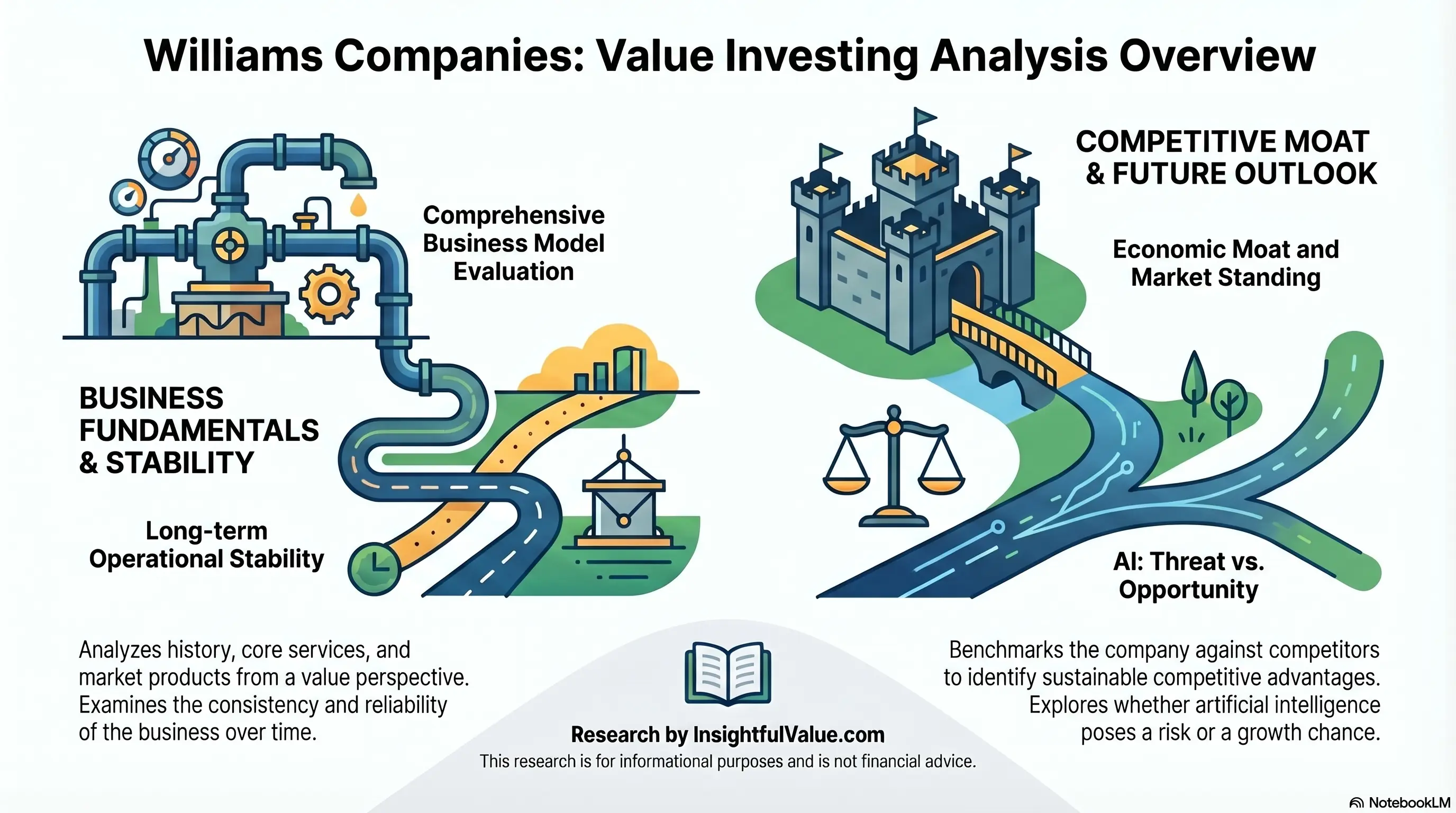
Infographic
Overview
The Williams Companies, Inc. is an American energy company headquartered in Tulsa, Oklahoma. The company was founded in 1908 as a pipeline construction company and has since expanded to become a leading provider of natural gas infrastructure. It operates three main business segments: Williams Partners, Williams NGL & Petchem Services, and Williams Northeast G&P. Williams Partners is the company’s largest segment and focuses on the transportation, storage, and processing of natural gas and natural gas liquids. This segment operates over 30,000 miles of pipelines, storage facilities, and other related assets across the United States. Williams NGL & Petchem Services offers gathering, processing, and fractionation services, as well as marketing and trading of natural gas liquids. This segment also provides services to ethylene producers for the conversion of NGLs into ethylene. The Williams Northeast G&P segment provides gathering, processing, and transportation services for natural gas in the northeastern United States, including the Marcellus and Utica shale regions. The Williams Companies is committed to being a responsible and sustainable energy company, with a focus on safety, environmental stewardship, and community engagement. It has also made strides in renewable energy, with a goal of reducing its carbon intensity by 56% by 2030. The company has a significant presence in the energy industry and employs over 5,000 people. It is publicly traded on the New York Stock Exchange under the ticker symbol WMB.
How to explain to a 10 year old kid about the company?
AI has the potential to impact various aspects of the Williams Companies’ operations, products, and competitive positioning, though the nature of that impact can vary. 1. Substitution: AI technologies can lead to the development of alternative energy solutions, such as advanced battery systems or new methods of energy storage, which might compete with traditional natural gas and energy services offered by Williams. However, the nature of the energy market often requires infrastructure and reliability that emerging technologies may not yet provide. 2. Disintermediation: The use of AI could streamline operations, allowing for more direct interactions between producers and consumers in the energy sector. For Williams, this might mean re-evaluating its role in the value chain. However, given the complexities of natural gas transportation and storage, it is less likely that disintermediation will significantly undermine their position in the near term. 3. Margin Pressure: AI can drive efficiencies in operations, potentially leading to cost reductions for companies that successfully integrate AI solutions. This could intensify competition, as companies with more advanced AI capabilities could offer lower prices or enhanced services, creating margin pressure on Williams. If competitors effectively utilize AI for predictive maintenance, operational efficiency, or customer engagement, it may force Williams to invest more in technology or adapt its pricing strategies. Overall, while AI presents challenges and potential disruptions, the specific threats it poses to Williams Companies depend on various factors, including the pace of technological adoption, regulatory changes, and shifts in consumer preference towards alternative energy solutions. The company may need to strategically leverage AI to enhance its competitive positioning and address any threats that arise.
Sensitivity to interest rates
The sensitivity of Williams Companies’ earnings, cash flow, and valuation to changes in interest rates can be understood through several key factors. 1. Cost of Debt: Williams Companies relies on debt financing for its operations and capital projects. If interest rates rise, the cost of servicing existing debt increases, leading to higher interest expenses. This can directly impact net earnings and cash flow, as a larger portion of profits may be allocated to interest payments rather than reinvestment or distribution to shareholders. 2. Capital Expenditures: The company frequently engages in capital-intensive projects. Higher interest rates can increase the cost of new financing needs, making it more expensive to fund growth initiatives. This can result in lower future cash flows if projects become less economically viable or if the company decides to scale back its capital spending. 3. Valuation Impact: Interest rates play a crucial role in the discount rate used in financial models to value the company. Higher interest rates can lead to a higher discount rate, which in turn can reduce the present value of future cash flows. This can lead to a decrease in the company’s market valuation as investors adjust their expectations based on the increased cost of capital. 4. Investor Sentiment: Changes in interest rates can influence investor sentiment and overall market conditions. When rates rise, investors may shift their focus toward fixed-income investments, reducing the attractiveness of equities, including those in the energy sector, which can further affect the stock’s performance and overall valuations. Overall, Williams Companies’ financial metrics are quite sensitive to changes in interest rates, impacting both its operational costs and market valuation.
👉 InsightfulValue is a platform for public company analysis.
👉 We provide a database of public companies, with a focus on value investing principles.
👉 We carefully select every company in our database. With only 1853 listed, there's a reason for that.
👉 The reason is simple – we only select the best-performing public companies, true champions. And we know exactly what we mean by "champion."
👉 For us, a champion is a company with strong finances, a history of impressive dividends, great management, and standout products or services. We mean it.
👉 For each company, we have 663 questions and answers covering every aspect of their market position and operations. Everything.
👉 ... plus additional 164 Q&A about the industry each company operates in.
InsightfulValue is an independent platform dedicated to value investing research. The information provided on this website is for informational and educational purposes only and does not constitute financial, investment, tax, or legal advice. We are not financial advisors, investment consultants, or licensed consultants. Our analyses, insights, and criteria are based on principles learned from renowned value investors such as Benjamin Graham, Warren Buffett, and Charlie Munger, but they should not be considered personalized investment recommendations. Investing in financial markets carries risks, and past performance is not indicative of future results. Users of this website should conduct their own due diligence and consult with a qualified professional before making any financial or investment decisions. InsightfulValue assumes no liability for any financial losses or decisions made based on the information provided on this site. By using this website, you acknowledge and accept that all investments involve risk and that InsightfulValue does not guarantee any financial outcomes.