The content provided in this video is for informational and educational purposes only. It does not constitute financial advice, investment recommendations, or an offer to buy or sell any securities. All views expressed are those of InsightfulValue and are based on publicly available information believed to be reliable, but no guarantee is made as to its accuracy or completeness. Always conduct your own research or consult a licensed financial advisor before making any investment decisions. Investing in the stock market involves risks, including the loss of principal.
Please be aware that the stock prices displayed on this website represent a curated selection of data. On desktop devices, you will see a wider range of stock prices, while on mobile devices, we provide a more streamlined view for better user experience and readability.
Our focus is on assessing a company's overall value and performance, rather than analyzing price fluctuations, even if we do watch prices in order to find companies trading below their intrinsic value. For more detailed charting and comprehensive market analysis, we recommend consulting a professional financial service or utilizing advanced charting tools.
We strive to provide accurate and timely information, but we encourage you to verify any financial data before making investment decisions.
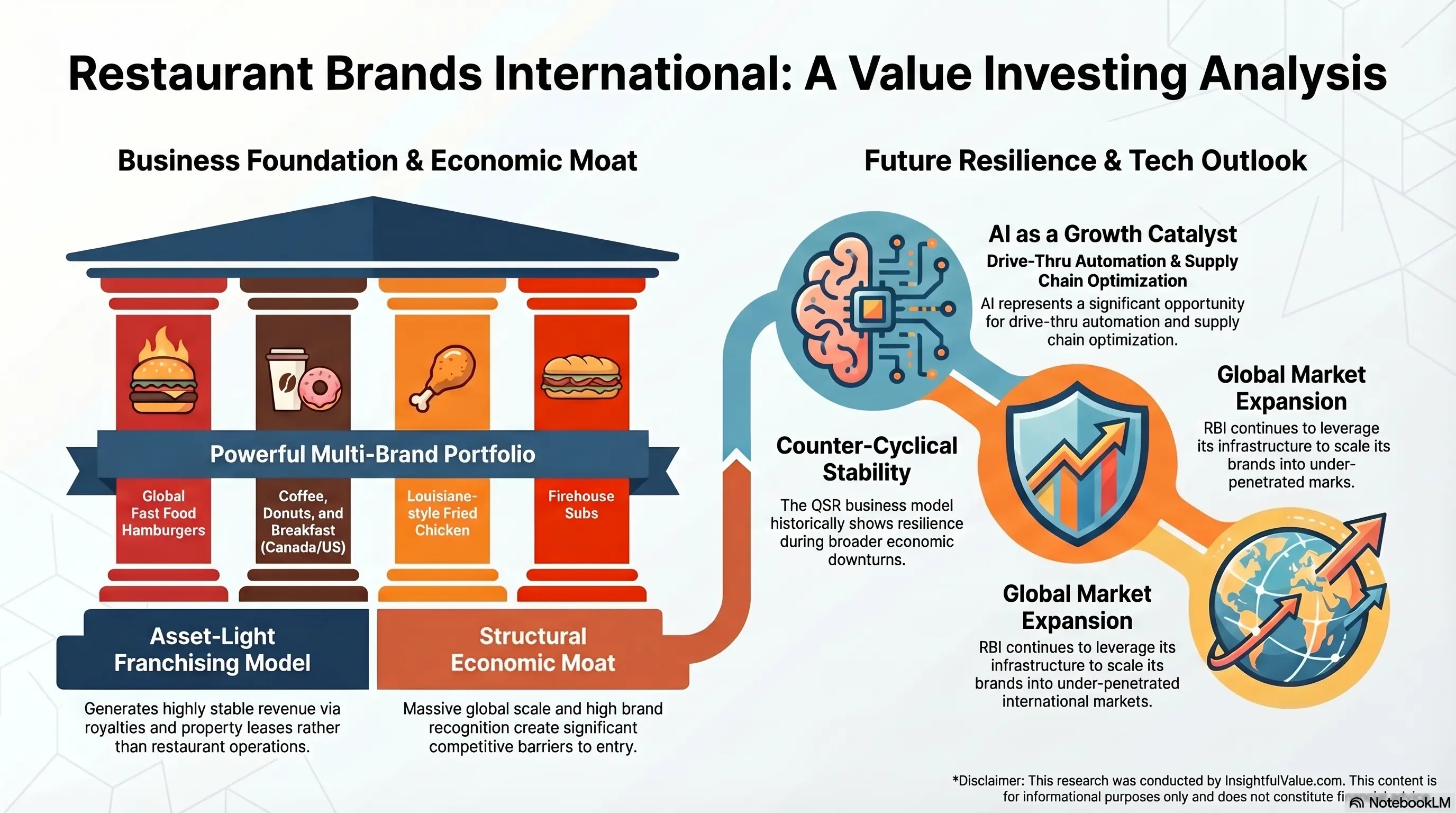
Infographic
Overview
Restaurant Brands International is a multinational fast food holding company that owns a portfolio of popular fast food chains including Burger King, Tim Hortons, and Popeyes. The company was formed in 2014 after Burger King's acquisition of Canadian coffee chain Tim Hortons. In 2017, Restaurant Brands International acquired Popeyes, adding another popular brand to their portfolio. The company is headquartered in Toronto, Canada and operates over 27,000 restaurants in more than 100 countries around the world. Restaurant Brands International is publicly traded on the New York Stock Exchange and the Toronto Stock Exchange. Burger King, Tim Hortons, and Popeyes are all known for their respective menus of burgers, coffee and baked goods, and fried chicken. Each brand operates independently, with its own menu, marketing, and management team. However, Restaurant Brands International oversees the overall strategy and direction of the company. In addition to its core brands, Restaurant Brands International also has a strong focus on international expansion and continues to open new restaurants in new markets. The company also prioritizes sustainability and social responsibility, implementing initiatives such as sustainable sourcing practices and community involvement programs.
How to explain to a 10 year old kid about the company?
📈 Want to read more about Restaurant Brands International?
Artificial intelligence (AI) can indeed pose a material threat to Restaurant Brands International (RBI) in several ways, including substitution, disintermediation, and margin pressure. 1. Substitution: AI-driven solutions, such as meal delivery services and automated kitchen technologies, could alter consumer choices. For example, advances in AI may lead to the rise of virtual restaurants or meal kits that use AI for personalized menu recommendations, potentially drawing customers away from traditional fast-food chains. If consumers find more convenience or better value through AI-enhanced dining options, RBI’s products may face direct competition from these substitutes. 2. Disintermediation: Technology can enable consumers to bypass traditional restaurant service models. For instance, AI-powered apps and platforms might allow customers to order meals directly from kitchen facilities that don’t have the overhead of physical locations. This shift could weaken the reliance on traditional outlets and make it more challenging for RBI to maintain its market presence. Additionally, partnerships with delivery services that employ AI for logistics and route optimization could further disrupt traditional distribution channels. 3. Margin Pressure: AI can lead to more efficient operations, but it could also heighten competition, driving down prices across the fast-food and quick-service restaurant sector. If competitors employ AI to improve service speed, reduce costs, or optimize their supply chains effectively, RBI may feel pressured to follow suit. Implementing AI solutions can also require significant upfront investment, which could strain margins in the short term. Moreover, if competitors leverage AI advancements to offer lower-priced alternatives or superior customer experiences, RBI could face eroded profit margins. In summary, while AI offers opportunities for operational efficiency, it also highlights potential risks to RBI, including the emergence of substitutes, shifts in consumer behavior, and increased competition that could affect overall profitability. The company must strategically embrace AI to stay competitive while managing these potential threats effectively.
Sensitivity to interest rates
The sensitivity of Restaurant Brands International’s earnings, cash flow, and valuation to changes in interest rates can be analyzed through several key factors: 1. Debt Levels: If Restaurant Brands International carries significant debt, increased interest rates can elevate interest expenses, thus reducing net earnings and cash flow. Higher rates may make refinancing more costly and limit financial flexibility. 2. Consumer Spending: Rising interest rates often lead to decreased consumer spending due to higher borrowing costs and decreased disposable income. For a company like Restaurant Brands, which relies on consumer discretionary spending, this could negatively impact sales and revenue. 3. Valuation Impact: Higher interest rates typically lead to higher discount rates used in valuation models. As the cost of capital increases, the present value of future cash flows decreases, potentially lowering the overall valuation of the company. 4. Cost of Capital: With interest rate hikes, the cost of equity may also rise, impacting investment decisions. If the company needs to finance growth initiatives or acquisitions, higher costs may deter such moves, affecting future growth prospects. 5. Operational Leverage: If Restaurant Brands International has high operational leverage, a decrease in sales due to interest rate-induced consumer spending cuts could disproportionately affect profitability. Overall, while the exact sensitivity will depend on the specific context of the company’s financial structure and economic conditions, it is clear that changes in interest rates can materially affect Restaurant Brands International’s earnings, cash flow, and valuation.
Resilience to the future changes
📈 Want to read more about Restaurant Brands International?
👉 InsightfulValue is a platform for public company analysis.
👉 We provide a database of public companies, with a focus on value investing principles.
👉 We carefully select every company in our database. With only 1853 listed, there's a reason for that.
👉 The reason is simple – we only select the best-performing public companies, true champions. And we know exactly what we mean by "champion."
👉 For us, a champion is a company with strong finances, a history of impressive dividends, great management, and standout products or services. We mean it.
👉 For each company, we have 663 questions and answers covering every aspect of their market position and operations. Everything.
👉 ... plus additional 164 Q&A about the industry each company operates in.
InsightfulValue is an independent platform dedicated to value investing research. The information provided on this website is for informational and educational purposes only and does not constitute financial, investment, tax, or legal advice. We are not financial advisors, investment consultants, or licensed consultants. Our analyses, insights, and criteria are based on principles learned from renowned value investors such as Benjamin Graham, Warren Buffett, and Charlie Munger, but they should not be considered personalized investment recommendations. Investing in financial markets carries risks, and past performance is not indicative of future results. Users of this website should conduct their own due diligence and consult with a qualified professional before making any financial or investment decisions. InsightfulValue assumes no liability for any financial losses or decisions made based on the information provided on this site. By using this website, you acknowledge and accept that all investments involve risk and that InsightfulValue does not guarantee any financial outcomes.