The content provided in this video is for informational and educational purposes only. It does not constitute financial advice, investment recommendations, or an offer to buy or sell any securities. All views expressed are those of InsightfulValue and are based on publicly available information believed to be reliable, but no guarantee is made as to its accuracy or completeness. Always conduct your own research or consult a licensed financial advisor before making any investment decisions. Investing in the stock market involves risks, including the loss of principal.
📊 Get full analytics about Western New England Bancorp
Please be aware that the stock prices displayed on this website represent a curated selection of data. On desktop devices, you will see a wider range of stock prices, while on mobile devices, we provide a more streamlined view for better user experience and readability.
Our focus is on assessing a company's overall value and performance, rather than analyzing price fluctuations, even if we do watch prices in order to find companies trading below their intrinsic value. For more detailed charting and comprehensive market analysis, we recommend consulting a professional financial service or utilizing advanced charting tools.
We strive to provide accurate and timely information, but we encourage you to verify any financial data before making investment decisions.
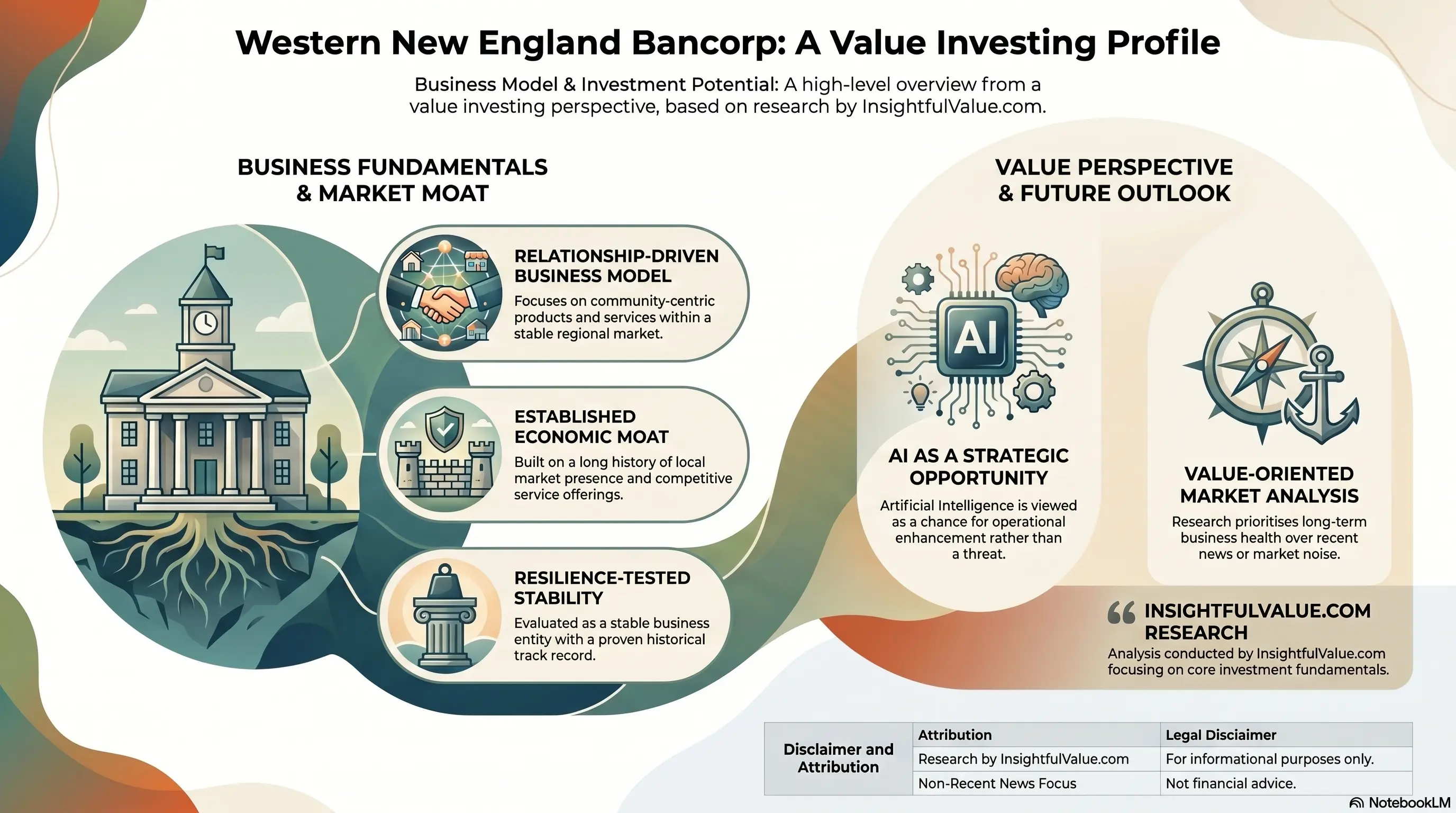
Infographic
Overview
Western New England Bancorp is a bank holding company that operates primarily through its subsidiary, Westfield Bank. The company is headquartered in Westfield, Massachusetts, and focuses on providing a variety of financial services to individuals and businesses in the region. Western New England Bancorp offers a range of products, including checking and savings accounts, loans (such as personal, mortgage, and commercial loans), and other banking services. The bank is known for its community-oriented approach, emphasizing customer service and local engagement. The institution operates several branches across Western Massachusetts, aiming to serve both urban and rural communities. Like many regional banks, it is committed to supporting economic development within its service area. In terms of financial performance, Western New England Bancorp has experienced moderate growth and stability, often reflecting the broader economic conditions in its operating territories. The company also emphasizes maintaining strong capital ratios and prudent risk management practices. For the most current information, including financial performance and strategic initiatives, it is advisable to refer to the company’s official website or recent financial filings.
How to explain to a 10 year old kid about the company?
📈 Want to read more about Western New England Bancorp?
AI has the potential to impact Western New England Bancorp’s products, services, and competitive positioning in several ways. 1. Substitution: AI technologies can create new financial products and services that may substitute traditional banking services offered by Western New England Bancorp. For instance, fintech companies are utilizing AI for automated wealth management, personalized financial advice, and lending, which could attract customers away from traditional banks. If these AI-driven offerings provide more convenience or better pricing, the bank might face significant competition. 2. Disintermediation: The rise of AI in the financial sector can lead to disintermediation, where consumers bypass traditional banks for direct services offered by fintech firms. For example, peer-to-peer lending platforms and robo-advisors use AI to connect lenders directly with borrowers or provide investment advice without the need for traditional banking intermediaries. This trend could reduce the volume of business that Western New England Bancorp currently engages in. 3. Margin Pressure: AI-driven efficiencies could pressure margins across the banking sector, as companies adopt technologies to reduce operational costs and enhance customer experiences. If Western New England Bancorp cannot keep pace with these advancements, it might struggle to maintain its competitive positioning, leading to reduced profitability. Furthermore, if competitors effectively leverage AI for enhanced services at lower costs, the bank may feel compelled to lower its prices to stay competitive, impacting overall margins. In summary, while AI does present potential threats through substitution, disintermediation, and margin pressure, the extent of these threats will depend on how effectively Western New England Bancorp can adapt to and integrate AI technologies into its own operations and product offerings.
Sensitivity to interest rates
Western New England Bancorp’s earnings, cash flow, and valuation are generally sensitive to changes in interest rates due to its operations as a financial institution primarily engaged in banking services. Here are some key factors to consider: 1. Interest Income: As a bank, a significant portion of the company’s revenue comes from interest earned on loans and investments. An increase in interest rates can lead to higher interest income from new loans and variable-rate loans, potentially boosting earnings. Conversely, if interest rates decrease, interest income may decline, negatively impacting earnings. 2. Cost of Funds: Changes in interest rates also affect the cost of funds for banks. If interest rates rise, the bank may face higher costs for deposits and borrowed funds. If these costs rise faster than the increase in interest income, it could squeeze profit margins and decrease net interest income, impacting overall earnings. 3. Loan Demand: Higher interest rates can negatively affect the demand for loans, as borrowers may be less inclined to take out loans or refinance existing loans at higher rates. This reduced demand can lead to lower loan volumes, further impacting the bank’s earnings and cash flows. 4. Asset-Backed Securities: If Western New England Bancorp holds a significant portfolio of fixed-rate assets, rising interest rates can lead to a decline in the market value of these securities. This can impact the company’s valuation metrics, as investors may adjust their expectations based on the effectiveness of the bank managing its interest rate risk. 5. Valuation Metrics: Interest rates influence the discount rate used in valuation models. Higher interest rates typically increase the discount rate, which can lower the present value of future cash flows and thus decrease the bank’s valuation. Conversely, lower interest rates tend to support higher valuations due to lower discount factors. 6. Regulatory Capital Requirements: Interest rate changes can also impact the regulatory capital ratios of the bank, as changes in asset valuations can affect the balance sheet. This can influence market perceptions and willingness to invest in or lend to the bank. In summary, Western New England Bancorp’s financial performance, cash flow, and overall valuation are closely linked to interest rate movements. Management’s ability to effectively navigate these changes and hedge interest rate risk will be crucial in maintaining profitability and shareholder value amidst fluctuating rates.
Resilience to the future changes
📈 Want to read more about Western New England Bancorp?
👉 InsightfulValue is a platform for public company analysis.
👉 We provide a database of public companies, with a focus on value investing principles.
👉 We carefully select every company in our database. With only 1855 listed, there's a reason for that.
👉 The reason is simple – we only select the best-performing public companies, true champions. And we know exactly what we mean by "champion."
👉 For us, a champion is a company with strong finances, a history of impressive dividends, great management, and standout products or services. We mean it.
👉 For each company, we have 663 questions and answers covering every aspect of their market position and operations. Everything.
👉 ... plus additional 164 Q&A about the industry each company operates in.
InsightfulValue is an independent platform dedicated to value investing research. The information provided on this website is for informational and educational purposes only and does not constitute financial, investment, tax, or legal advice. We are not financial advisors, investment consultants, or licensed consultants. Our analyses, insights, and criteria are based on principles learned from renowned value investors such as Benjamin Graham, Warren Buffett, and Charlie Munger, but they should not be considered personalized investment recommendations. Investing in financial markets carries risks, and past performance is not indicative of future results. Users of this website should conduct their own due diligence and consult with a qualified professional before making any financial or investment decisions. InsightfulValue assumes no liability for any financial losses or decisions made based on the information provided on this site. By using this website, you acknowledge and accept that all investments involve risk and that InsightfulValue does not guarantee any financial outcomes.