The content provided in this video is for informational and educational purposes only. It does not constitute financial advice, investment recommendations, or an offer to buy or sell any securities. All views expressed are those of InsightfulValue and are based on publicly available information believed to be reliable, but no guarantee is made as to its accuracy or completeness. Always conduct your own research or consult a licensed financial advisor before making any investment decisions. Investing in the stock market involves risks, including the loss of principal.
Please be aware that the stock prices displayed on this website represent a curated selection of data. On desktop devices, you will see a wider range of stock prices, while on mobile devices, we provide a more streamlined view for better user experience and readability.
Our focus is on assessing a company's overall value and performance, rather than analyzing price fluctuations, even if we do watch prices in order to find companies trading below their intrinsic value. For more detailed charting and comprehensive market analysis, we recommend consulting a professional financial service or utilizing advanced charting tools.
We strive to provide accurate and timely information, but we encourage you to verify any financial data before making investment decisions.
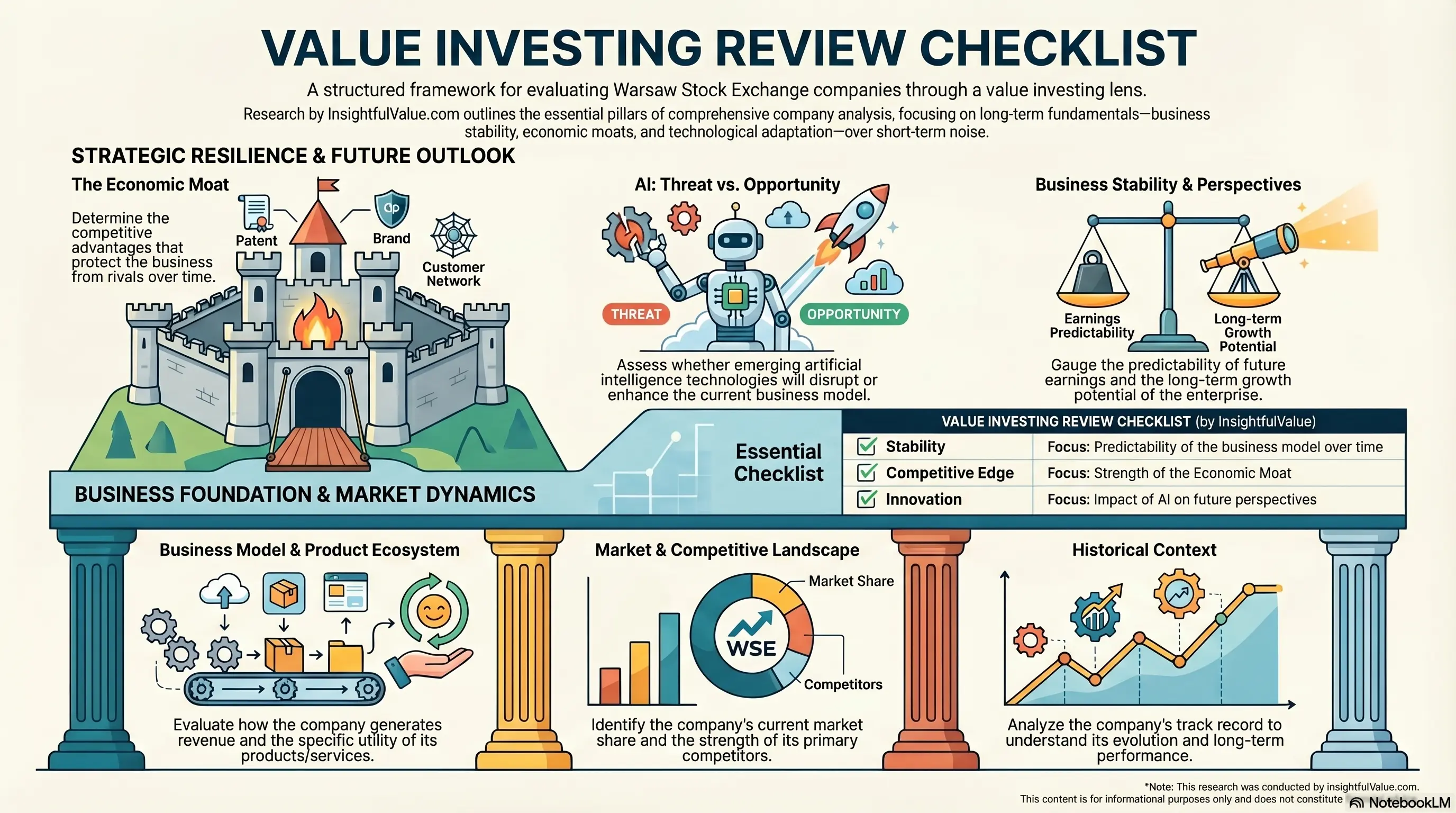
Infographic
Overview
when it was established and key milestones in its history: The Warsaw Stock Exchange (WSE) was established on April 12, 1991 following the transformation of the former Warsaw Commodity Exchange into a modern exchange. It was the first modern stock exchange in Poland and played a crucial role in the development of the Polish capital market. Some key milestones in the history of the WSE include: - The first trading session on April 16, 1991, with 5 listed companies and 9 brokerage houses participating - Launch of the WIG index on April 16, 1994, which serves as a benchmark for the performance of the Polish stock market - Introduction of electronic trading on the WSE in 1995, replacing the traditional trading floor - Privatization of the WSE in 1999, with the majority of shares sold to a group of private investors - Merger with the Warsaw Futures and Options Exchange in 2002, creating a multi-asset-class exchange offering trading in stocks, bonds, derivatives, and commodities - Launch of the NewConnect market in 2007 for small and medium-sized companies seeking capital - Introduction of the Catalyst market in 2009 for trading in corporate and municipal bonds - Obtaining full membership in the World Federation of Exchanges in 2010 - Launch of the TGE (Polish Power Exchange) in 2012 as a subsidiary of the WSE, offering trading in electricity and natural gas derivatives - Alliance formed in 2013 with the Vienna Stock Exchange to strengthen cooperation and cross-listing opportunities - Record high of 500 listed companies reached in 2015 - Strategic cooperation agreement signed with the Shanghai Stock Exchange in 2016, allowing for mutual promotion and market access - Introduction of the WSE Growth market in 2017 for smaller companies with high growth potential - Implementation of a new IT trading platform in 2018 to increase efficiency and attract more foreign investors - Launch of the Catalyst+ market in 2019 to provide access to capital for large and medium-sized enterprises - Record high of 770 billion PLN in market capitalization reached in August 2020.
How to explain to a 10 year old kid about the company?
AI can pose a material threat to the Warsaw Stock Exchange and its associated companies in several ways: 1. Substitution: AI technologies enable the development of alternative trading platforms and products that can automate trading decisions, analyze market trends, and optimize investment strategies more efficiently than traditional methods. As these AI-driven solutions become more accessible, they could attract traders away from conventional exchanges, potentially undermining the Warsaw Stock Exchange’s market share. 2. Disintermediation: AI’s ability to facilitate direct trading between buyers and sellers can lead to disintermediation. This means that companies may no longer rely on the services of traditional exchanges for transactions, opting instead for decentralized platforms powered by AI algorithms. This shift could erode the traditional roles and fees associated with exchanges, impacting their revenue streams. 3. Margin Pressure: The implementation of AI can lead to increased competition by lowering operational costs for financial services and firms. Enhanced algorithmic trading enabled by AI can drive down trading costs, which could result in pressures on the margins of traditional services offered by the Warsaw Stock Exchange. If competitors leverage AI effectively, they might be able to offer lower fees and better services, potentially reducing the exchange’s profitability. Overall, the integration and advancement of AI technologies present significant challenges that could disrupt the traditional operational framework of the Warsaw Stock Exchange and necessitate strategic adaptations to remain competitive.
Sensitivity to interest rates
The sensitivity of a company’s earnings, cash flow, and valuation to changes in interest rates can vary significantly based on several factors, including the industry, the company’s capital structure, and its overall financial health. 1. Earnings Sensitivity: Companies with significant amounts of debt are typically more sensitive to interest rate changes because higher interest rates can increase borrowing costs, leading to reduced profit margins. Conversely, companies with low or no debt may be less affected, as their cost of financing remains stable. Additionally, firms in interest-sensitive sectors, such as real estate and utilities, may see more pronounced impacts on their earnings due to changes in demand and financing conditions tied to interest rates. 2. Cash Flow Sensitivity: Cash flow can also be significantly affected by interest rate changes. Higher interest rates can lead to increased interest expenses, impacting cash flows negatively. In contrast, if a company can pass on increased costs to consumers through price increases, it may mitigate the impact on cash flow. Companies that rely heavily on credit for their operations may experience cash flow issues if rates rise, while those with stable cash flows may weather the changes better. 3. Valuation Sensitivity: Valuation, often assessed through discounted cash flow (DCF) models, is directly influenced by interest rates. Higher rates increase the discount rate applied to future cash flows, leading to lower present values and thus, lower valuations. Conversely, lower interest rates reduce the discount rate, increasing valuations. This effect is particularly pronounced in growth companies, which rely on future cash flows for their current valuations. Market sentiment can also shift based on interest rate expectations, influencing stock prices. In summary, companies listed on the Warsaw Stock Exchange, like those elsewhere, experience varying degrees of sensitivity in earnings, cash flow, and valuation to changes in interest rates. The specific impact depends on their financial structures, the economic environment, and the sectors they operate in.
👉 InsightfulValue is a platform for public company analysis.
👉 We provide a database of public companies, with a focus on value investing principles.
👉 We carefully select every company in our database. With only 1855 listed, there's a reason for that.
👉 The reason is simple – we only select the best-performing public companies, true champions. And we know exactly what we mean by "champion."
👉 For us, a champion is a company with strong finances, a history of impressive dividends, great management, and standout products or services. We mean it.
👉 For each company, we have 663 questions and answers covering every aspect of their market position and operations. Everything.
👉 ... plus additional 164 Q&A about the industry each company operates in.
InsightfulValue is an independent platform dedicated to value investing research. The information provided on this website is for informational and educational purposes only and does not constitute financial, investment, tax, or legal advice. We are not financial advisors, investment consultants, or licensed consultants. Our analyses, insights, and criteria are based on principles learned from renowned value investors such as Benjamin Graham, Warren Buffett, and Charlie Munger, but they should not be considered personalized investment recommendations. Investing in financial markets carries risks, and past performance is not indicative of future results. Users of this website should conduct their own due diligence and consult with a qualified professional before making any financial or investment decisions. InsightfulValue assumes no liability for any financial losses or decisions made based on the information provided on this site. By using this website, you acknowledge and accept that all investments involve risk and that InsightfulValue does not guarantee any financial outcomes.