The content provided in this video is for informational and educational purposes only. It does not constitute financial advice, investment recommendations, or an offer to buy or sell any securities. All views expressed are those of InsightfulValue and are based on publicly available information believed to be reliable, but no guarantee is made as to its accuracy or completeness. Always conduct your own research or consult a licensed financial advisor before making any investment decisions. Investing in the stock market involves risks, including the loss of principal.
Please be aware that the stock prices displayed on this website represent a curated selection of data. On desktop devices, you will see a wider range of stock prices, while on mobile devices, we provide a more streamlined view for better user experience and readability.
Our focus is on assessing a company's overall value and performance, rather than analyzing price fluctuations, even if we do watch prices in order to find companies trading below their intrinsic value. For more detailed charting and comprehensive market analysis, we recommend consulting a professional financial service or utilizing advanced charting tools.
We strive to provide accurate and timely information, but we encourage you to verify any financial data before making investment decisions.
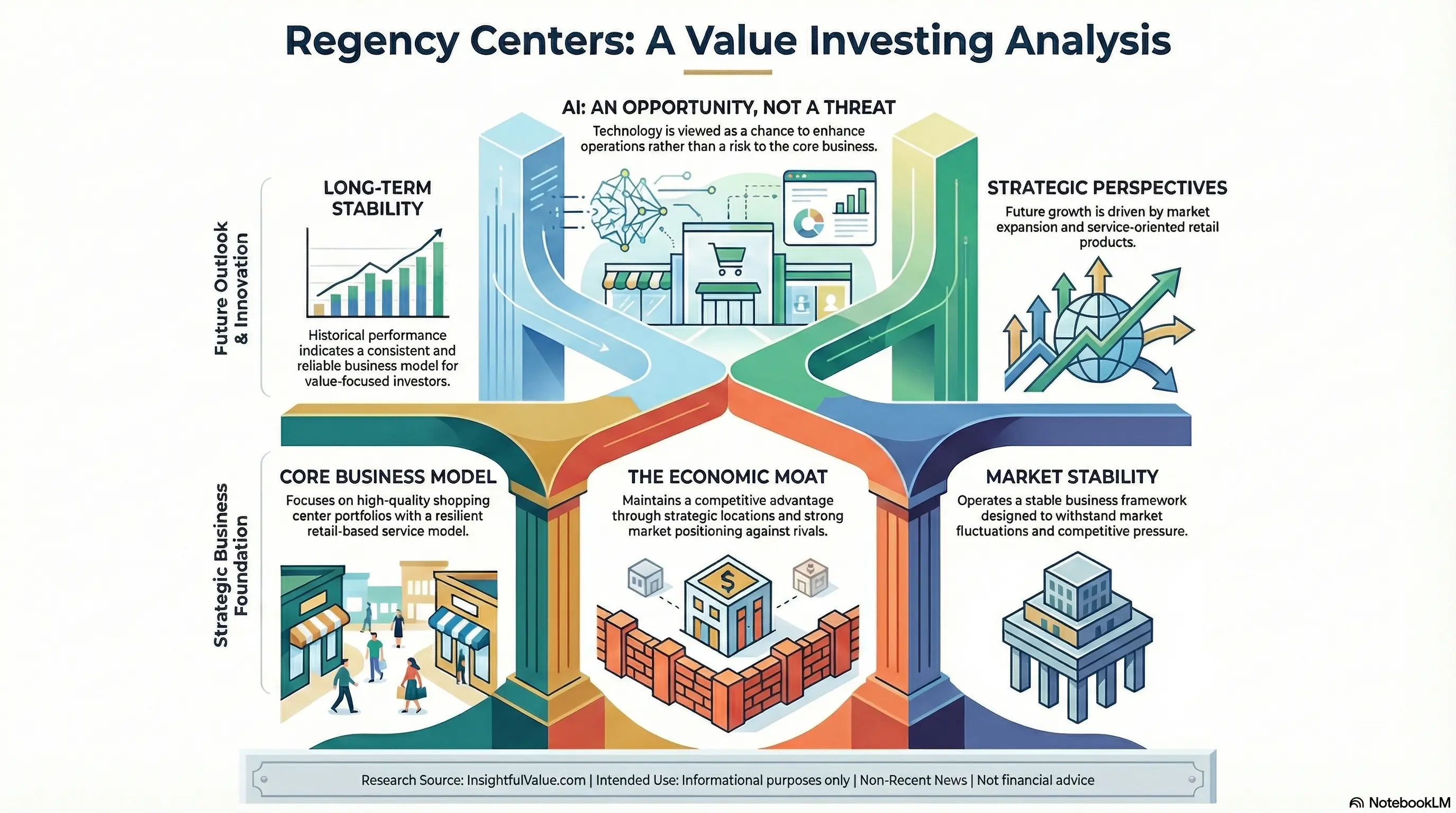
Infographic
Overview
Regency Centers is a real estate investment trust (REIT) company that specializes in the acquisition, development, and management of shopping centers in affluent and densely populated areas in the United States. The company was founded in 1963 in Jacksonville, Florida, by Martin and Joan Connor as a small development firm. In the 1970s, the company focused on building neighborhood and community shopping centers in the Southeast, and expanded into regional malls in the 1980s. In 1993, the company became a publicly traded REIT and shifted its focus again to neighborhood and community shopping centers in major metropolitan areas. This strategy proved successful and by 2000, Regency Centers became the largest owner and operator of grocery-anchored shopping centers in the country. In the mid-2000s, Regency Centers began to diversify its portfolio by including mixed-use developments and outdoor lifestyle centers. Today, the company owns and operates over 400 properties across 28 states, with a total market value of over $16 billion. Regency Centers has a strong commitment to sustainability and has implemented several green initiatives in its properties, including energy efficiency programs, recycling efforts, and LEED certification for new developments. In addition to its real estate operations, Regency Centers is also involved in community outreach and philanthropy. The company has a charitable foundation, Regency Cares, which supports various causes and organizations in the communities where they operate. Overall, Regency Centers has built a reputation as a leader in the shopping center industry, with a focus on creating high-quality, sustainable, and community-focused properties.
How to explain to a 10 year old kid about the company?
AI could pose certain threats to Regency Centers’ products, services, and competitive positioning, although the impact may vary based on the nature of the company’s offerings and market environment. 1. Substitution: AI-driven technologies may lead to new forms of retail or shopping experiences, such as virtual reality shopping or fully automated online platforms. If consumers shift towards these alternatives, traditional shopping centers may face reduced foot traffic and demand for retail spaces. This can indirectly affect Regency Centers if tenants struggle to attract customers. 2. Disintermediation: AI can streamline various processes and services, reducing the need for intermediaries. For Regency Centers, this could mean potential challenges if property management or leasing processes become more automated or simpler through AI solutions. Tenants might find new ways to connect with customers directly, bypassing traditional retail spaces and impacting occupancy rates. 3. Margin Pressure: If AI leads to more efficient operations for competitors, they may be able to offer better pricing or improved customer experiences, putting pressure on Regency Centers to reduce their own operational costs or enhance their service offerings. Additionally, if AI transforms marketing, customer engagement, and logistics, Regency Centers may need to invest significantly in technology to remain competitive, which could compress margins. In summary, while AI presents potential threats to Regency Centers’ business model, the actual impact will depend on how effectively the company adapts to these changes and embraces technology in its operations.
Sensitivity to interest rates
The sensitivity of Regency Centers’ earnings, cash flow, and valuation to changes in interest rates can be significant due to the nature of its business as a real estate investment trust (REIT) focusing on shopping centers and retail properties. 1. Earnings Sensitivity: Regency Centers’ earnings can be affected by interest rate fluctuations, particularly if the company has variable-rate debt. An increase in interest rates could lead to higher interest expenses, thereby reducing net income. Additionally, higher interest rates might lead to reduced consumer spending, which could impact the tenants’ performance and, in turn, the rental income. 2. Cash Flow Sensitivity: Cash flows from operations (CFO) may also be sensitive to interest rate changes. If interest rates rise, refinancing existing debt could become more expensive, which could reduce available cash flows. Conversely, if interest rates decline, the cost of borrowing could decrease, improving cash flow positions. Furthermore, if higher rates lead to decreased consumer spending, there could be an impact on tenant sales and ultimately on rent payments. 3. Valuation Sensitivity: The valuation of Regency Centers is closely tied to discount rates and capitalization rates used in property valuations. Rising interest rates typically increase these rates, leading to a lower present value of future cash flows derived from property investments. This could diminish the market capitalization of the REIT. Investors may require higher returns in a higher interest rate environment, causing a downward adjustment in property values. Overall, while Regency Centers is well-positioned in the retail sector, fluctuations in interest rates can significantly affect its earnings, cash flow, and overall valuation due to the interconnectedness of financing costs, consumer spending behavior, and investment risk assessments.
👉 InsightfulValue is a platform for public company analysis.
👉 We provide a database of public companies, with a focus on value investing principles.
👉 We carefully select every company in our database. With only 1853 listed, there's a reason for that.
👉 The reason is simple – we only select the best-performing public companies, true champions. And we know exactly what we mean by "champion."
👉 For us, a champion is a company with strong finances, a history of impressive dividends, great management, and standout products or services. We mean it.
👉 For each company, we have 663 questions and answers covering every aspect of their market position and operations. Everything.
👉 ... plus additional 164 Q&A about the industry each company operates in.
InsightfulValue is an independent platform dedicated to value investing research. The information provided on this website is for informational and educational purposes only and does not constitute financial, investment, tax, or legal advice. We are not financial advisors, investment consultants, or licensed consultants. Our analyses, insights, and criteria are based on principles learned from renowned value investors such as Benjamin Graham, Warren Buffett, and Charlie Munger, but they should not be considered personalized investment recommendations. Investing in financial markets carries risks, and past performance is not indicative of future results. Users of this website should conduct their own due diligence and consult with a qualified professional before making any financial or investment decisions. InsightfulValue assumes no liability for any financial losses or decisions made based on the information provided on this site. By using this website, you acknowledge and accept that all investments involve risk and that InsightfulValue does not guarantee any financial outcomes.