The content provided in this video is for informational and educational purposes only. It does not constitute financial advice, investment recommendations, or an offer to buy or sell any securities. All views expressed are those of InsightfulValue and are based on publicly available information believed to be reliable, but no guarantee is made as to its accuracy or completeness. Always conduct your own research or consult a licensed financial advisor before making any investment decisions. Investing in the stock market involves risks, including the loss of principal.
Please be aware that the stock prices displayed on this website represent a curated selection of data. On desktop devices, you will see a wider range of stock prices, while on mobile devices, we provide a more streamlined view for better user experience and readability.
Our focus is on assessing a company's overall value and performance, rather than analyzing price fluctuations, even if we do watch prices in order to find companies trading below their intrinsic value. For more detailed charting and comprehensive market analysis, we recommend consulting a professional financial service or utilizing advanced charting tools.
We strive to provide accurate and timely information, but we encourage you to verify any financial data before making investment decisions.
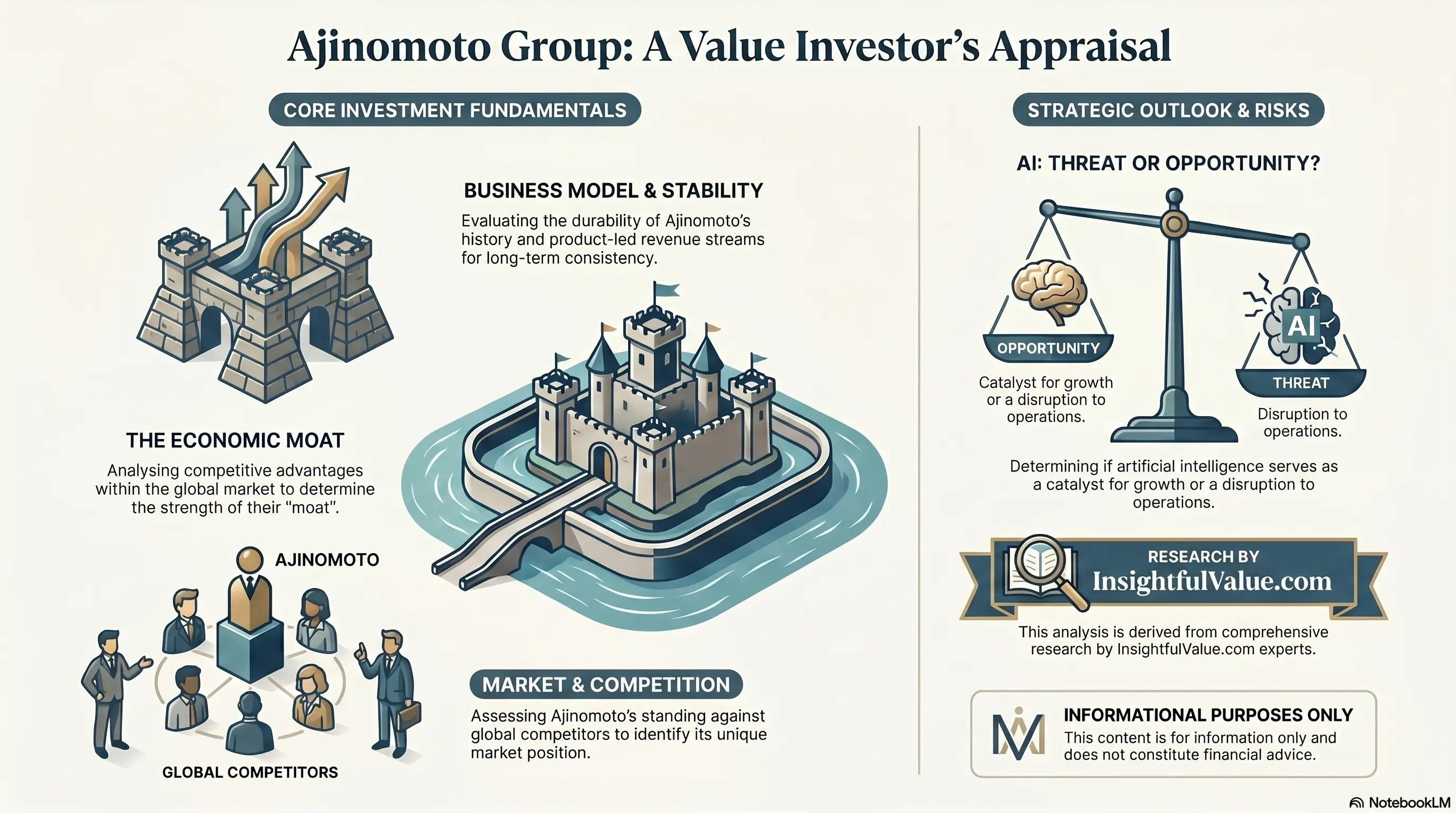
Infographic
Overview
Ajinomoto Co., Inc. is a global food and chemical company based in Japan. It is one of the world’s largest producers of amino acids, including monosodium glutamate (MSG) and other food and nutrition products. Founded in 1909, the company’s name is derived from the Japanese words for taste (aji) and sugar (no moto). Its goal is to enhance people’s daily lives through the creation of delicious and healthy food. Ajinomoto has subsidiaries and affiliates in 35 countries and regions, and its products are sold in over 130 countries. The company’s main business segments include Food Products, Amino Acids, Pharmaceuticals, and Other Businesses. Its food products range from seasoning and instant meals to frozen foods and beverages. Some of its popular products include AJI-NO-MOTO seasoning, Gourmet Seasoning Sazón, and Hondashi broth. Ajinomoto is also a leader in the production of amino acids for use in food, pharmaceuticals, and industrial applications. Its pharmaceutical division develops and sells drugs and diagnostic reagents, as well as clinical testing and other diagnostic services. In addition to its core businesses, Ajinomoto has also expanded into the healthcare and wellness market. It offers nutrition and supplement products under the brand names Calorie Mate and Amino Vital, as well as functional ingredients for cosmetics and personal care products. The company prioritizes sustainability and social responsibility, with initiatives to reduce its environmental impact, promote diversity and inclusion, and engage in philanthropic activities. It has also established a global food and nutrition research institute to promote innovative and healthy food solutions. Overall, Ajinomoto is a diversified company with a strong commitment to providing high-quality food and products to improve the lives of people around the world.
How to explain to a 10 year old kid about the company?
AI can indeed pose a material threat to Ajinomoto’s products, services, or competitive positioning through various mechanisms such as substitution, disintermediation, and margin pressure. 1. Substitution: As AI technology continues to advance, it may lead to the development of alternative ingredients or synthetic substitutes for traditional products like flavor enhancers, seasonings, and even amino acids. If companies utilize AI to create more cost-effective and efficient alternatives, it could diminish demand for Ajinomoto’s core products. 2. Disintermediation: AI and advancements in food technology may enable consumers or businesses to bypass traditional distribution channels. For instance, AI could facilitate direct-to-consumer sales models or allow users to customize flavors or products using AI-enabled home devices, reducing the need for established suppliers like Ajinomoto in the sales chain. 3. Margin Pressure: The integration of AI into supply chain management, production processes, and predictive analytics could enable competitors to operate with lower costs and greater efficiency. If competitors implement AI solutions that drive down production costs, it could create margin pressure for Ajinomoto, forcing them to lower prices or invest heavily in technology to remain competitive. Overall, while AI presents opportunities for innovation and efficiency, it also carries risks that could affect Ajinomoto’s market position and financial health if not proactively managed.
Sensitivity to interest rates
The sensitivity of Ajinomoto’s earnings, cash flow, and valuation to changes in interest rates can be analyzed through several factors: 1. Earnings: Changes in interest rates can impact Ajinomoto’s cost of capital. If interest rates rise, the company’s borrowing costs become more expensive, which may reduce net income. Additionally, higher interest rates can lead to decreased consumer spending as borrowing becomes more costly, potentially leading to lower sales growth. Conversely, if interest rates fall, the cost of debt decreases, which could enhance profitability. 2. Cash Flow: Ajinomoto’s cash flow is influenced by its financing activities. Rising interest rates can increase cash outflows related to interest payments on debt, negatively affecting free cash flow. This situation could limit available funds for operational expansion or dividends. On the other hand, lower interest rates can improve cash flow by reducing interest expenses, allowing more cash to be reinvested in the business or returned to shareholders. 3. Valuation: Ajinomoto’s valuation is often based on discounted cash flows (DCF). Higher interest rates lead to a higher discount rate, which reduces the present value of future cash flows and can lower the company’s valuation. In contrast, if interest rates decline, the discounted cash flows become more valuable, potentially increasing the company’s valuation. Overall, while Ajinomoto is primarily a consumer goods company with stable cash flows, raises or cuts in interest rates can still significantly impact its financial metrics and investor perceptions, particularly if those changes affect overall economic conditions and consumer demand.
👉 InsightfulValue is a platform for public company analysis.
👉 We provide a database of public companies, with a focus on value investing principles.
👉 We carefully select every company in our database. With only 1853 listed, there's a reason for that.
👉 The reason is simple – we only select the best-performing public companies, true champions. And we know exactly what we mean by "champion."
👉 For us, a champion is a company with strong finances, a history of impressive dividends, great management, and standout products or services. We mean it.
👉 For each company, we have 663 questions and answers covering every aspect of their market position and operations. Everything.
👉 ... plus additional 164 Q&A about the industry each company operates in.
InsightfulValue is an independent platform dedicated to value investing research. The information provided on this website is for informational and educational purposes only and does not constitute financial, investment, tax, or legal advice. We are not financial advisors, investment consultants, or licensed consultants. Our analyses, insights, and criteria are based on principles learned from renowned value investors such as Benjamin Graham, Warren Buffett, and Charlie Munger, but they should not be considered personalized investment recommendations. Investing in financial markets carries risks, and past performance is not indicative of future results. Users of this website should conduct their own due diligence and consult with a qualified professional before making any financial or investment decisions. InsightfulValue assumes no liability for any financial losses or decisions made based on the information provided on this site. By using this website, you acknowledge and accept that all investments involve risk and that InsightfulValue does not guarantee any financial outcomes.