The content provided in this video is for informational and educational purposes only. It does not constitute financial advice, investment recommendations, or an offer to buy or sell any securities. All views expressed are those of InsightfulValue and are based on publicly available information believed to be reliable, but no guarantee is made as to its accuracy or completeness. Always conduct your own research or consult a licensed financial advisor before making any investment decisions. Investing in the stock market involves risks, including the loss of principal.
Please be aware that the stock prices displayed on this website represent a curated selection of data. On desktop devices, you will see a wider range of stock prices, while on mobile devices, we provide a more streamlined view for better user experience and readability.
Our focus is on assessing a company's overall value and performance, rather than analyzing price fluctuations, even if we do watch prices in order to find companies trading below their intrinsic value. For more detailed charting and comprehensive market analysis, we recommend consulting a professional financial service or utilizing advanced charting tools.
We strive to provide accurate and timely information, but we encourage you to verify any financial data before making investment decisions.
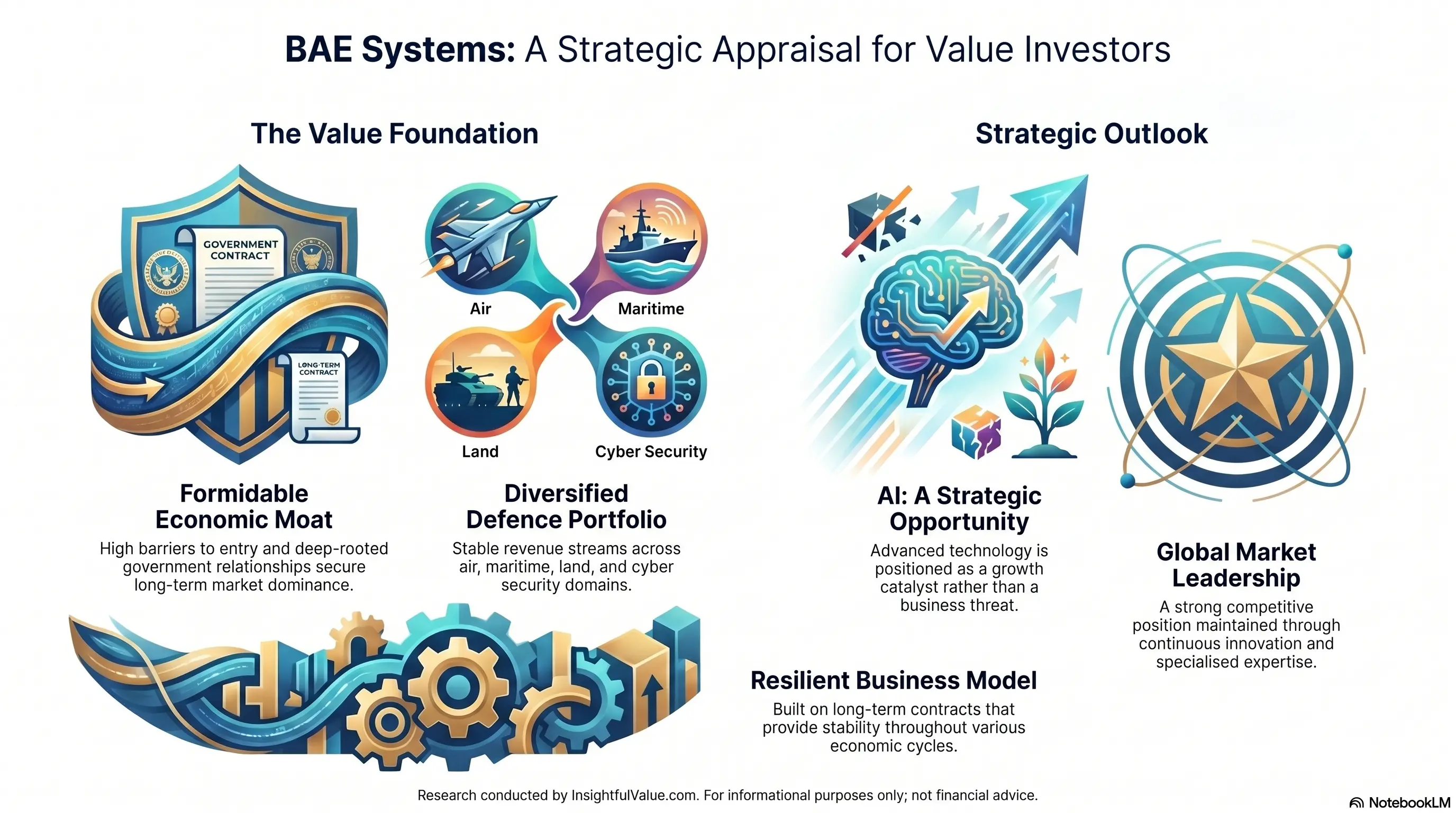
Infographic
Overview
BAE Systems is a global defense, aerospace, and security company headquartered in London, England. It was formed in 1999 through the merger of British Aerospace (BAe) and Marconi Electronic Systems (MES). BAE Systems designs, develops, manufactures, and supports military aircraft, weapons systems, and electronics. It also offers a wide range of land, sea, and cyber solutions for both military and commercial customers. As of 2021, BAE Systems has operations in over 40 countries and employs around 90,000 people globally. It is one of the largest defense contractors in the world, with its main customers being the United Kingdom and United States governments. BAE Systems is also involved in joint ventures with other major defense companies, including Airbus and Leonardo. History of BAE Systems BAE Systems can trace its roots back to several historic companies that have played significant roles in the development of British aviation and defense. The roots of British Aerospace can be traced back to 1910 when the first aircraft manufacturing company in Britain, The British Aircraft Company, was established. Over the years, the company went through various mergers and acquisitions, resulting in the formation of British Aerospace as a nationalized company in 1977. In 1999, British Aerospace merged with Marconi Electronic Systems (formerly GEC-Marconi) to form BAE Systems. This merger brought together the aircraft, naval, and electronic capabilities of both companies and positioned BAE Systems as one of the world's leading defense and aerospace companies. Since its formation, BAE Systems has continued to grow and expand its offerings through strategic acquisitions and partnerships. In recent years, the company has increased its focus on emerging technologies, such as autonomous systems, artificial intelligence, and cyber security. Products and services As a global defense and aerospace company, BAE Systems offers a wide range of products and services in the following areas: 1. Aircraft: BAE Systems designs, develops, and manufactures advanced military aircraft, including fighter jets, trainers, and unmanned aerial vehicles (UAVs). Its flagship products include the Typhoon fighter jet, F-35 Lightning II aircraft, and Hawk trainer jet. 2. Land and Armaments: BAE Systems provides a variety of land systems and weapons, such as armored vehicles, artillery systems, and munitions, to customers around the world. It also offers specialized services in vehicle maintenance, upgrade, and support. 3. Maritime: BAE Systems designs and manufactures naval ships, submarines, and weapons systems. It also provides integration, support, and modernization services for naval fleets worldwide. 4. Electronics and Cyber: BAE Systems provides advanced electronic systems and solutions for military and commercial applications. This includes communication systems, radar and sensor technology, and cyber security solutions. 5. Services and Support: BAE Systems offers a range of post-delivery services, including maintenance, repair, overhaul, and logistics support for its products. It also provides training, modernization, and support services for defense and security systems. Global presence BAE Systems has a strong global presence, with operations in over 40 countries and partnerships and joint ventures in many others. Its main markets are in the United States and United Kingdom, but the company also has a significant presence in Australia, Saudi Arabia, and other countries in Europe and the Middle East. In the United States, BAE Systems is one of the largest defense contractors, working closely with the U.S. Department of Defense on a range of programs. In the United Kingdom, BAE Systems plays a critical role in supporting the country's armed forces and partnering with other defense and technology companies to deliver advanced capabilities. Community involvement and ethical practices BAE Systems is committed to being a responsible corporate citizen and upholds high standards of ethical business practices. The company supports various charitable organizations and initiatives in the areas of education, veterans, and STEM (science, technology, engineering, math) education. BAE Systems also has a comprehensive Code of Conduct and a strong commitment to sustainability, diversity, and inclusion. The company strives to create a work environment where all employees feel valued and included, and it has received recognition for its efforts in these areas.
How to explain to a 10 year old kid about the company?
AI can potentially pose a material threat to BAE Systems in several ways, affecting its products, services, and competitive positioning. Here are a few considerations: 1. Substitution: AI technologies could lead to the development of new defense systems and solutions that replace traditional platforms offered by BAE Systems. For instance, advancements in autonomous systems, drone technology, and AI-enhanced decisiomaking could provide alternatives to conventional military hardware. If competitors successfully integrate AI into their products, they could offer enhanced capabilities that might attract customers away from BAE Systems. 2. Disintermediation: The increasing use of AI in defense and security may lead to a shift in supply chains and procurement processes. Companies leveraging AI might streamline operations, allowing them to bypass traditional intermediaries or contractors that BAE Systems typically relies on. This could reduce BAE’s relevance in certain markets or project opportunities, particularly if clients seek more direct, cost-effective solutions. 3. Margin Pressure: As the defense industry increasingly adopts AI-driven technologies, there might be intense competition around pricing and performance. If new entrants or existing competitors leverage AI to reduce costs and improve efficiency, BAE Systems could face pressure to lower its prices to remain competitive. Additionally, growing capabilities in AI could enable competitors to deliver projects faster and at a reduced expense, thereby squeezing the margins of traditional defense contractors. 4. Emerging Threats: AI’s evolving nature could also result in emerging threats to security and defense strategies. For example, adversaries might use AI for cyberattacks, drone swarms, or other advanced weaponry that could undermine current defense technologies developed by BAE Systems. The company would need to adapt continually to counter these developing threats, which could strain resources and focus on innovation. In conclusion, while AI presents opportunities for BAE Systems to enhance its offerings, it also poses significant challenges that could affect its market position, profitability, and relevance in the rapidly changing landscape of defense technologies. The company would need to strategically invest in AI capabilities and innovate continually to mitigate these potential threats.
Sensitivity to interest rates
BAE Systems’ sensitivity to changes in interest rates can be analyzed through its earnings, cash flow, and overall valuation. 1. Earnings Sensitivity: BAE Systems’ earnings may be impacted by interest rates primarily through its cost of debt. If interest rates rise, the cost of borrowing increases, which can lead to higher expenses if the company has significant debt. This could potentially reduce net earnings. Additionally, if interest rates affect government budgets or defense spending, it could influence revenue, particularly since a substantial portion of BAE’s contracts are with government entities. 2. Cash Flow Sensitivity: Changes in interest rates can affect BAE Systems’ cash flow in a few ways. An increase in interest rates may lead to higher interest payments on variable-rate debt, reducing free cash flow. Conversely, higher interest rates might also result in larger returns on cash reserves, potentially increasing cash flow in that area. Furthermore, cash flow can be affected by the timing of government contracts and associated payments, which may fluctuate with economic conditions influenced by interest rates. 3. Valuation Sensitivity: The valuation of BAE Systems is typically assessed using discounted cash flow (DCF) analysis, where future cash flows are discounted back to their present value using a discount rate that often reflects current interest rates. A rise in interest rates generally increases the discount rate, which can diminish the present value of future cash flows, potentially leading to a lower valuation. Additionally, higher interest rates can impact market sentiment toward equities, affecting overall valuation multiples. In summary, BAE Systems’ earnings, cash flow, and valuation are all sensitive to changes in interest rates, primarily through the effects on cost of debt, government spending, and discounted cash flow calculations. The magnitude of this sensitivity would depend on the company’s leverage, the nature of its contracts, and the broader economic environment.
👉 InsightfulValue is a platform for public company analysis.
👉 We provide a database of public companies, with a focus on value investing principles.
👉 We carefully select every company in our database. With only 1853 listed, there's a reason for that.
👉 The reason is simple – we only select the best-performing public companies, true champions. And we know exactly what we mean by "champion."
👉 For us, a champion is a company with strong finances, a history of impressive dividends, great management, and standout products or services. We mean it.
👉 For each company, we have 663 questions and answers covering every aspect of their market position and operations. Everything.
👉 ... plus additional 164 Q&A about the industry each company operates in.
InsightfulValue is an independent platform dedicated to value investing research. The information provided on this website is for informational and educational purposes only and does not constitute financial, investment, tax, or legal advice. We are not financial advisors, investment consultants, or licensed consultants. Our analyses, insights, and criteria are based on principles learned from renowned value investors such as Benjamin Graham, Warren Buffett, and Charlie Munger, but they should not be considered personalized investment recommendations. Investing in financial markets carries risks, and past performance is not indicative of future results. Users of this website should conduct their own due diligence and consult with a qualified professional before making any financial or investment decisions. InsightfulValue assumes no liability for any financial losses or decisions made based on the information provided on this site. By using this website, you acknowledge and accept that all investments involve risk and that InsightfulValue does not guarantee any financial outcomes.