The content provided in this video is for informational and educational purposes only. It does not constitute financial advice, investment recommendations, or an offer to buy or sell any securities. All views expressed are those of InsightfulValue and are based on publicly available information believed to be reliable, but no guarantee is made as to its accuracy or completeness. Always conduct your own research or consult a licensed financial advisor before making any investment decisions. Investing in the stock market involves risks, including the loss of principal.
Please be aware that the stock prices displayed on this website represent a curated selection of data. On desktop devices, you will see a wider range of stock prices, while on mobile devices, we provide a more streamlined view for better user experience and readability.
Our focus is on assessing a company's overall value and performance, rather than analyzing price fluctuations, even if we do watch prices in order to find companies trading below their intrinsic value. For more detailed charting and comprehensive market analysis, we recommend consulting a professional financial service or utilizing advanced charting tools.
We strive to provide accurate and timely information, but we encourage you to verify any financial data before making investment decisions.
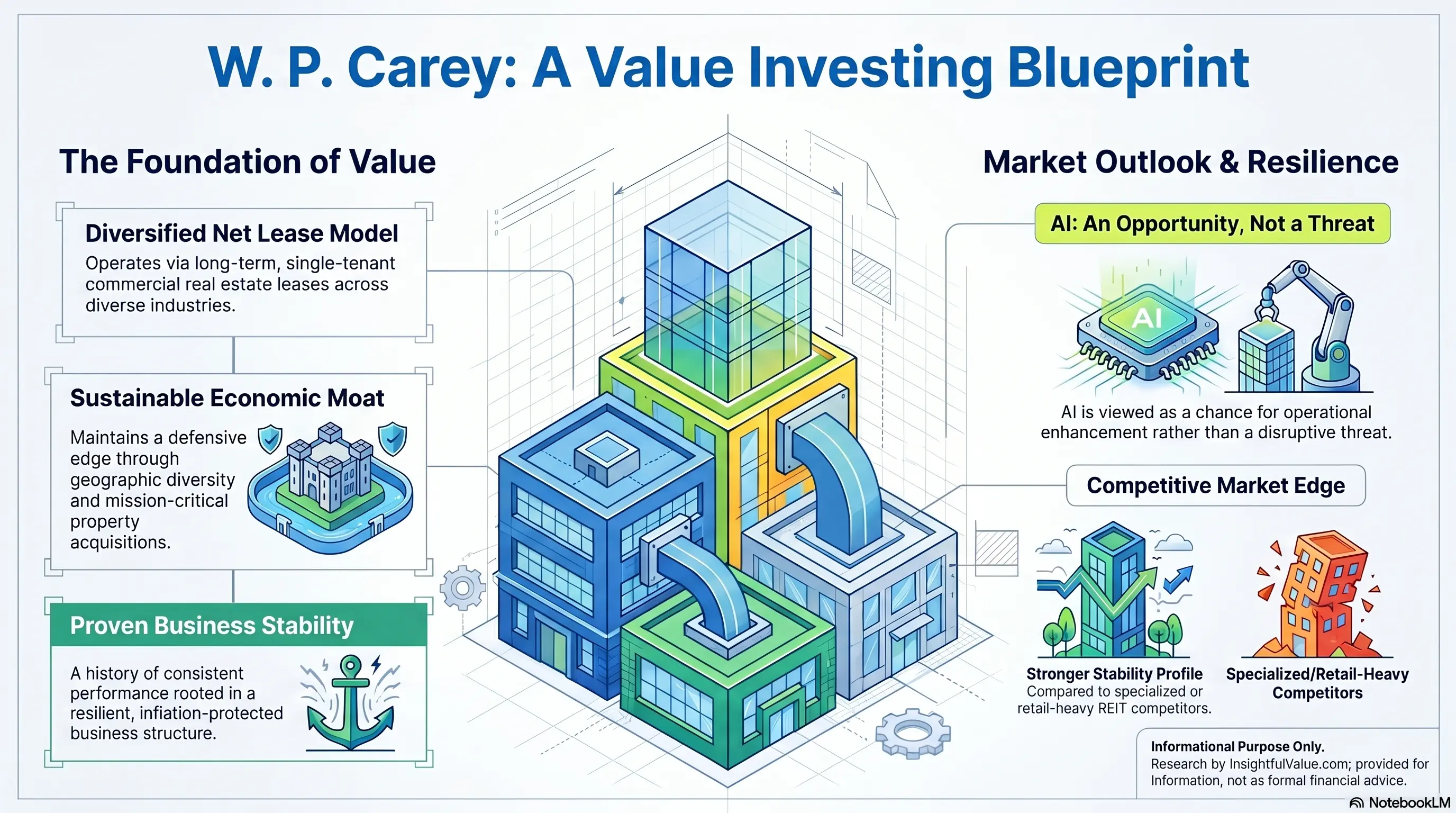
Infographic
Overview
The W. P. Carey company is a global real estate investment trust (REIT) that owns and manages a diverse portfolio of income-generating properties. It was founded in 1973 by entrepreneur William Polk Carey and is headquartered in New York City. The company primarily focuses on investing in commercial real estate properties, such as office buildings, industrial facilities, retail centers, and self-storage facilities. The W. P. Carey company is structured as a REIT, meaning it must distribute at least 90% of its taxable income to shareholders in the form of dividends. This structure allows the company to avoid corporate taxes and instead pass along a majority of its profits to investors. The company's investment strategy is based on acquiring high-quality, income-producing properties with long-term leases to creditworthy tenants. This approach helps to provide stable and predictable cash flows for the company and its shareholders. Some key facts about the W. P. Carey company include: - It is listed on the New York Stock Exchange under the ticker symbol WPC. - As of 2021, the company has a market capitalization of over $13 billion. - The company has a global presence, with investments in North America, Europe, and the Asia-Pacific region. - W. P. Carey has a long history of paying consistent dividends, with 114 consecutive quarterly increases and a track record of increasing dividends for 24 consecutive years. In addition to its core real estate business, the W. P. Carey company also provides asset management services to institutional investors and manages publicly traded non-traded REITs. In summary, the W. P. Carey company is a leading global REIT that specializes in investing in income-generating properties and offering stable dividends to its shareholders.
How to explain to a 10 year old kid about the company?
The W. P. Carey company, known for its real estate investment trust (REIT) model and its focus on net lease properties, may face various challenges related to AI, but the extent of the threat would depend on several factors. 1. Substitution: AI could lead to the development of new technologies or platforms that change the way real estate transactions are conducted. For instance, advancements in virtual reality and AI-driven analytics can enhance property assessment processes and streamline transactions. However, since W. P. Carey specializes in long-term net leases, the immediate risk of complete substitution might be limited, although the company would need to adapt to any changes in how investors and tenants make decisions. 2. Disintermediation: The rise of AI could facilitate direct transactions between property owners and tenants, potentially reducing the role of traditional intermediaries, including REITs. If customers find AI-enabled platforms that allow them to bypass REITs for investment or leasing decisions, W. P. Carey could face challenges in attracting investors and tenants. However, the advantages of a professionally managed REIT, such as stability, risk diversification, and expert management, may mitigate this threat significantly. 3. Margin Pressure: AI’s ability to optimize operations, reduce costs, and enhance decisiomaking could result in increased competition. If competitors leverage AI to improve efficiency or offer better pricing models, W. P. Carey may feel margin pressure as it competes to maintain its market share. The company would need to invest in technology and process improvements to stay competitive, which could impact short-term profitability. In summary, while AI poses potential risks through substitution, disintermediation, and margin pressure, W. P. Carey’s established model and strategies can help mitigate these threats. The company will need to stay vigilant and adapt to technological advancements to maintain its competitive positioning in the evolving real estate landscape.
Sensitivity to interest rates
The sensitivity of W. P. Carey Inc.’s earnings, cash flow, and valuation to changes in interest rates can be categorized into several key areas: 1. Earnings Sensitivity: W. P. Carey is a real estate investment trust (REIT) that primarily invests in commercial properties under long-term net leases. Its earnings can be sensitive to interest rate changes because higher rates can increase the cost of borrowing. If the company needs to finance acquisitions or refinance existing debt, higher interest rates may lead to increased expenses, directly impacting net income. Additionally, if interest rates rise significantly, it could dampen demand for real estate investments, potentially leading to lower rental income or property valuations. 2. Cash Flow Sensitivity: The cash flow of W. P. Carey may also be affected by interest rate fluctuations. Increased interest rates can raise the cost of debt, leading to higher interest payments. This could reduce cash flows available for distribution to shareholders, which is crucial for REITs as they are required to distribute a significant portion of their taxable income as dividends. Furthermore, if rising interest rates cause tenants to face financial challenges, this could lead to increased vacancy rates or rent reductions, further impacting cash flows. 3. Valuation Sensitivity: The valuation of W. P. Carey is influenced by investor perceptions about risk and return in the real estate market. Higher interest rates generally lead to higher discount rates used in discounted cash flow models, which can lower the present value of future cash flows. For REITs, this can affect their market capitalization and share prices. If investors view the rising interest rates as indicative of a stronger economy, it might lead to a mixed impact on valuations depending on how the underlying properties and tenants perform. In summary, W. P. Carey’s earnings, cash flow, and valuation are sensitive to changes in interest rates due to the effects on borrowing costs, rental income stability, and investor perceptions regarding risk and return. As interest rates rise, the potential negative impacts on these financial metrics require close monitoring by investors and management.
👉 InsightfulValue is a platform for public company analysis.
👉 We provide a database of public companies, with a focus on value investing principles.
👉 We carefully select every company in our database. With only 1853 listed, there's a reason for that.
👉 The reason is simple – we only select the best-performing public companies, true champions. And we know exactly what we mean by "champion."
👉 For us, a champion is a company with strong finances, a history of impressive dividends, great management, and standout products or services. We mean it.
👉 For each company, we have 663 questions and answers covering every aspect of their market position and operations. Everything.
👉 ... plus additional 164 Q&A about the industry each company operates in.
InsightfulValue is an independent platform dedicated to value investing research. The information provided on this website is for informational and educational purposes only and does not constitute financial, investment, tax, or legal advice. We are not financial advisors, investment consultants, or licensed consultants. Our analyses, insights, and criteria are based on principles learned from renowned value investors such as Benjamin Graham, Warren Buffett, and Charlie Munger, but they should not be considered personalized investment recommendations. Investing in financial markets carries risks, and past performance is not indicative of future results. Users of this website should conduct their own due diligence and consult with a qualified professional before making any financial or investment decisions. InsightfulValue assumes no liability for any financial losses or decisions made based on the information provided on this site. By using this website, you acknowledge and accept that all investments involve risk and that InsightfulValue does not guarantee any financial outcomes.