The content provided in this video is for informational and educational purposes only. It does not constitute financial advice, investment recommendations, or an offer to buy or sell any securities. All views expressed are those of InsightfulValue and are based on publicly available information believed to be reliable, but no guarantee is made as to its accuracy or completeness. Always conduct your own research or consult a licensed financial advisor before making any investment decisions. Investing in the stock market involves risks, including the loss of principal.
Please be aware that the stock prices displayed on this website represent a curated selection of data. On desktop devices, you will see a wider range of stock prices, while on mobile devices, we provide a more streamlined view for better user experience and readability.
Our focus is on assessing a company's overall value and performance, rather than analyzing price fluctuations, even if we do watch prices in order to find companies trading below their intrinsic value. For more detailed charting and comprehensive market analysis, we recommend consulting a professional financial service or utilizing advanced charting tools.
We strive to provide accurate and timely information, but we encourage you to verify any financial data before making investment decisions.
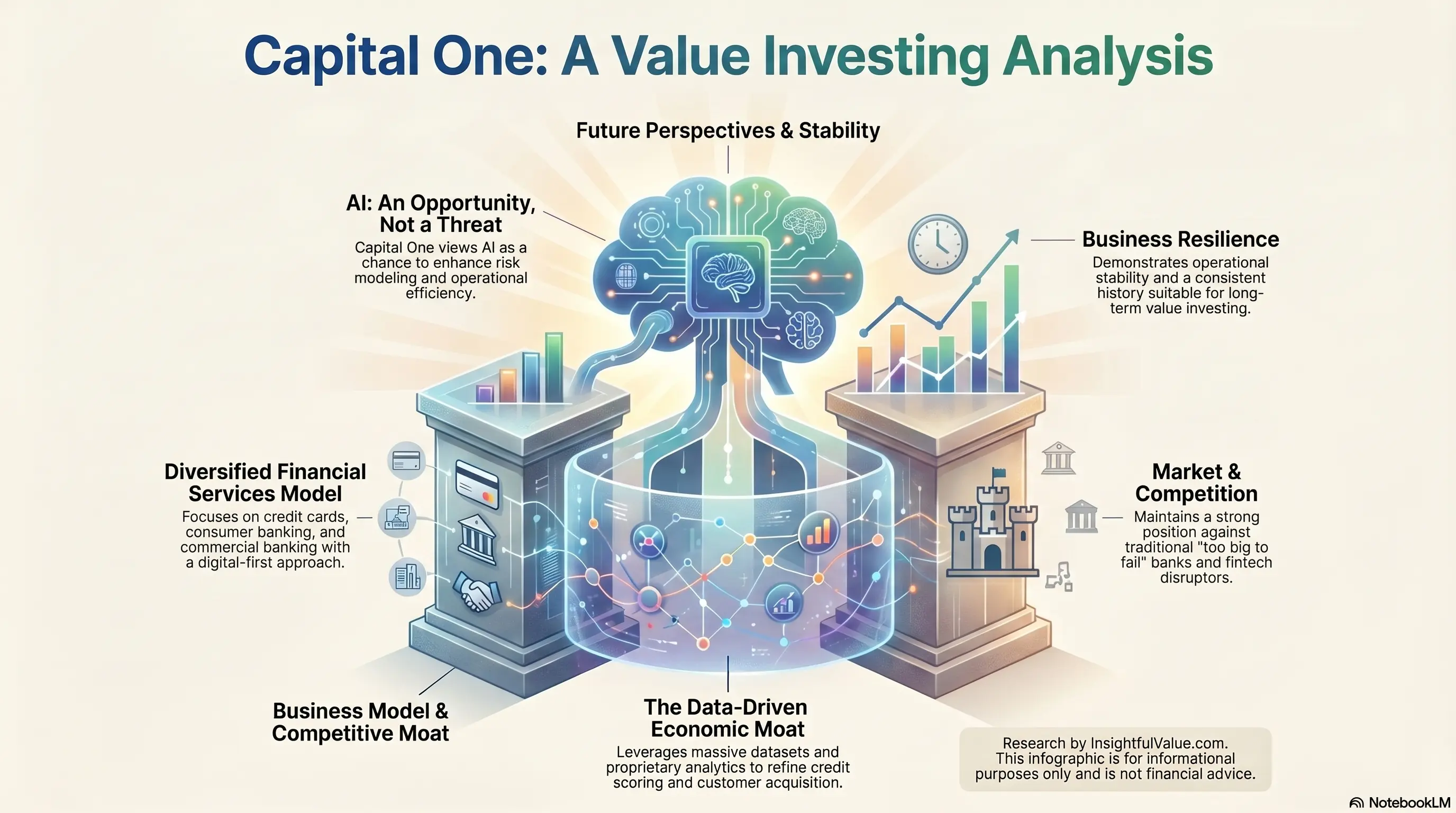
Infographic
Overview
and its products Capital One Financial Corporation is a diversified financial services company and one of the largest banks in the United States. The company offers a wide range of financial products and services to consumers, small businesses, and commercial clients. Established in 1994, Capital One is based in McLean, Virginia and operates primarily in the United States, Canada, and the United Kingdom. The company has over 750 branches and 2,000 ATMs across the US, as well as online and mobile banking services. Products and services offered by Capital One include credit cards, personal loans, auto loans, mortgages, and savings and checking accounts. The company also provides commercial lending and treasury management services to businesses. Capital One is known for its innovation and customer-centric approach, offering a range of rewards and benefits on their credit cards and other products. The company also offers financial education and resources for its customers to help them manage their finances. In addition to its financial products and services, Capital One is involved in philanthropy and community initiatives, including providing support for small businesses and financial education programs. Overall, Capital One is a reputable and well-established company that offers a variety of financial solutions for individuals and businesses. Its commitment to innovation and customer service makes it a popular choice for many consumers.
How to explain to a 10 year old kid about the company?
AI can pose certain threats to Capital One Financial’s products, services, and competitive positioning, primarily through substitution, disintermediation, and margin pressure. 1. Substitution: AI-driven financial technology companies, often referred to as FinTech, can develop innovative solutions that may substitute traditional banking services. For example, AI can enhance personal finance management through apps that analyze spending habits and provide budgeting advice, thereby substituting conventional financial advisory services. If Capital One does not adapt to these trends, it risks losing customers to more agile, tech-savvy competitors. 2. Disintermediation: The rise of AI-powered platforms can facilitate direct transactions between consumers and service providers, bypassing traditional banks like Capital One. For instance, peer-to-peer lending and blockchain technology could enable consumers to access loans without going through a bank, which would disrupt Capital One’s traditional revenue streams from loan origination and servicing. 3. Margin Pressure: The deployment of AI can lower operational costs for financial services, leading to increased competition and tighter margins. If competitors adopt AI to streamline their operations and reduce costs, Capital One may be pressured to lower its own fees or interest rates, affecting profitability. Furthermore, AI in decisiomaking processes can allow competitors to offer more attractive products quickly, which could erode Capital One’s market share. In summary, while AI presents opportunities for Capital One to enhance its offerings, it also introduces significant risks related to substitution, disintermediation, and margin pressure that the company must navigate carefully to maintain its competitive position.
Sensitivity to interest rates
Capital One Financial’s earnings, cash flow, and valuation are notably sensitive to changes in interest rates due to its business model as a diversified bank primarily focused on credit cards, auto loans, banking products, and other financial services. 1. Earnings Sensitivity: Changes in interest rates directly affect Capital One’s earnings through net interest income, which is the difference between the interest income generated from loans and the interest paid on deposits. When interest rates rise, the bank can charge higher rates on loans, potentially boosting earnings. Conversely, if rates fall, earnings may decline as the interest income decreases. Additionally, rate changes can influence loan demand and overall credit quality, affecting charge-off rates and provision for loan losses. 2. Cash Flow Sensitivity: Cash flow is similarly impacted by interest rate fluctuations. Higher interest rates can lead to increased cash inflows through higher loan interest payments, which positively affect operating cash flows. However, if higher rates lead to reduced consumer borrowing or defaults, this could negatively impact cash flows. Moreover, changes in interest rates can influence the bank’s funding costs, impacting liquidity and cash flow management. 3. Valuation Sensitivity: Valuation is affected by interest rates due to their impact on discount rates used in financial modeling. Rising interest rates typically lead to higher discount rates, which can decrease the present value of future cash flows, potentially lowering the bank’s overall valuation. Additionally, interest rates affect market sentiment and investor expectations for growth, which can alter the bank’s price-to-earnings ratios and other valuation metrics. In summary, interest rate changes can have pronounced effects on Capital One’s earnings, cash flow, and valuation, making the bank sensitive to monetary policy shifts and economic conditions. The degree of sensitivity will also depend on the overall economic environment, competitive conditions, and management strategies in response to rate changes.
👉 InsightfulValue is a platform for public company analysis.
👉 We provide a database of public companies, with a focus on value investing principles.
👉 We carefully select every company in our database. With only 1853 listed, there's a reason for that.
👉 The reason is simple – we only select the best-performing public companies, true champions. And we know exactly what we mean by "champion."
👉 For us, a champion is a company with strong finances, a history of impressive dividends, great management, and standout products or services. We mean it.
👉 For each company, we have 663 questions and answers covering every aspect of their market position and operations. Everything.
👉 ... plus additional 164 Q&A about the industry each company operates in.
InsightfulValue is an independent platform dedicated to value investing research. The information provided on this website is for informational and educational purposes only and does not constitute financial, investment, tax, or legal advice. We are not financial advisors, investment consultants, or licensed consultants. Our analyses, insights, and criteria are based on principles learned from renowned value investors such as Benjamin Graham, Warren Buffett, and Charlie Munger, but they should not be considered personalized investment recommendations. Investing in financial markets carries risks, and past performance is not indicative of future results. Users of this website should conduct their own due diligence and consult with a qualified professional before making any financial or investment decisions. InsightfulValue assumes no liability for any financial losses or decisions made based on the information provided on this site. By using this website, you acknowledge and accept that all investments involve risk and that InsightfulValue does not guarantee any financial outcomes.