The content provided in this video is for informational and educational purposes only. It does not constitute financial advice, investment recommendations, or an offer to buy or sell any securities. All views expressed are those of InsightfulValue and are based on publicly available information believed to be reliable, but no guarantee is made as to its accuracy or completeness. Always conduct your own research or consult a licensed financial advisor before making any investment decisions. Investing in the stock market involves risks, including the loss of principal.
Please be aware that the stock prices displayed on this website represent a curated selection of data. On desktop devices, you will see a wider range of stock prices, while on mobile devices, we provide a more streamlined view for better user experience and readability.
Our focus is on assessing a company's overall value and performance, rather than analyzing price fluctuations, even if we do watch prices in order to find companies trading below their intrinsic value. For more detailed charting and comprehensive market analysis, we recommend consulting a professional financial service or utilizing advanced charting tools.
We strive to provide accurate and timely information, but we encourage you to verify any financial data before making investment decisions.
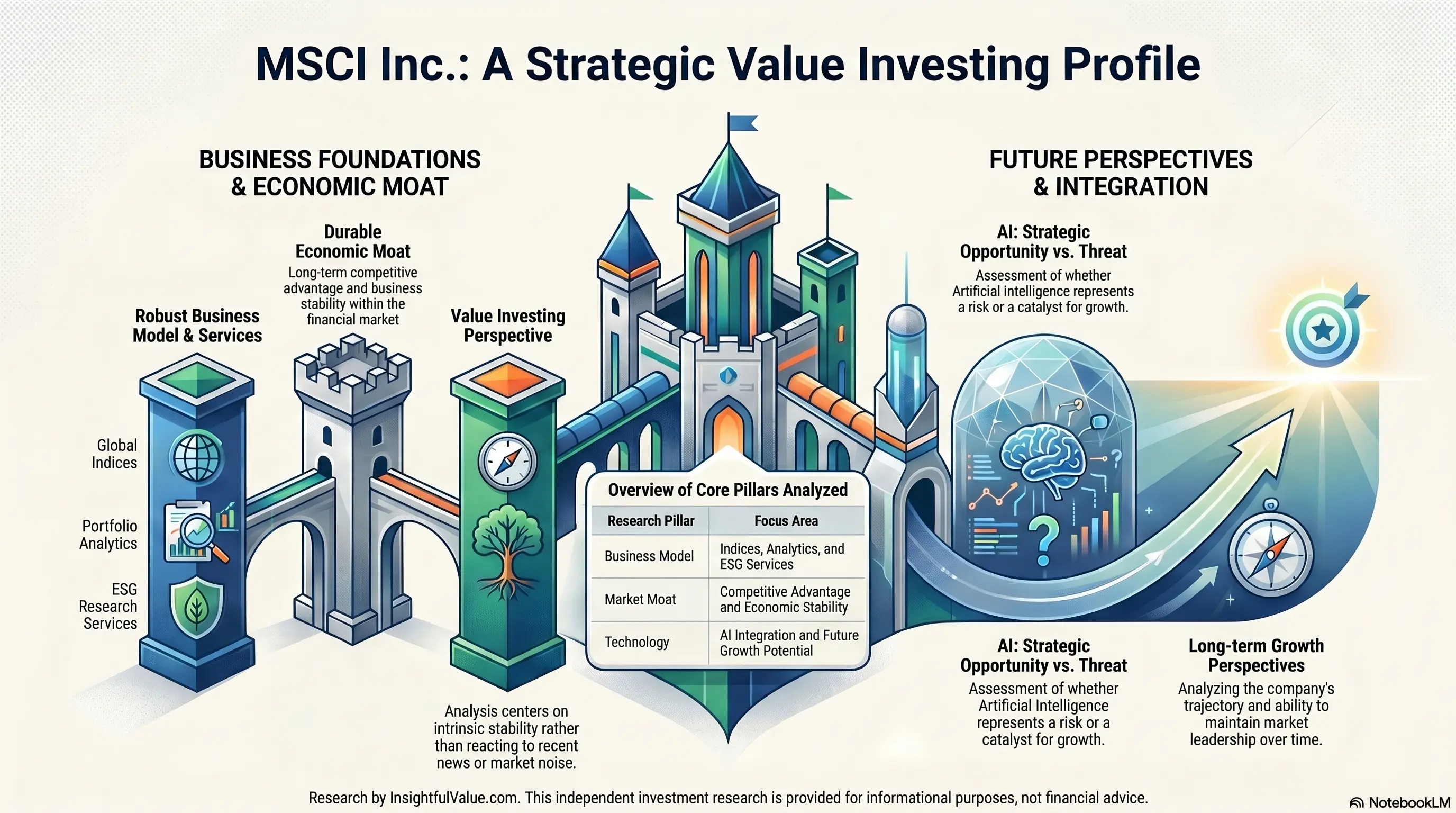
Infographic
Overview
MSCI (Morgan Stanley Capital International) is a leading provider of investment decision support tools for investors globally. The company was founded in 1969 by Capital Research and Management Company as an independent research firm aimed at providing investors with the information they need to make informed investment decisions. MSCI's main business is providing global equity indexes, risk management analytics, and performance analysis services to clients in the financial industry. The company's indexes are used as benchmarks by investors to measure the performance of their portfolios and make informed investment decisions. MSCI also offers a wide range of data and tools to assist investors in managing risk and optimizing their investment strategies. Today, MSCI is a global company with offices in over 30 countries, serving clients in more than 82 countries. It is headquartered in New York City and has over 3,000 employees worldwide. In addition to its core business, MSCI also conducts research and publishes reports on a variety of topics related to the global economy, ESG (environmental, social, and corporate governance) trends, and investment strategies. Overall, MSCI is a trusted and reputable company in the financial industry, providing essential tools and services to help investors make informed decisions and navigate the complex world of investing.
How to explain to a 10 year old kid about the company?
AI can potentially pose a threat to MSCI’s products and services in several ways, but the extent of this risk depends on various factors. 1. Substitution: AI can provide advanced analytics and data insights that might substitute some of MSCI’s offerings. For example, machine learning algorithms can be used to analyze large datasets more efficiently or predict market trends, which could lead clients to seek alternatives outside of MSCI for certain services. 2. Disintermediation: As AI becomes more integrated into financial services, there is a possibility that clients may bypass traditional providers like MSCI in favor of direct AI-driven solutions. These solutions could offer tailored investment strategies or risk assessments without the need for intermediaries, potentially diminishing MSCI’s role in the financial ecosystem. 3. Margin Pressure: As AI technologies become more accessible and cost-effective, competition in the financial analytics sector could intensify. New entrants using AI might offer similar or superior products at lower prices, putting pressure on MSCI to reduce its pricing or enhance its service offerings, potentially affecting its profit margins. However, it’s important to note that MSCI has a strong brand reputation, established relationships with clients, and a comprehensive data set that could be difficult for new AI-focused competitors to replicate. Additionally, MSCI may also leverage AI to enhance its own products and services, thus mitigating some of the threats. The impact of AI on MSCI will depend on how the company adapts to these challenges and opportunities in the evolving financial landscape.
Sensitivity to interest rates
The sensitivity of MSCI companies’ earnings, cash flow, and valuation to changes in interest rates can vary significantly based on several factors, including their industry, capital structure, and overall economic conditions. Earnings: Companies with higher levels of debt may see their earnings more significantly impacted by rising interest rates because increased borrowing costs can erode profit margins. Conversely, companies with less debt or those that derive earnings from stable, recurring revenue streams might be less sensitive to interest rate changes. Cash Flow: Interest rate changes also affect cash flow, especially for companies reliant on external financing. Higher interest rates can lead to increased interest expenses, reducing available cash flows. Additionally, changes in interest rates can impact consumer spending and investment, which can influence cash flows across various sectors. Valuation: Interest rates are a critical factor in discounting cash flows in valuation models. When interest rates rise, the present value of future cash flows decreases, which can lead to lower valuations for growth-focused companies. Conversely, value stocks, which may offer dividends or consistent cash flows, might be less affected by rising rates, as their valuations are often based on current and near-term cash flows. Overall, the sensitivity of MSCI companies to interest rate changes is multifaceted and depends on individual business models, debt levels, and market conditions.
👉 InsightfulValue is a platform for public company analysis.
👉 We provide a database of public companies, with a focus on value investing principles.
👉 We carefully select every company in our database. With only 1853 listed, there's a reason for that.
👉 The reason is simple – we only select the best-performing public companies, true champions. And we know exactly what we mean by "champion."
👉 For us, a champion is a company with strong finances, a history of impressive dividends, great management, and standout products or services. We mean it.
👉 For each company, we have 663 questions and answers covering every aspect of their market position and operations. Everything.
👉 ... plus additional 164 Q&A about the industry each company operates in.
InsightfulValue is an independent platform dedicated to value investing research. The information provided on this website is for informational and educational purposes only and does not constitute financial, investment, tax, or legal advice. We are not financial advisors, investment consultants, or licensed consultants. Our analyses, insights, and criteria are based on principles learned from renowned value investors such as Benjamin Graham, Warren Buffett, and Charlie Munger, but they should not be considered personalized investment recommendations. Investing in financial markets carries risks, and past performance is not indicative of future results. Users of this website should conduct their own due diligence and consult with a qualified professional before making any financial or investment decisions. InsightfulValue assumes no liability for any financial losses or decisions made based on the information provided on this site. By using this website, you acknowledge and accept that all investments involve risk and that InsightfulValue does not guarantee any financial outcomes.