The content provided in this video is for informational and educational purposes only. It does not constitute financial advice, investment recommendations, or an offer to buy or sell any securities. All views expressed are those of InsightfulValue and are based on publicly available information believed to be reliable, but no guarantee is made as to its accuracy or completeness. Always conduct your own research or consult a licensed financial advisor before making any investment decisions. Investing in the stock market involves risks, including the loss of principal.
Please be aware that the stock prices displayed on this website represent a curated selection of data. On desktop devices, you will see a wider range of stock prices, while on mobile devices, we provide a more streamlined view for better user experience and readability.
Our focus is on assessing a company's overall value and performance, rather than analyzing price fluctuations, even if we do watch prices in order to find companies trading below their intrinsic value. For more detailed charting and comprehensive market analysis, we recommend consulting a professional financial service or utilizing advanced charting tools.
We strive to provide accurate and timely information, but we encourage you to verify any financial data before making investment decisions.
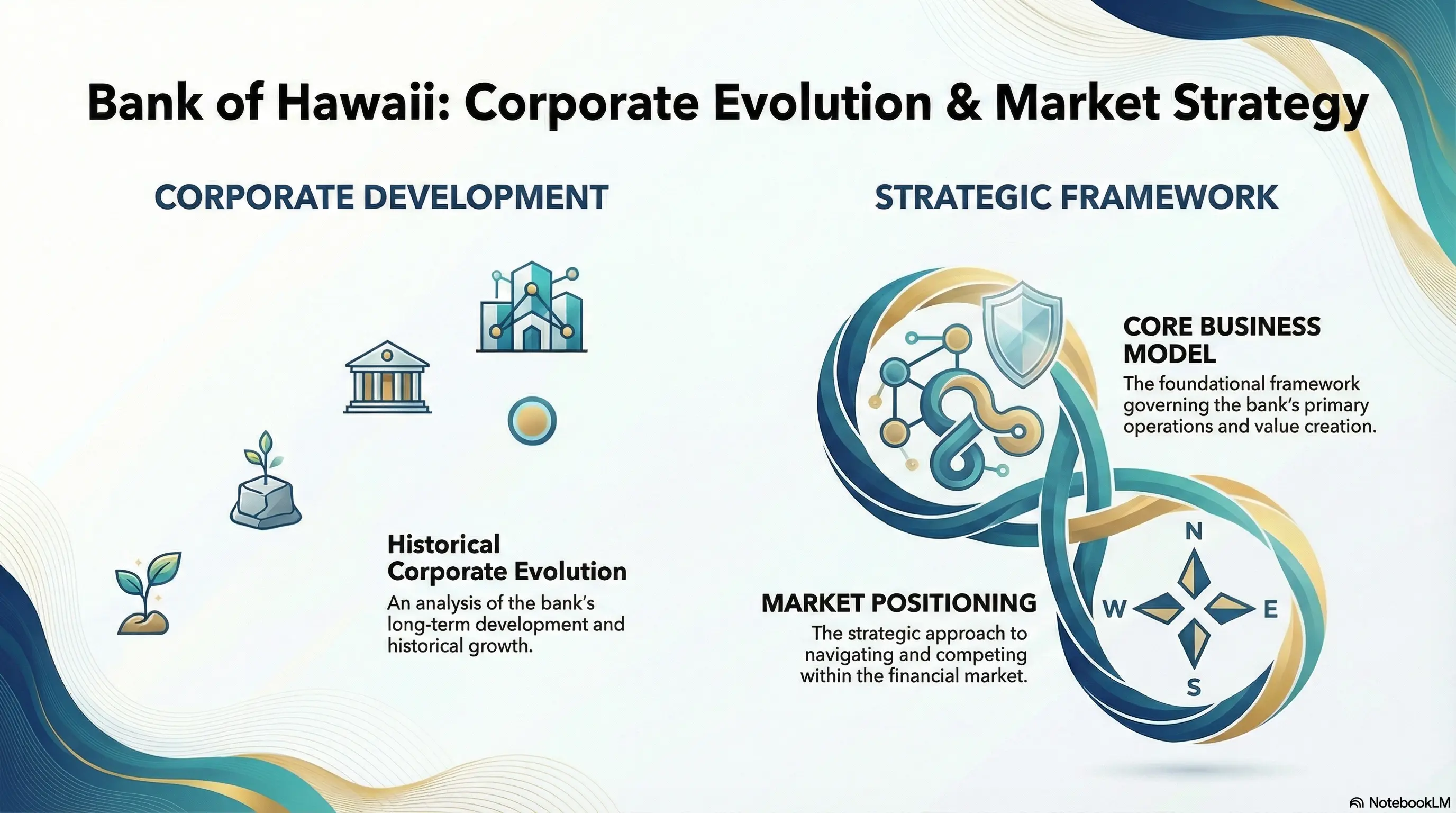
Infographic
Overview
The Bank of Hawaii is a bank and financial services company based in Honolulu, Hawaii. It is the largest independently owned and operated bank in Hawaii and the second oldest financial institution in the state, with roots dating back to 1858. The bank offers a range of services, including personal and business banking, investment and wealth management, and international banking. History The Bank of Hawaii was founded in 1897 as the Bank of Bishop & Co. by Charles Reed Bishop, a businessman and philanthropist, and his wife Princess Bernice Pauahi Bishop, the last royal descendent of the Kamehameha dynasty. The bank opened its first branch in downtown Honolulu and quickly grew to become one of the largest financial institutions in the Hawaiian islands. In the early 20th century, the bank played a crucial role in the development of the Hawaiian economy, financing many of the sugar plantations and businesses that drove the island's economy. In the 1930s, the bank began expanding its services to include personal and home loans. In the 1960s, the bank experienced significant growth, expanding its operations to include the other islands in Hawaii and opening its first international branch in Guam. In the 1980s, the bank continued to expand, opening branches in American Samoa and Saipan. Today, the Bank of Hawaii is present in 11 countries and territories and has over 70 branches across Hawaii, Guam, and the Pacific region. It is one of the top 10 banks in terms of assets in the state of Hawaii and continues to be a major player in the local economy. Services The Bank of Hawaii offers a wide range of financial services, including personal and business banking, investment and wealth management, and international banking. Some of its main services include checking and savings accounts, personal loans, mortgages, credit cards, and retirement planning. The bank also offers specialized services such as private banking for high net worth individuals and businesses, as well as trust and estate planning services. In addition, the Bank of Hawaii is a leader in international banking, offering services such as foreign currency exchange, international wire transfers, and trade financing for businesses. Community Involvement The Bank of Hawaii is deeply invested in the local community and has a strong commitment to giving back. The bank contributes to various non-profit organizations and community projects, with a focus on education, the arts, and economic development. In addition, the Bank of Hawaii Foundation, the bank's philanthropic arm, provides grants and scholarships to support education, healthcare, and cultural programs in Hawaii and the Pacific region. The foundation also offers financial education programs to promote financial literacy and empowerment in the community. Conclusion The Bank of Hawaii is a well-established bank with a long history of serving the Hawaiian community. It offers a full range of financial services and is committed to giving back to the community through philanthropic efforts. As the oldest and largest independent bank in Hawaii, the Bank of Hawaii continues to play a significant role in the state's economy.
How to explain to a 10 year old kid about the company?
AI does pose several potential threats and challenges to the Bank of Hawaii’s products, services, and competitive positioning. Here are some key considerations: 1. Substitution: AI technologies and fintech innovations enable consumers to access banking services without traditional institutions. For example, automated payment systems, robo-advisors, and peer-to-peer lending platforms can provide alternatives to Bank of Hawaii’s offerings. If customers opt for these AI-driven solutions, it could lead to decreased demand for traditional banking products. 2. Disintermediation: AI can facilitate transactions directly between parties, reducing the role of banks as intermediaries. With advancements in blockchain technology and smart contracts, some services traditionally offered by banks may become obsolete. This disintermediation could threaten the Bank of Hawaii’s business model and revenue streams. 3. Margin Pressure: The integration of AI into banking operations can drive efficiencies and reduce costs. While this is beneficial for banks that adopt these technologies, it can also lead to increased competition, particularly from new entrants that leverage AI to offer lower fees or better rates. The Bank of Hawaii may face pressure to lower its margins to remain competitive, impacting profitability. 4. Customer Expectations: As AI enhances customer experience in other sectors, clients may expect a similar level of service from their bank. If the Bank of Hawaii does not keep pace with AI innovations in customer service (e.g., chatbots, personalized financial advice through AI tools), it risks losing customers to competitors who do. 5. Regulatory Challenges: While AI offers opportunities, it also introduces regulatory scrutiny. Banks must ensure compliance with evolving regulations surrounding AI usage, data privacy, and security. Nocompliance could create risks and costs that impact the Bank of Hawaii’s operational efficiency. In summary, while AI presents opportunities for innovation and improved customer service, it also poses material threats through substitution, disintermediation, margin pressures, and evolving customer expectations. The Bank of Hawaii needs to strategically navigate these challenges to maintain its competitive positioning.
Sensitivity to interest rates
The Bank of Hawaii, like most financial institutions, is significantly sensitive to changes in interest rates due to its business model, which is heavily reliant on the interest income from loans and investments. 1. Earnings Sensitivity: Changes in interest rates directly impact the bank’s net interest margin, which is the difference between the interest income generated from loans and the interest paid on deposits. When interest rates rise, the bank can charge more for loans, potentially increasing earnings. Conversely, if rates fall, the bank may have to lower loan rates but could also see a decline in deposit rates, which could pressure margins. 2. Cash Flow Sensitivity: Interest rate fluctuations affect cash flow, particularly in the bank’s loan portfolio. Higher rates may lead to decreased borrowing demand, affecting cash flow from new loans. On the other hand, if rates rise and the economy remains strong, existing borrowers may refinance, impacting cash flow as well. The bank must manage its liability structure carefully to maintain steady cash flows. 3. Valuation Sensitivity: The valuation of Bank of Hawaii is closely linked to its earnings trajectory, which is influenced by interest rate changes. A higher interest rate environment can lead to improved short-term earnings, boosting valuations based on discounted cash flow analysis. However, an extended period of high rates could lead to increased credit risk if borrowers struggle to meet higher payment obligations, potentially weighing on valuations. Overall, the Bank of Hawaii’s financial health and stock performance are likely to be impacted significantly by interest rate movements, requiring strategic management of its interest rate risk.
👉 InsightfulValue is a platform for public company analysis.
👉 We provide a database of public companies, with a focus on value investing principles.
👉 We carefully select every company in our database. With only 1855 listed, there's a reason for that.
👉 The reason is simple – we only select the best-performing public companies, true champions. And we know exactly what we mean by "champion."
👉 For us, a champion is a company with strong finances, a history of impressive dividends, great management, and standout products or services. We mean it.
👉 For each company, we have 663 questions and answers covering every aspect of their market position and operations. Everything.
👉 ... plus additional 164 Q&A about the industry each company operates in.
InsightfulValue is an independent platform dedicated to value investing research. The information provided on this website is for informational and educational purposes only and does not constitute financial, investment, tax, or legal advice. We are not financial advisors, investment consultants, or licensed consultants. Our analyses, insights, and criteria are based on principles learned from renowned value investors such as Benjamin Graham, Warren Buffett, and Charlie Munger, but they should not be considered personalized investment recommendations. Investing in financial markets carries risks, and past performance is not indicative of future results. Users of this website should conduct their own due diligence and consult with a qualified professional before making any financial or investment decisions. InsightfulValue assumes no liability for any financial losses or decisions made based on the information provided on this site. By using this website, you acknowledge and accept that all investments involve risk and that InsightfulValue does not guarantee any financial outcomes.