The content provided in this video is for informational and educational purposes only. It does not constitute financial advice, investment recommendations, or an offer to buy or sell any securities. All views expressed are those of InsightfulValue and are based on publicly available information believed to be reliable, but no guarantee is made as to its accuracy or completeness. Always conduct your own research or consult a licensed financial advisor before making any investment decisions. Investing in the stock market involves risks, including the loss of principal.
Please be aware that the stock prices displayed on this website represent a curated selection of data. On desktop devices, you will see a wider range of stock prices, while on mobile devices, we provide a more streamlined view for better user experience and readability.
Our focus is on assessing a company's overall value and performance, rather than analyzing price fluctuations, even if we do watch prices in order to find companies trading below their intrinsic value. For more detailed charting and comprehensive market analysis, we recommend consulting a professional financial service or utilizing advanced charting tools.
We strive to provide accurate and timely information, but we encourage you to verify any financial data before making investment decisions.
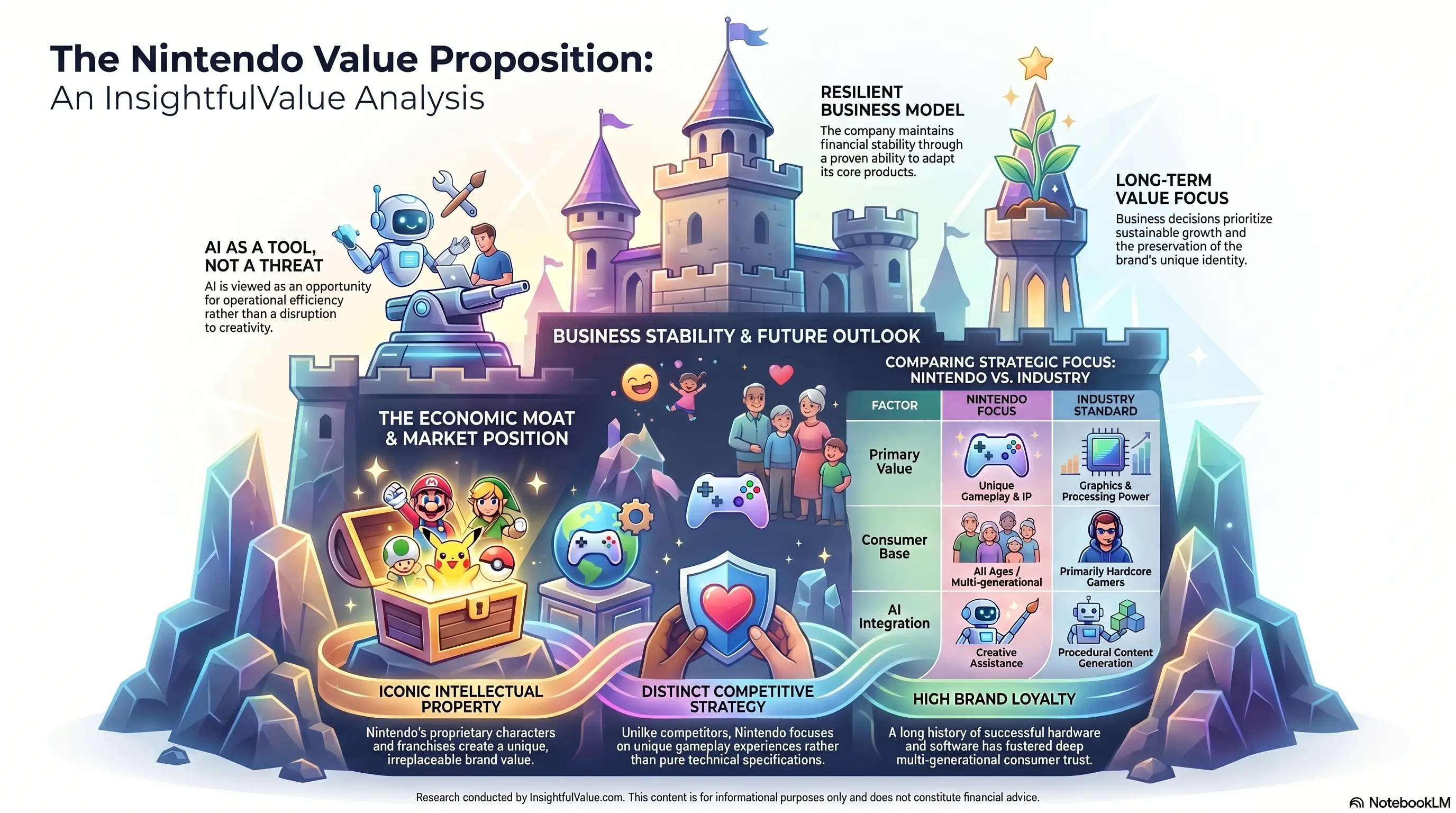
Infographic
Overview
Nintendo is a Japanese multinational consumer electronics and video game company headquartered in Kyoto, Japan. It was founded in 1889 by Fusajiro Yamauchi and originally produced handmade playing cards. In the 1960s, Nintendo expanded into other forms of entertainment, including toys and arcade games. In the 1970s, the company entered the video game industry and released its first home console, the Color TV-Game, in 1977. Nintendo achieved worldwide success in the 1980s with the release of the Nintendo Entertainment System (NES) and its iconic video game series, Super Mario Bros. This success continued with the release of the Game Boy handheld console in 1989 and the Super Nintendo Entertainment System (SNES) in 1990. The company also released popular consoles such as the Nintendo 64, GameCube, and Wii. Nintendo's most recent console, the Nintendo Switch, was released in 2017 and has become one of the fastest-selling consoles in history. The company is known for its family-friendly and innovative approach to gaming, with iconic franchises such as Mario, The Legend of Zelda, and Pokemon. In addition to video games, Nintendo is also involved in other forms of entertainment, including mobile gaming, theme parks, and merchandise. The company has had a significant impact on the video game industry and continues to be a major player in the market.
How to explain to a 10 year old kid about the company?
AI can potentially impact Nintendo’s products, services, and competitive positioning in various ways, though the severity of the threat may vary based on several factors. 1. Substitution: AI technologies can enable the development of gaming experiences that may compete with traditional console games. For instance, AI-driven games can provide unique, adaptive gameplay that adjusts to the player’s style, offering experiences that don’t rely on traditional gaming mechanics. However, Nintendo has a strong brand and a loyal customer base that appreciates its exclusive franchises, like Mario and Zelda. As long as Nintendo continues to innovate within its own ecosystem and develop engaging content, the threat from AI-driven substitutes may be mitigated. 2. Disintermediation: The rise of AI could lead to new systems for content creation and game development, potentially allowing developers to produce games more independently. This might change the competitive landscape, as smaller developers equipped with AI tools could more easily enter the market. Nintendo’s established IP and development capabilities provide a cushion against this threat, but it would need to evolve its strategies to maintain its edge in a shifting environment. 3. Margin Pressure: If AI leads to a decrease in development costs for competitors, it could increase competition and pressure margins across the gaming industry. Competitors could leverage AI to create lower-cost alternatives to high-budget titles, which might cannibalize Nintendo’s market share. However, Nintendo’s focus on unique gameplay experiences and strong character-driven narratives can help it differentiate its products in this competitive landscape. Overall, while AI poses potential threats through substitution, disintermediation, and margin pressure, Nintendo’s brand strength, dedicated fanbase, and capability for innovation position it to navigate these challenges effectively. Engaging with and leveraging AI technologies could also present opportunities for Nintendo to enhance its own offerings, rather than just threats to be managed.
Sensitivity to interest rates
Nintendo’s earnings, cash flow, and valuation are sensitive to changes in interest rates due to several interconnected factors. 1. Cost of Capital: Higher interest rates increase the cost of borrowing for companies. If Nintendo relies on debt for financing its operations or investments, higher rates can lead to increased interest expenses, thereby reducing net earnings and cash flow. 2. Consumer Spending: Interest rates influence consumer spending patterns. Higher rates may lead to reduced disposable income and increased borrowing costs for consumers, potentially resulting in lower sales of Nintendo’s gaming consoles and software. Since a significant portion of Nintendo’s revenue comes from consumer purchases, this can adversely affect earnings and cash flow. 3. Valuation Models: The valuation of companies like Nintendo often relies on discounted cash flows. When interest rates rise, the discount rate used in these models also increases, which can decrease the present value of future cash flows. This can lead to a lower valuation of Nintendo’s stock. 4. Investment Decisions: When interest rates rise, alternative investments such as bonds may become more attractive compared to equities. This can lead to a decrease in demand for Nintendo’s stock, adversely affecting its market valuation. 5. International Operations: As a global company, Nintendo also faces challenges related to foreign exchange rates, which can be influenced by interest rate changes. Fluctuations in currency values can impact revenues from sales in various international markets, further affecting overall earnings and cash flow. Overall, while Nintendo may not be as directly impacted by interest rates as some other industries, any significant changes can still influence its financial performance and valuation considerably.
👉 InsightfulValue is a platform for public company analysis.
👉 We provide a database of public companies, with a focus on value investing principles.
👉 We carefully select every company in our database. With only 1853 listed, there's a reason for that.
👉 The reason is simple – we only select the best-performing public companies, true champions. And we know exactly what we mean by "champion."
👉 For us, a champion is a company with strong finances, a history of impressive dividends, great management, and standout products or services. We mean it.
👉 For each company, we have 663 questions and answers covering every aspect of their market position and operations. Everything.
👉 ... plus additional 164 Q&A about the industry each company operates in.
InsightfulValue is an independent platform dedicated to value investing research. The information provided on this website is for informational and educational purposes only and does not constitute financial, investment, tax, or legal advice. We are not financial advisors, investment consultants, or licensed consultants. Our analyses, insights, and criteria are based on principles learned from renowned value investors such as Benjamin Graham, Warren Buffett, and Charlie Munger, but they should not be considered personalized investment recommendations. Investing in financial markets carries risks, and past performance is not indicative of future results. Users of this website should conduct their own due diligence and consult with a qualified professional before making any financial or investment decisions. InsightfulValue assumes no liability for any financial losses or decisions made based on the information provided on this site. By using this website, you acknowledge and accept that all investments involve risk and that InsightfulValue does not guarantee any financial outcomes.