The content provided in this video is for informational and educational purposes only. It does not constitute financial advice, investment recommendations, or an offer to buy or sell any securities. All views expressed are those of InsightfulValue and are based on publicly available information believed to be reliable, but no guarantee is made as to its accuracy or completeness. Always conduct your own research or consult a licensed financial advisor before making any investment decisions. Investing in the stock market involves risks, including the loss of principal.
Please be aware that the stock prices displayed on this website represent a curated selection of data. On desktop devices, you will see a wider range of stock prices, while on mobile devices, we provide a more streamlined view for better user experience and readability.
Our focus is on assessing a company's overall value and performance, rather than analyzing price fluctuations, even if we do watch prices in order to find companies trading below their intrinsic value. For more detailed charting and comprehensive market analysis, we recommend consulting a professional financial service or utilizing advanced charting tools.
We strive to provide accurate and timely information, but we encourage you to verify any financial data before making investment decisions.
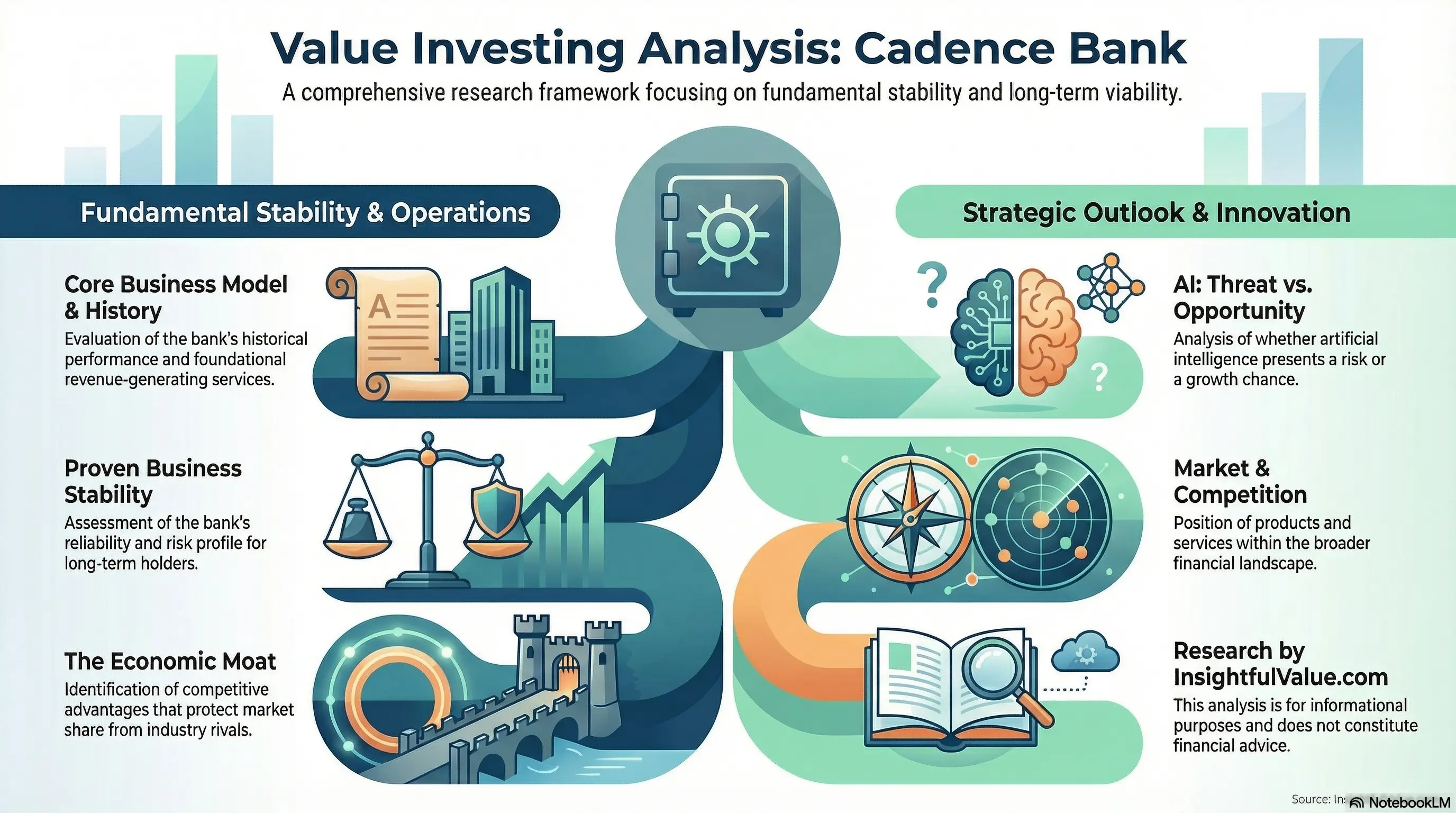
Infographic
Overview
Cadence Bank is a financial services company that was founded in 1888 in Starkville, Mississippi. The bank offers a range of products and services, including personal and business banking, wealth management, trust and estate planning, and mortgage lending. The bank currently has over 100 branch locations throughout Alabama, Florida, Georgia, Mississippi, Tennessee, and Texas. It also has a strong online presence, offering online and mobile banking services to its customers. In 2011, Cadence Bank was acquired by Community Bancorp LLC and underwent a major rebranding and restructuring in order to become a stronger, more competitive financial institution. The bank's mission is to empower people to thrive and reach their goals through sound financial advice and innovative solutions. Additionally, Cadence Bank is committed to giving back to the communities it serves through various philanthropic efforts, including financial education programs, volunteering, and charitable donations. The bank has been recognized for its corporate social responsibility efforts, including being named a top corporate philanthropist in 2020 by the Atlanta Business Chronicle. Overall, Cadence Bank aims to provide exceptional customer service, build and maintain strong relationships with its customers, and continuously evolve to meet the changing needs of the communities it serves.
How to explain to a 10 year old kid about the company?
Cadence Bank is a company that helps people and businesses with their money. Think of it like a big piggy bank where lots of people keep their money safe. But Cadence Bank does more than just hold money; it offers services to help people save, borrow, and manage their money better. Here’s how it makes money: 1. Interest from Loans: When people or businesses need money to buy a house, a car, or start a project, they can borrow from Cadence Bank. They pay back the money they borrowed with a little extra called interest. This interest is how the bank earns money. 2. Fees for Services: Sometimes, banks charge small fees for things like using an ATM or keeping a special type of account. Cadence Bank gets money from these fees too. 3. Investing: Banks can also invest money wisely to earn more. They help people grow their savings through things like savings accounts and investments, and they make some money on the side. Now, why is Cadence Bank successful and likely to stay that way in the future? 1. Trust: People trust Cadence Bank to take care of their money. When people feel safe and respected, they are more likely to keep their money there. 2. Good Service: If the bank helps customers with friendly service and useful advice, people will want to do business with them and recommend them to others. 3. Smart Choices: Cadence Bank makes smart decisions about lending and investing, which helps them avoid losing money. This keeps them strong and healthy financially. 4. Technology: Banks are using computers and apps to make banking easier for people. If Cadence Bank keeps using the best technology, they can serve customers better and faster. 5. Community Involvement: Cadence Bank often helps in the community, like supporting local events or charities. When people see them helping out, they feel good about banking there. In short, Cadence Bank helps people with their money, makes money by lending and charging small fees, and is successful because it earns trust, provides good service, makes smart choices, embraces technology, and helps the community.
AI does pose certain threats to Cadence Bank’s products, services, and competitive positioning, primarily through substitution, disintermediation, and margin pressure. Firstly, substitution can occur as AI enhances alternative financial services. Fintech companies, leveraging AI for credit scoring, lending, and personalized financial advice, can offer products that compete directly with traditional banking services. This can lead to customers preferring these innovative solutions over conventional banking options provided by Cadence Bank. Secondly, disintermediation is a risk as AI technology allows customers to access financial services directly without needing a bank as an intermediary. For example, peer-to-peer lending platforms and decentralized finance (DeFi) services can bypass traditional banks, reducing their role in certain transactions and ultimately impacting Cadence Bank’s business model. Lastly, margin pressure can arise as the increased adoption of AI leads to cost reductions in financial services. Competitors that implement AI efficiently can offer lower fees or better rates, putting pressure on Cadence Bank to reduce its own pricing. This can erode profit margins, particularly if the bank is slow to adopt similar technologies. In summary, while AI offers opportunities for Cadence Bank to enhance its service offerings, it also introduces significant threats that could impact its market position and overall profitability. To mitigate these risks, the bank would need to invest in AI technologies to innovate and remain competitive in the evolving financial landscape.
Sensitivity to interest rates
Cadence Bank’s earnings, cash flow, and valuation can be significantly affected by changes in interest rates due to several factors: 1. Earnings Sensitivity: Changes in interest rates directly impact the bank’s net interest margin, which is the difference between the interest income generated from loans and the interest paid on deposits. When interest rates rise, banks may benefit from higher loan rates, potentially increasing earnings. Conversely, falling rates could compress margins, leading to reduced earnings. 2. Cash Flow Sensitivity: The bank’s cash flow is influenced by interest payments from loans and investments versus the interest it pays to depositors. Higher rates might drive increased cash flow from variable-rate loans, but could also lead to higher payments on other liabilities. Additionally, changes in interest rates can affect prepayment speeds on fixed-rate loans, impacting cash flow timing. 3. Valuation Sensitivity: Interest rates are a key determinant in the discount rates used to calculate the present value of future cash flows, affecting the bank’s valuation. Higher interest rates can lead to a higher discount rate, which may lower the present value of the bank’s future earnings. Conversely, lower interest rates might enhance valuation as they reduce the discount rate, increasing the present value of expected cash flows. Overall, Cadence Bank’s financial performance and market valuation are closely tied to interest rate fluctuations, making it critical for the bank to effectively manage interest rate risk.
👉 InsightfulValue is a platform for public company analysis.
👉 We provide a database of public companies, with a focus on value investing principles.
👉 We carefully select every company in our database. With only 1873 listed, there's a reason for that.
👉 The reason is simple – we only select the best-performing public companies, true champions. And we know exactly what we mean by "champion."
👉 For us, a champion is a company with strong finances, a history of impressive dividends, great management, and standout products or services. We mean it.
👉 For each company, we have 574 questions and answers covering every aspect of their market position and operations. Everything.
👉 ... plus additional 121 Q&A about the industry each company operates in.
InsightfulValue is an independent platform dedicated to value investing research. The information provided on this website is for informational and educational purposes only and does not constitute financial, investment, tax, or legal advice. We are not financial advisors, investment consultants, or licensed consultants. Our analyses, insights, and criteria are based on principles learned from renowned value investors such as Benjamin Graham, Warren Buffett, and Charlie Munger, but they should not be considered personalized investment recommendations. Investing in financial markets carries risks, and past performance is not indicative of future results. Users of this website should conduct their own due diligence and consult with a qualified professional before making any financial or investment decisions. InsightfulValue assumes no liability for any financial losses or decisions made based on the information provided on this site. By using this website, you acknowledge and accept that all investments involve risk and that InsightfulValue does not guarantee any financial outcomes.