The content provided in this video is for informational and educational purposes only. It does not constitute financial advice, investment recommendations, or an offer to buy or sell any securities. All views expressed are those of InsightfulValue and are based on publicly available information believed to be reliable, but no guarantee is made as to its accuracy or completeness. Always conduct your own research or consult a licensed financial advisor before making any investment decisions. Investing in the stock market involves risks, including the loss of principal.
Please be aware that the stock prices displayed on this website represent a curated selection of data. On desktop devices, you will see a wider range of stock prices, while on mobile devices, we provide a more streamlined view for better user experience and readability.
Our focus is on assessing a company's overall value and performance, rather than analyzing price fluctuations, even if we do watch prices in order to find companies trading below their intrinsic value. For more detailed charting and comprehensive market analysis, we recommend consulting a professional financial service or utilizing advanced charting tools.
We strive to provide accurate and timely information, but we encourage you to verify any financial data before making investment decisions.
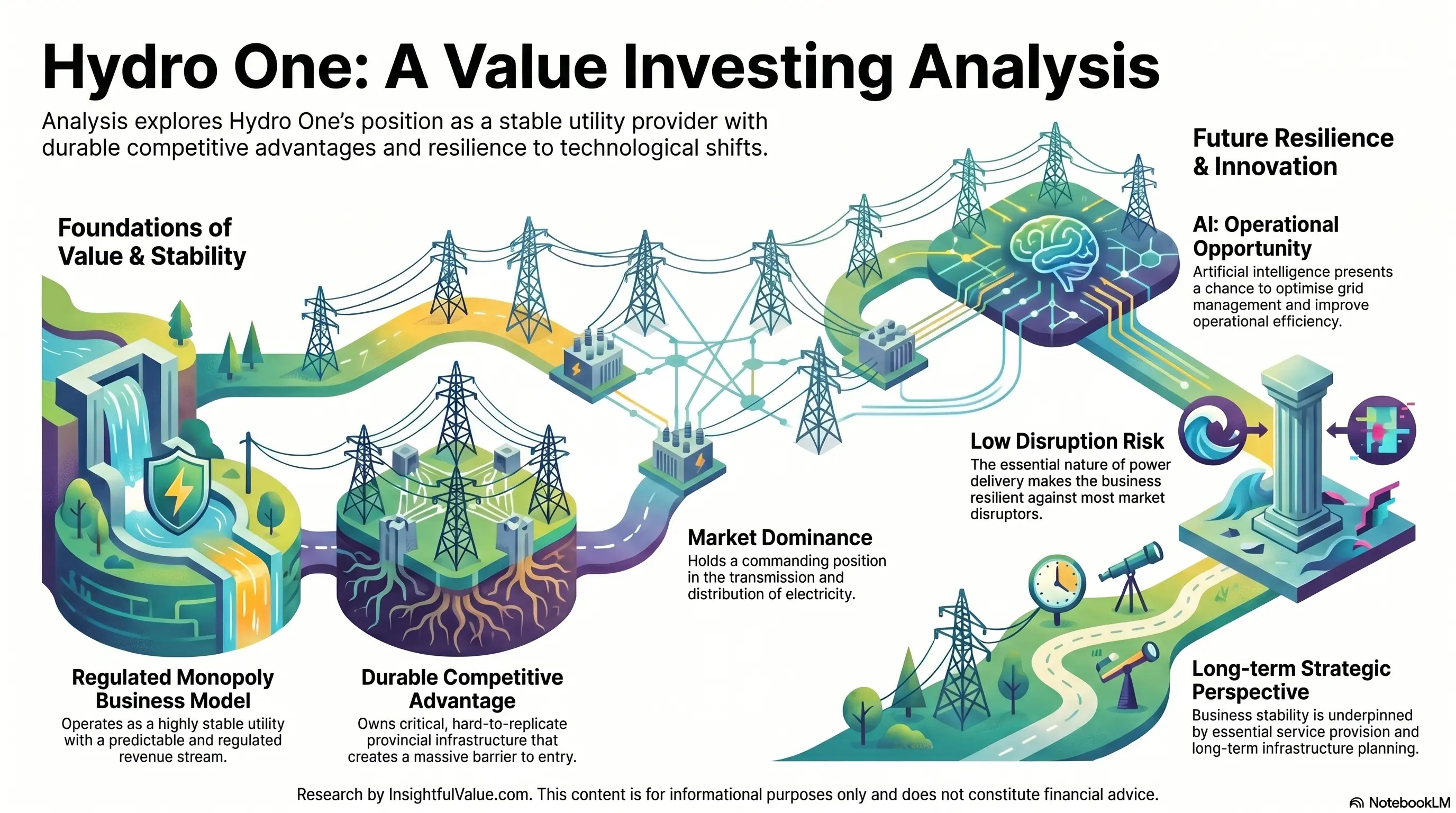
Infographic
Overview
Hydro One is an electricity transmission and distribution company in Ontario, Canada. It is the largest electricity transmission and distribution utility in the province, serving over 1.4 million customers. History: Hydro One was originally established in 1906 as the Hydro-Electric Power Commission of Ontario, with the purpose of building hydroelectric power stations on the Niagara Falls. In 1928, the provincial government formed Ontario Hydro as the new parent company for the Commission. In 1999, Ontario Hydro was divided into several separate entities, including Hydro One, which operates as a Crown corporation under the ownership of the Government of Ontario. Services: Hydro One provides electricity transmission and distribution services to both residential and business customers. This includes maintaining and operating the transmission and distribution system, connecting new customers to the grid, and managing power outage and restoration efforts. Customers: Hydro One serves customers throughout Ontario, with a majority of its customers located in the southern and central parts of the province. The company also has a small number of customers in northern Ontario, including remote and Indigenous communities. Corporate Responsibility: Hydro One is committed to providing reliable and safe electricity services to its customers. The company also places a strong emphasis on environmental sustainability and is working towards reducing its carbon footprint and promoting renewable energy sources. Additionally, Hydro One is committed to supporting and investing in the communities it serves through various charitable initiatives and partnerships. Controversies: In recent years, Hydro One has faced some controversies, including criticism over its high executive salaries and customer service issues. In 2018, the provincial government announced plans to partially privatize the company, sparking backlash and concerns over potential increases in electricity prices. Despite these challenges, Hydro One remains a vital part of the electricity infrastructure in Ontario and continues to provide essential services to its customers.
How to explain to a 10 year old kid about the company?
AI can potentially pose a material threat to Hydro One, a company that provides electricity transmission and distribution services, in several ways: 1. Substitution: Advances in AI can lead to the development of alternative energy solutions, such as distributed energy resources like solar panels and battery storage systems. If consumers increasingly adopt these alternatives, it could reduce demand for traditional electricity supply, impacting Hydro One’s market position. Additionally, AI-driven energy management systems can optimize energy consumption and generation at the consumer level, further threatening the demand for conventional services. 2. Disintermediation: AI could facilitate more direct energy transactions between producers and consumers, bypassing traditional utility models. For instance, blockchain technology combined with AI could enable peer-to-peer energy trading, allowing consumers to buy and sell energy directly among themselves. This could disrupt Hydro One’s role as an intermediary in energy distribution and sales. 3. Margin Pressure: Implementing AI can improve operational efficiencies and reduce costs for utilities. However, if competitors leverage AI technology better or faster, they may achieve lower operational costs and offer services at more competitive rates. This can put pressure on Hydro One’s profit margins, especially if they are slow to adopt AI-driven improvements or if they significantly increase their operational expenses without corresponding returns. Overall, Hydro One must carefully navigate the evolving landscape shaped by AI to mitigate these potential threats and explore opportunities for integration within their existing business model.
Sensitivity to interest rates
The sensitivity of Hydro One’s earnings, cash flow, and valuation to changes in interest rates can be significant due to its nature as a utility company. Here are some key factors to consider: 1. Interest Rate Impact on Financing Costs: Hydro One, like many utility companies, relies on both equity and debt financing to fund its capital expenditures and operational costs. An increase in interest rates can lead to higher borrowing costs, which may adversely affect net income and cash flow. 2. Valuation Sensitivity: The valuation of Hydro One is often assessed using discounted cash flow (DCF) models, where future cash flows are discounted back to present value using a discount rate. An increase in interest rates raises the discount rate, which can decrease the present value of expected future cash flows, potentially leading to a lower valuation. 3. Regulatory Environment: Utilities typically operate in regulated environments where prices and returns are overseen by governmental bodies. If interest rates rise, utilities may seek to adjust rates to maintain profitability, which could lead to regulatory scrutiny or delays. 4. Investor Sentiment: Higher interest rates generally make fixed-income investments more attractive compared to dividend-paying stocks like those of Hydro One. This could lead to stock price pressure as investors shift their portfolios. 5. Operational Cash Flow: While the impact of interest rates on operational cash flow may be less direct, higher rates can lead to reduced consumer spending and economic activity, potentially resulting in lower demand for electricity and affecting overall revenues. In summary, Hydro One’s earnings, cash flow, and valuation are sensitive to changes in interest rates due to their impact on financing costs, valuation models, regulatory dynamics, investor behavior, and overall economic conditions. The degree of sensitivity will depend on the magnitude of the interest rate change and the company’s specific financial structure and operational strategy.
👉 InsightfulValue is a platform for public company analysis.
👉 We provide a database of public companies, with a focus on value investing principles.
👉 We carefully select every company in our database. With only 1853 listed, there's a reason for that.
👉 The reason is simple – we only select the best-performing public companies, true champions. And we know exactly what we mean by "champion."
👉 For us, a champion is a company with strong finances, a history of impressive dividends, great management, and standout products or services. We mean it.
👉 For each company, we have 663 questions and answers covering every aspect of their market position and operations. Everything.
👉 ... plus additional 164 Q&A about the industry each company operates in.
InsightfulValue is an independent platform dedicated to value investing research. The information provided on this website is for informational and educational purposes only and does not constitute financial, investment, tax, or legal advice. We are not financial advisors, investment consultants, or licensed consultants. Our analyses, insights, and criteria are based on principles learned from renowned value investors such as Benjamin Graham, Warren Buffett, and Charlie Munger, but they should not be considered personalized investment recommendations. Investing in financial markets carries risks, and past performance is not indicative of future results. Users of this website should conduct their own due diligence and consult with a qualified professional before making any financial or investment decisions. InsightfulValue assumes no liability for any financial losses or decisions made based on the information provided on this site. By using this website, you acknowledge and accept that all investments involve risk and that InsightfulValue does not guarantee any financial outcomes.