The content provided in this video is for informational and educational purposes only. It does not constitute financial advice, investment recommendations, or an offer to buy or sell any securities. All views expressed are those of InsightfulValue and are based on publicly available information believed to be reliable, but no guarantee is made as to its accuracy or completeness. Always conduct your own research or consult a licensed financial advisor before making any investment decisions. Investing in the stock market involves risks, including the loss of principal.
Please be aware that the stock prices displayed on this website represent a curated selection of data. On desktop devices, you will see a wider range of stock prices, while on mobile devices, we provide a more streamlined view for better user experience and readability.
Our focus is on assessing a company's overall value and performance, rather than analyzing price fluctuations, even if we do watch prices in order to find companies trading below their intrinsic value. For more detailed charting and comprehensive market analysis, we recommend consulting a professional financial service or utilizing advanced charting tools.
We strive to provide accurate and timely information, but we encourage you to verify any financial data before making investment decisions.
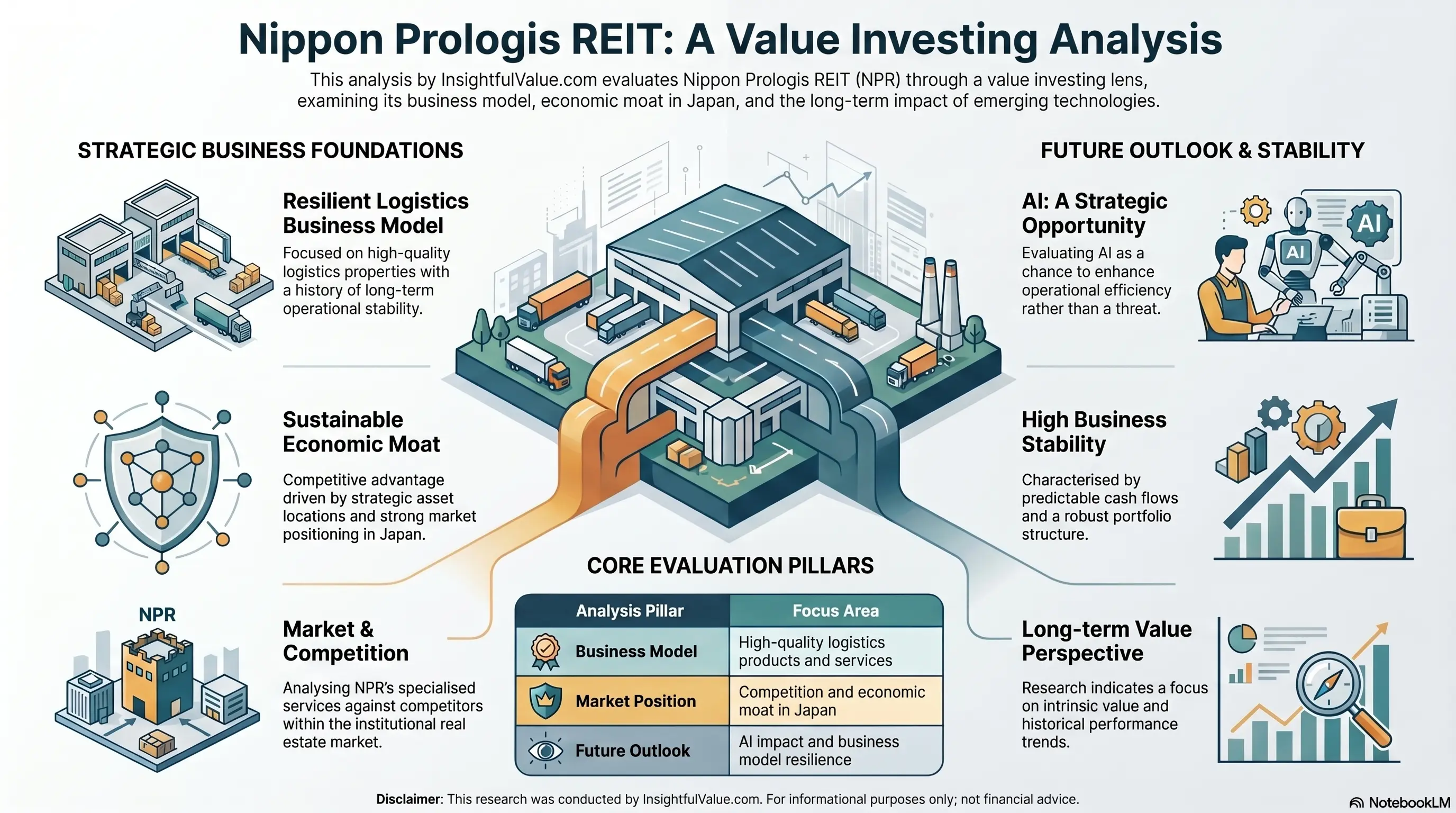
Infographic
Overview
Nippon Prologis REIT is a real estate investment trust (REIT) that focuses on investing in modern logistics facilities and distribution centers in Japan. The company was established in April 2012 and has been listed on the Tokyo Stock Exchange since March 2013. Nippon Prologis REIT is managed by Prologis, a leading global provider of logistics real estate with a portfolio of over 979 million square feet in 19 countries. Prologis has a strong track record in the Japanese logistics market and has been operating in Japan since 1997. Nippon Prologis REIT’s portfolio includes high-quality logistics facilities located in major logistics hubs and key distribution markets across Japan, including Tokyo, Osaka, Nagoya, Fukuoka, and Sapporo. As of March 2021, the company’s portfolio consists of 79 properties with a total leasable area of approximately 15.6 million square feet. The company’s goal is to provide stable and sustainable dividends to its shareholders by acquiring and managing high-quality logistics facilities with strong tenant profiles and long-term leases. Nippon Prologis REIT is committed to environmentally responsible and sustainable operations, with a focus on energy efficiency, waste reduction, and the use of renewable energy sources in its properties. The company has received various sustainability certifications and awards for its efforts in this area. In addition, Nippon Prologis REIT is committed to maintaining a strong corporate governance structure, with independent directors making up the majority of its board of directors. The company also regularly discloses its financial and operational information to ensure transparency and accountability to its shareholders and stakeholders. Overall, Nippon Prologis REIT is a reputable and well-established company in the Japanese logistics real estate market, with a strong focus on sustainability and responsible management practices.
How to explain to a 10 year old kid about the company?
AI’s impact on a company like Nippon Prologis REIT can vary depending on how AI technologies are implemented and integrated within the real estate investment trust (REIT) sector. Here are several considerations regarding potential threats from AI: 1. Substitution: AI could lead to the development of new real estate investment platforms and technologies that automate property management, investment analysis, and tenant interactions. This could enable competitors to create more efficient processes, potentially offering lower fees or better services than traditional REITs like Nippon Prologis. 2. Disintermediation: The rise of AI-driven platforms could enable direct transactions between property owners and tenants, reducing the need for intermediaries like REITs. If investors can access properties directly through technology without relying on traditional REIT structures, it may erode the market share of Nippon Prologis and similar firms. 3. Margin Pressure: AI can optimize operations, reduce costs, and improve decisiomaking processes. This could lead to increased competition as firms that effectively leverage AI may operate with lower margins. If Nippon Prologis cannot match these efficiencies, it could face margin pressure, impacting profitability and shareholder value. 4. Operational Efficiency: On the other hand, if Nippon Prologis proactively adopts AI technologies to enhance its operations—such as predictive analytics for investment decisions, improved property management through smart technologies, and enhanced tenant experiences—this may strengthen its competitive position rather than threaten it. 5. Market Adaptation: The REIT industry is relatively mature, but as AI becomes more prevalent, Nippon Prologis may need to continuously adapt its strategy to incorporate AI innovations in order to remain competitive. Failure to do so could leave the firm vulnerable to agile competitors leveraging AI. In summary, while AI presents certain risks that could pose material threats to Nippon Prologis’s products, services, and competitive positioning, proactive adoption and integration of AI could also offer significant opportunities for enhancement and innovation in the REIT market.
Sensitivity to interest rates
The sensitivity of Nippon Prologis REIT’s earnings, cash flow, and valuation to changes in interest rates can be attributed to several factors relevant to real estate investment trusts (REITs) in general. 1. Earnings Sensitivity: Changes in interest rates can significantly impact a REIT’s earnings through debt costs. If interest rates rise, the cost of borrowing for refinancing existing debt or obtaining new financing increases, which can erode profit margins. Additionally, higher interest rates could slow down economic growth, leading to decreased demand for rental spaces, ultimately affecting rental income and occupancy rates. 2. Cash Flow Sensitivity: Cash flows are closely linked to the financing costs and the overall economic environment influenced by interest rates. An increase in interest rates may reduce cash flow from operations if loans become more expensive and if tenant demand wanes due to a more challenging economic climate. On the other hand, if interest rates rise, it can squeeze out more marginal tenants, potentially leading to higher default risk and vacancy rates. 3. Valuation Sensitivity: A REIT’s valuation is often determined using metrics like funds from operations (FFO) and net asset value (NAV), both of which can be adversely affected by increased interest rates. Higher rates can lead to an increase in the required rate of return for investors, resulting in lower valuations for REITs as investors demand higher yields. This creates downward pressure on share prices, as the attractiveness of REITs diminishes compared to other fixed-income investments that may offer a better return in a higher interest rate environment. In summary, the Nippon Prologis REIT’s earnings, cash flow, and valuation are sensitive to interest rate changes, with higher rates potentially leading to decreased earnings, reduced cash flows, and lower overall valuations. Investors should closely monitor interest rate trends and their potential implications for the REIT’s financial performance.
👉 InsightfulValue is a platform for public company analysis.
👉 We provide a database of public companies, with a focus on value investing principles.
👉 We carefully select every company in our database. With only 1853 listed, there's a reason for that.
👉 The reason is simple – we only select the best-performing public companies, true champions. And we know exactly what we mean by "champion."
👉 For us, a champion is a company with strong finances, a history of impressive dividends, great management, and standout products or services. We mean it.
👉 For each company, we have 663 questions and answers covering every aspect of their market position and operations. Everything.
👉 ... plus additional 164 Q&A about the industry each company operates in.
InsightfulValue is an independent platform dedicated to value investing research. The information provided on this website is for informational and educational purposes only and does not constitute financial, investment, tax, or legal advice. We are not financial advisors, investment consultants, or licensed consultants. Our analyses, insights, and criteria are based on principles learned from renowned value investors such as Benjamin Graham, Warren Buffett, and Charlie Munger, but they should not be considered personalized investment recommendations. Investing in financial markets carries risks, and past performance is not indicative of future results. Users of this website should conduct their own due diligence and consult with a qualified professional before making any financial or investment decisions. InsightfulValue assumes no liability for any financial losses or decisions made based on the information provided on this site. By using this website, you acknowledge and accept that all investments involve risk and that InsightfulValue does not guarantee any financial outcomes.