The content provided in this video is for informational and educational purposes only. It does not constitute financial advice, investment recommendations, or an offer to buy or sell any securities. All views expressed are those of InsightfulValue and are based on publicly available information believed to be reliable, but no guarantee is made as to its accuracy or completeness. Always conduct your own research or consult a licensed financial advisor before making any investment decisions. Investing in the stock market involves risks, including the loss of principal.
Please be aware that the stock prices displayed on this website represent a curated selection of data. On desktop devices, you will see a wider range of stock prices, while on mobile devices, we provide a more streamlined view for better user experience and readability.
Our focus is on assessing a company's overall value and performance, rather than analyzing price fluctuations, even if we do watch prices in order to find companies trading below their intrinsic value. For more detailed charting and comprehensive market analysis, we recommend consulting a professional financial service or utilizing advanced charting tools.
We strive to provide accurate and timely information, but we encourage you to verify any financial data before making investment decisions.
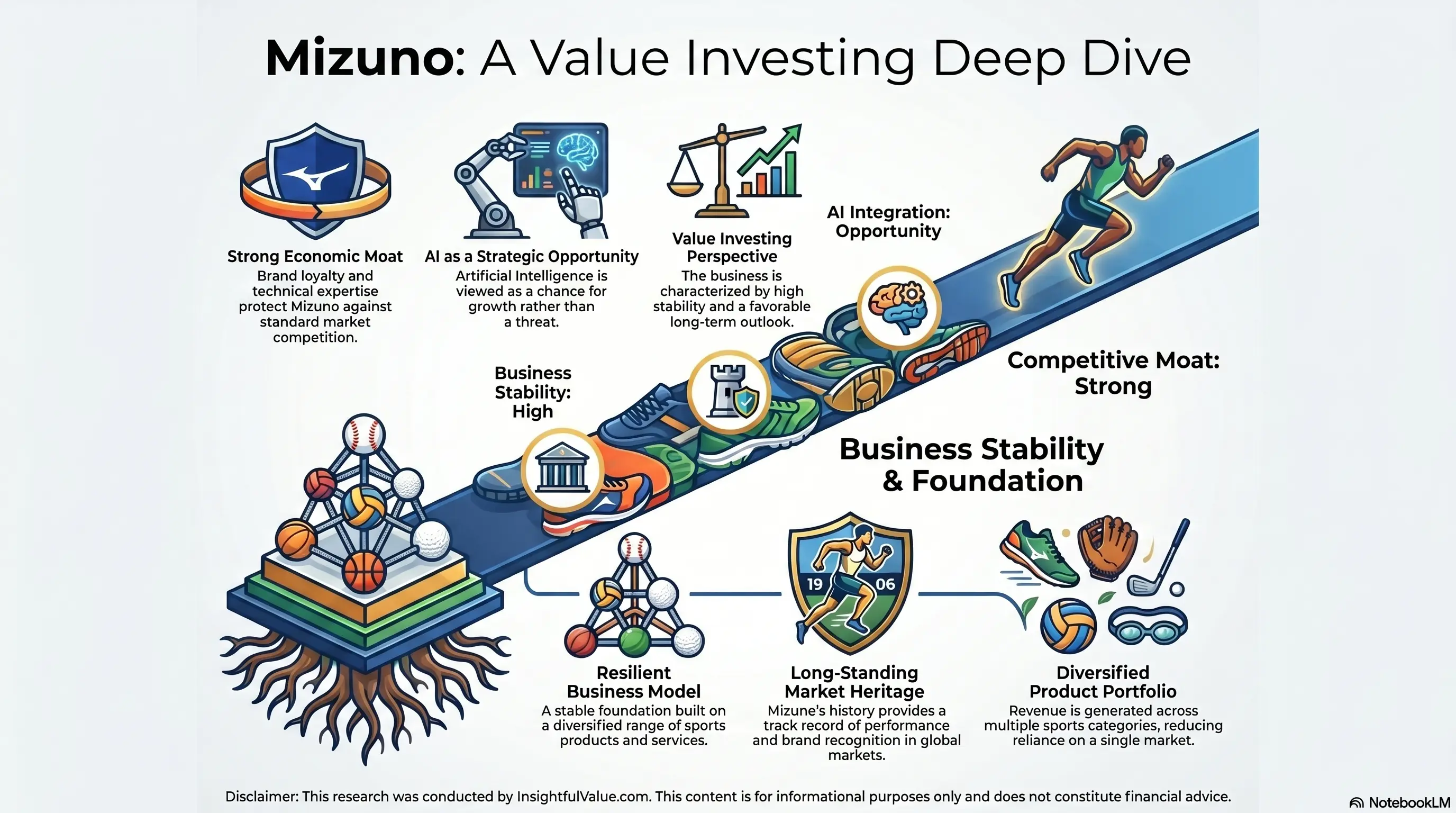
Infographic
Overview
Mizuno is a Japanese sports equipment and apparel company, founded in Osaka in 1906 by Rihachi Mizuno and his younger brother Rizo. Originally specializing in traditional Japanese tabi shoes, Mizuno gradually expanded into other sports gear and equipment, particularly for baseball and golf. Today, Mizuno is known as a global sports brand, producing a wide range of products for a variety of sports including running, volleyball, tennis, and soccer. They are particularly renowned for their high-quality running shoes and golf clubs. In addition to their sports equipment, Mizuno also sponsors and partners with various professional athletes and sports teams around the world, including track and field athletes Usain Bolt and Kim Collins, and the Japanese national rugby team. Mizuno is also committed to sustainability and has implemented various eco-friendly initiatives, such as using recycled materials in their products and reducing their carbon footprint. In recent years, Mizuno has expanded their reach to a more mainstream audience by collaborating with fashion designers and launching lifestyle collections. Overall, Mizuno is a well-respected and trusted brand in the sports world, known for its innovative products and commitment to excellence.
How to explain to a 10 year old kid about the company?
AI has the potential to impact Mizuno’s products, services, and competitive positioning in several ways, although the level of threat can vary based on numerous factors. 1. Product Development and Customization: AI can enable competitors to rapidly develop and customize sports products through advanced data analytics and machine learning. If rivals employ AI to analyze consumer preferences and performance data more effectively, they could offer tailored products that appeal to a broader audience, potentially threatening Mizuno’s market share. 2. Smart Products Integration: The sports industry is increasingly incorporating smart technology into products, like wearable sensors or smart footwear. If Mizuno does not adapt by integrating AI-driven features and enhancements in their offerings, they may fall behind competitors who leverage these innovations to improve athlete performance, monitor health metrics, and deepen customer engagement. 3. E-commerce and Distribution: AI-driven platforms can optimize supply chains, inventory management, and personalized marketing, giving competitors a significant advantage in distribution and sales efficiency. If Mizuno does not leverage AI to improve its own e-commerce capabilities, they could face disintermediation where other companies capture their market by effectively utilizing digital channels. 4. Cost Pressures and Margins: The efficiency gains from AI in manufacturing, logistics, and customer experience can create pricing pressure in the industry. If competitors reduce costs significantly through AI-driven processes, Mizuno may be forced to lower prices or invest in similar technologies, which could impact margins. 5. Consumer Insights and Marketing: AI tools can enhance market research and consumer analysis, enabling competitors to better understand trends and customer needs. If Mizuno fails to harness these insights effectively, they risk losing relevance in an evolving market where consumer preferences change rapidly. In conclusion, while AI presents a material threat to Mizuno through potential substitution of products and services, disintermediation in sales channels, and margin pressure from increased efficiency and competition, the magnitude of this threat will largely depend on Mizuno’s responsiveness and adaptability to integrate AI into their business strategy.
Sensitivity to interest rates
Mizuno Corporation, like many companies, is sensitive to changes in interest rates, and this sensitivity can manifest in various aspects of its financial performance, including earnings, cash flow, and overall valuation. 1. Earnings: Changes in interest rates can affect Mizuno’s earnings primarily through borrowing costs and consumer spending. If interest rates rise, the cost of servicing debt increases for companies with outstanding loans. This can impact Mizuno if it relies on debt for expansion, inventory financing, or operations. Higher rates may also lead to reduced consumer spending, as individuals face greater borrowing costs for mortgages and loans, potentially leading to decreased sales for Mizuno’s sporting goods. 2. Cash Flow: Interest rate changes can significantly impact cash flow. Higher interest rates can reduce Mizuno’s free cash flow if its interest expenses rise and if it experiences a slowdown in sales due to decreased consumer spending. Conversely, lower interest rates can improve cash flow by reducing interest expenses and potentially stimulating customer demand for products. Therefore, the company’s cash flow is closely tied to the prevailing interest rate environment. 3. Valuation: The valuation of Mizuno, often assessed through discounted cash flow models, is highly sensitive to interest rates. Higher rates increase the discount rate used to calculate the present value of expected future cash flows, thereby reducing the company’s valuation. Conversely, lower interest rates decrease the discount rate, leading to a higher valuation. Investors also view interest rates as a proxy for risk-free returns; as rates rise, equities may become less attractive compared to fixed-income investments, potentially leading to a decline in stock prices. In summary, Mizuno’s earnings, cash flow, and valuation are all impacted by interest rate changes, primarily through effects on borrowing costs, consumer spending, and investment attractiveness in the broader market. As such, fluctuations in interest rates can lead to significant implications for the company’s financial health and market performance.
👉 InsightfulValue is a platform for public company analysis.
👉 We provide a database of public companies, with a focus on value investing principles.
👉 We carefully select every company in our database. With only 1854 listed, there's a reason for that.
👉 The reason is simple – we only select the best-performing public companies, true champions. And we know exactly what we mean by "champion."
👉 For us, a champion is a company with strong finances, a history of impressive dividends, great management, and standout products or services. We mean it.
👉 For each company, we have 663 questions and answers covering every aspect of their market position and operations. Everything.
👉 ... plus additional 164 Q&A about the industry each company operates in.
InsightfulValue is an independent platform dedicated to value investing research. The information provided on this website is for informational and educational purposes only and does not constitute financial, investment, tax, or legal advice. We are not financial advisors, investment consultants, or licensed consultants. Our analyses, insights, and criteria are based on principles learned from renowned value investors such as Benjamin Graham, Warren Buffett, and Charlie Munger, but they should not be considered personalized investment recommendations. Investing in financial markets carries risks, and past performance is not indicative of future results. Users of this website should conduct their own due diligence and consult with a qualified professional before making any financial or investment decisions. InsightfulValue assumes no liability for any financial losses or decisions made based on the information provided on this site. By using this website, you acknowledge and accept that all investments involve risk and that InsightfulValue does not guarantee any financial outcomes.